

118
Q. Wang
δ R
δv
= −[η∇ · ∇v − ∇ p − γ v − ˙
ρv] + ∇φ M
−1 ˙
φ = 0,
δ R
δp
= ∇ · v = 0,
δ R
δ ˙
φ
= ˙
φ + Mμ = 0,
(3.83)
where
μ =
δ F
δφ
.
(3.84)
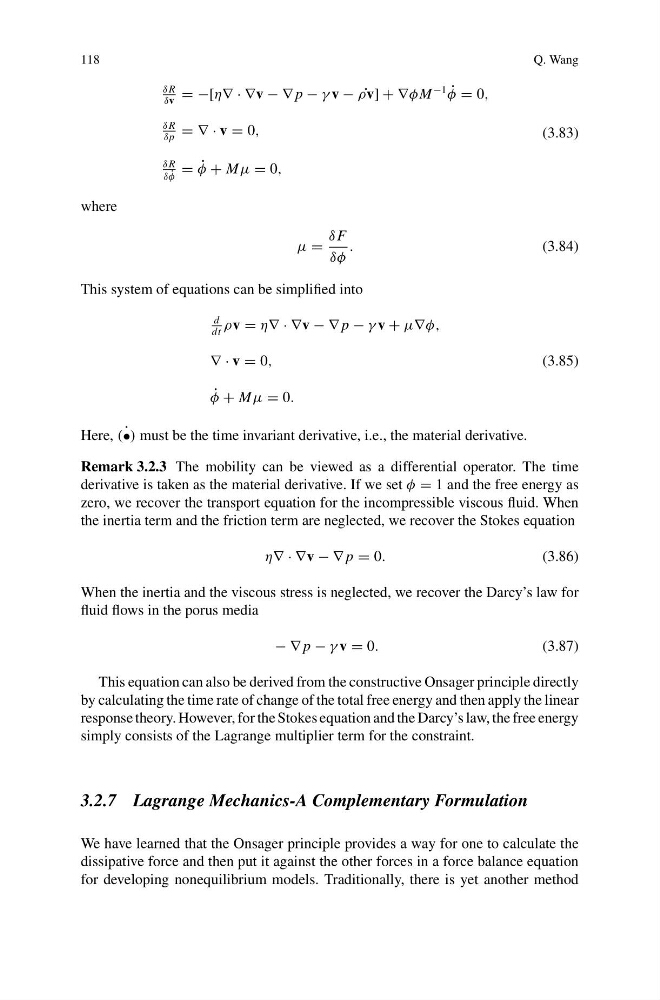
This system of equations can be simplified into
d
dt
ρv = η∇ · ∇v − ∇ p − γ v + μ∇φ,
∇ · v = 0,
˙
φ + Mμ = 0.
(3.85)
Here, ˙
(•) must be the time invariant derivative, i.e., the material derivative.
Remark 3.2.3 The mobility can be viewed as a differential operator. The time
derivative is taken as the material derivative. If we set φ = 1 and the free energy as
zero, we recover the transport equation for the incompressible viscous fluid. When
the inertia term and the friction term are neglected, we recover the Stokes equation
η∇ · ∇v − ∇ p = 0.
(3.86)
When the inertia and the viscous stress is neglected, we recover the Darcy’s law for
fluid flows in the porus media
− ∇ p − γ v = 0.
(3.87)
This equation can also be derived from the constructive Onsager principle directly
by calculating the time rate of change of the total free energy and then apply the linear
response theory. However, for the Stokes equation and the Darcy’s law, the free energy
simply consists of the Lagrange multiplier term for the constraint.
3.2.7 Lagrange Mechanics-A Complementary Formulation
We have learned that the Onsager principle provides a way for one to calculate the
dissipative force and then put it against the other forces in a force balance equation
for developing nonequilibrium models. Traditionally, there is yet another method
Q. Wang
δ R
δv
= −[η∇ · ∇v − ∇ p − γ v − ˙
ρv] + ∇φ M
−1 ˙
φ = 0,
δ R
δp
= ∇ · v = 0,
δ R
δ ˙
φ
= ˙
φ + Mμ = 0,
(3.83)
where
μ =
δ F
δφ
.
(3.84)
This system of equations can be simplified into
d
dt
ρv = η∇ · ∇v − ∇ p − γ v + μ∇φ,
∇ · v = 0,
˙
φ + Mμ = 0.
(3.85)
Here, ˙
(•) must be the time invariant derivative, i.e., the material derivative.
Remark 3.2.3 The mobility can be viewed as a differential operator. The time
derivative is taken as the material derivative. If we set φ = 1 and the free energy as
zero, we recover the transport equation for the incompressible viscous fluid. When
the inertia term and the friction term are neglected, we recover the Stokes equation
η∇ · ∇v − ∇ p = 0.
(3.86)
When the inertia and the viscous stress is neglected, we recover the Darcy’s law for
fluid flows in the porus media
− ∇ p − γ v = 0.
(3.87)
This equation can also be derived from the constructive Onsager principle directly
by calculating the time rate of change of the total free energy and then apply the linear
response theory. However, for the Stokes equation and the Darcy’s law, the free energy
simply consists of the Lagrange multiplier term for the constraint.
3.2.7 Lagrange Mechanics-A Complementary Formulation
We have learned that the Onsager principle provides a way for one to calculate the
dissipative force and then put it against the other forces in a force balance equation
for developing nonequilibrium models. Traditionally, there is yet another method