

3 Generalized Onsager Principle and It Applications
117
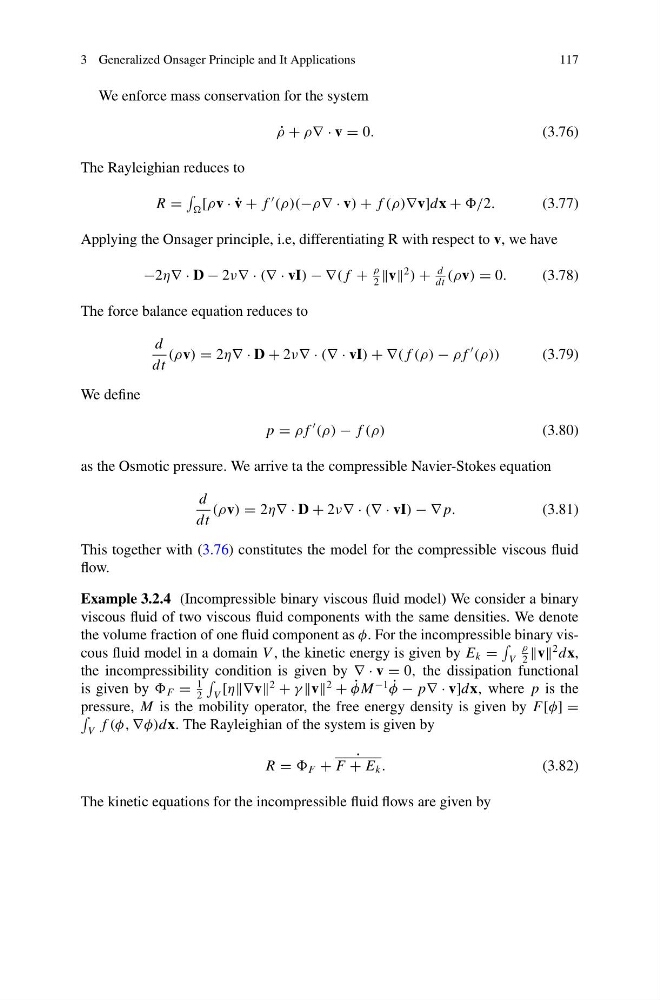
We enforce mass conservation for the system
˙
ρ + ρ∇ · v = 0.
(3.76)
The Rayleighian reduces to
R =
[ρv · ˙
v + f
(ρ)(−ρ∇ · v) + f (ρ)∇v]dx + /2.
(3.77)
Applying the Onsager principle, i.e, differentiating R with respect to v, we have
−2η∇ · D − 2ν∇ · (∇ · vI) − ∇( f +
ρ
2
v
2
) +
d
dt
(ρv) = 0.
(3.78)
The force balance equation reduces to
d
dt
(ρv) = 2η∇ · D + 2ν∇ · (∇ · vI) + ∇( f (ρ) − ρ f
(ρ))
(3.79)
We define
p = ρ f
(ρ) − f (ρ)
(3.80)
as the Osmotic pressure. We arrive ta the compressible Navier-Stokes equation
d
dt
(ρv) = 2η∇ · D + 2ν∇ · (∇ · vI) − ∇ p.
(3.81)
This together with (3.76) constitutes the model for the compressible viscous fluid
flow.
Example 3.2.4 (Incompressible binary viscous fluid model) We consider a binary
viscous fluid of two viscous fluid components with the same densities. We denote
the volume fraction of one fluid component as φ. For the incompressible binary viscous fluid model in a domain V , the kinetic energy is given by E k =
V
ρ
2
v
2 dx,
the incompressibility condition is given by ∇ · v = 0, the dissipation functional
is given by F =
1
2
V [η∇v
2
+ γ v
2
+ ˙
φ M
−1 ˙
φ − p∇ · v]dx, where p is the
pressure, M is the mobility operator, the free energy density is given by F[φ] =
V f (φ, ∇φ)dx. The Rayleighian of the system is given by
R = F +
˙
F + E k .
(3.82)
The kinetic equations for the incompressible fluid flows are given by
117
We enforce mass conservation for the system
˙
ρ + ρ∇ · v = 0.
(3.76)
The Rayleighian reduces to
R =
[ρv · ˙
v + f
(ρ)(−ρ∇ · v) + f (ρ)∇v]dx + /2.
(3.77)
Applying the Onsager principle, i.e, differentiating R with respect to v, we have
−2η∇ · D − 2ν∇ · (∇ · vI) − ∇( f +
ρ
2
v
2
) +
d
dt
(ρv) = 0.
(3.78)
The force balance equation reduces to
d
dt
(ρv) = 2η∇ · D + 2ν∇ · (∇ · vI) + ∇( f (ρ) − ρ f
(ρ))
(3.79)
We define
p = ρ f
(ρ) − f (ρ)
(3.80)
as the Osmotic pressure. We arrive ta the compressible Navier-Stokes equation
d
dt
(ρv) = 2η∇ · D + 2ν∇ · (∇ · vI) − ∇ p.
(3.81)
This together with (3.76) constitutes the model for the compressible viscous fluid
flow.
Example 3.2.4 (Incompressible binary viscous fluid model) We consider a binary
viscous fluid of two viscous fluid components with the same densities. We denote
the volume fraction of one fluid component as φ. For the incompressible binary viscous fluid model in a domain V , the kinetic energy is given by E k =
V
ρ
2
v
2 dx,
the incompressibility condition is given by ∇ · v = 0, the dissipation functional
is given by F =
1
2
V [η∇v
2
+ γ v
2
+ ˙
φ M
−1 ˙
φ − p∇ · v]dx, where p is the
pressure, M is the mobility operator, the free energy density is given by F[φ] =
V f (φ, ∇φ)dx. The Rayleighian of the system is given by
R = F +
˙
F + E k .
(3.82)
The kinetic equations for the incompressible fluid flows are given by