

116
Q. Wang
R = ˙
F +
2
.
(3.69)
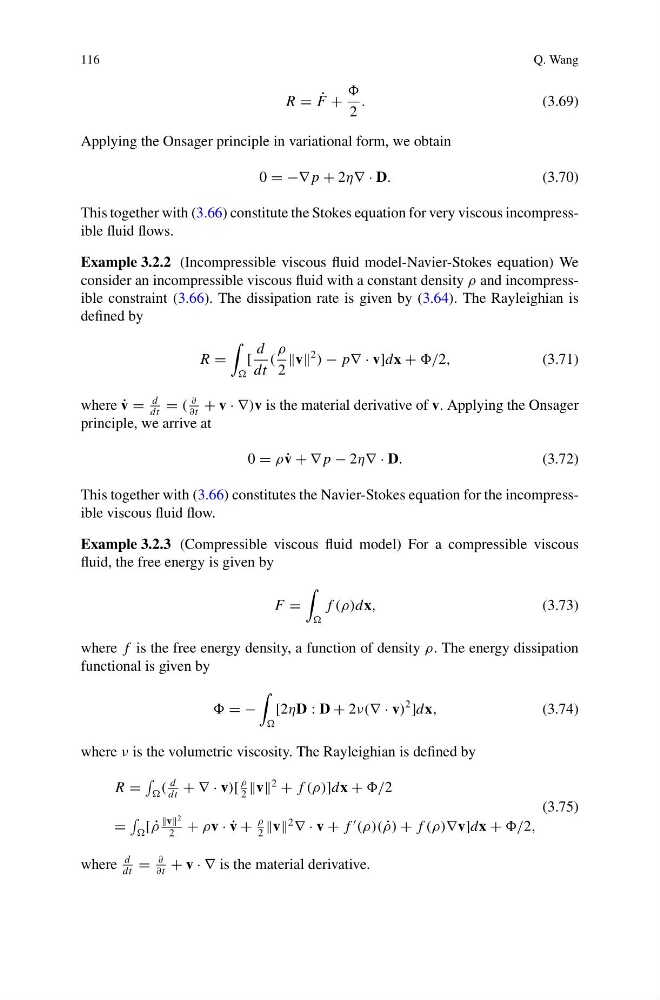
Applying the Onsager principle in variational form, we obtain
0 = −∇ p + 2η∇ · D.
(3.70)
This together with (3.66) constitute the Stokes equation for very viscous incompressible fluid flows.
Example 3.2.2 (Incompressible viscous fluid model-Navier-Stokes equation) We
consider an incompressible viscous fluid with a constant density ρ and incompressible constraint (3.66). The dissipation rate is given by (3.64). The Rayleighian is
defined by
R =
[
d
dt
(
ρ
2
v
2
) − p∇ · v]dx + /2,
(3.71)
where ˙
v =
d
dt
= (
∂
∂t
+ v · ∇)v is the material derivative of v. Applying the Onsager
principle, we arrive at
0 = ρ ˙
v + ∇ p − 2η∇ · D.
(3.72)
This together with (3.66) constitutes the Navier-Stokes equation for the incompressible viscous fluid flow.
Example 3.2.3 (Compressible viscous fluid model) For a compressible viscous
fluid, the free energy is given by
F =
f (ρ)dx,
(3.73)
where f is the free energy density, a function of density ρ. The energy dissipation
functional is given by
= −
[2ηD : D + 2ν(∇ · v)
2
]dx,
(3.74)
where ν is the volumetric viscosity. The Rayleighian is defined by
R =
(
d
dt
+ ∇ · v)[
ρ
2
v
2
+ f (ρ)]dx + /2
=
[ ˙
ρ
v
2
2
+ ρv · ˙
v +
ρ
2
v
2
∇ · v + f
(ρ)( ˙
ρ) + f (ρ)∇v]dx + /2,
(3.75)
where
d
dt
=
∂
∂t
+ v · ∇ is the material derivative.
Q. Wang
R = ˙
F +
2
.
(3.69)
Applying the Onsager principle in variational form, we obtain
0 = −∇ p + 2η∇ · D.
(3.70)
This together with (3.66) constitute the Stokes equation for very viscous incompressible fluid flows.
Example 3.2.2 (Incompressible viscous fluid model-Navier-Stokes equation) We
consider an incompressible viscous fluid with a constant density ρ and incompressible constraint (3.66). The dissipation rate is given by (3.64). The Rayleighian is
defined by
R =
[
d
dt
(
ρ
2
v
2
) − p∇ · v]dx + /2,
(3.71)
where ˙
v =
d
dt
= (
∂
∂t
+ v · ∇)v is the material derivative of v. Applying the Onsager
principle, we arrive at
0 = ρ ˙
v + ∇ p − 2η∇ · D.
(3.72)
This together with (3.66) constitutes the Navier-Stokes equation for the incompressible viscous fluid flow.
Example 3.2.3 (Compressible viscous fluid model) For a compressible viscous
fluid, the free energy is given by
F =
f (ρ)dx,
(3.73)
where f is the free energy density, a function of density ρ. The energy dissipation
functional is given by
= −
[2ηD : D + 2ν(∇ · v)
2
]dx,
(3.74)
where ν is the volumetric viscosity. The Rayleighian is defined by
R =
(
d
dt
+ ∇ · v)[
ρ
2
v
2
+ f (ρ)]dx + /2
=
[ ˙
ρ
v
2
2
+ ρv · ˙
v +
ρ
2
v
2
∇ · v + f
(ρ)( ˙
ρ) + f (ρ)∇v]dx + /2,
(3.75)
where
d
dt
=
∂
∂t
+ v · ∇ is the material derivative.