

3 Generalized Onsager Principle and It Applications
115
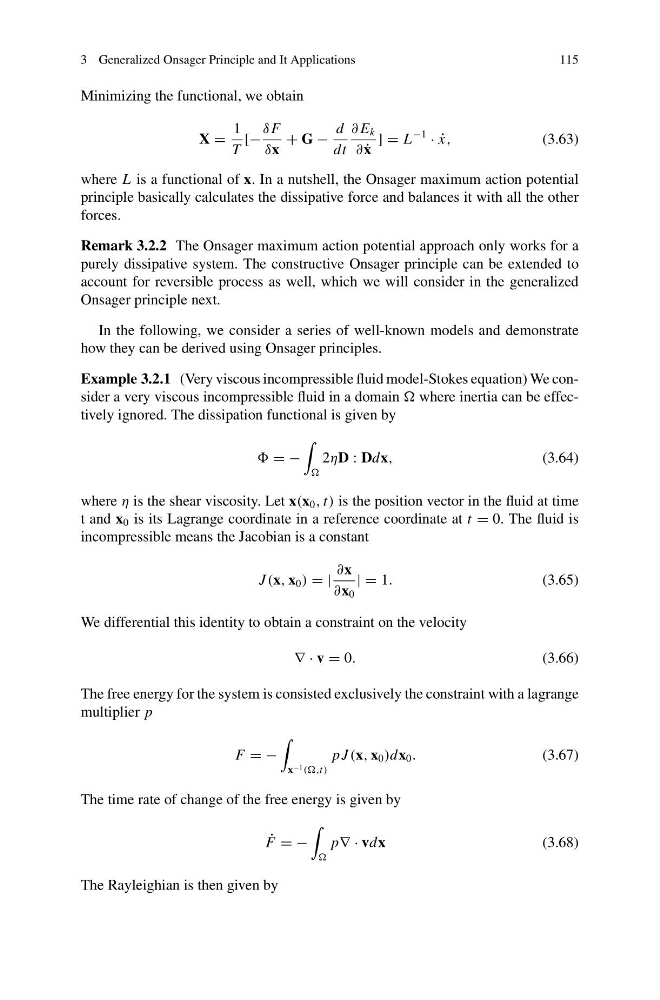
Minimizing the functional, we obtain
X =
1
T
[−
δ F
δx
+ G −
d
dt
∂ E k
∂ ˙
x
] = L
−1
· ˙
x,
(3.63)
where L is a functional of x. In a nutshell, the Onsager maximum action potential
principle basically calculates the dissipative force and balances it with all the other
forces.
Remark 3.2.2 The Onsager maximum action potential approach only works for a
purely dissipative system. The constructive Onsager principle can be extended to
account for reversible process as well, which we will consider in the generalized
Onsager principle next.
In the following, we consider a series of well-known models and demonstrate
how they can be derived using Onsager principles.
Example 3.2.1 (Very viscous incompressible fluid model-Stokes equation) We consider a very viscous incompressible fluid in a domain where inertia can be effectively ignored. The dissipation functional is given by
= −
2ηD : Ddx,
(3.64)
where η is the shear viscosity. Let x(x 0 , t) is the position vector in the fluid at time
t and x 0 is its Lagrange coordinate in a reference coordinate at t = 0. The fluid is
incompressible means the Jacobian is a constant
J (x, x 0 ) = |
∂x
∂x 0
| = 1.
(3.65)
We differential this identity to obtain a constraint on the velocity
∇ · v = 0.
(3.66)
The free energy for the system is consisted exclusively the constraint with a lagrange
multiplier p
F = −
x −1 ((,t)
p J (x, x 0 )dx 0 .
(3.67)
The time rate of change of the free energy is given by
˙
F = −
p∇ · vdx
(3.68)
The Rayleighian is then given by
115
Minimizing the functional, we obtain
X =
1
T
[−
δ F
δx
+ G −
d
dt
∂ E k
∂ ˙
x
] = L
−1
· ˙
x,
(3.63)
where L is a functional of x. In a nutshell, the Onsager maximum action potential
principle basically calculates the dissipative force and balances it with all the other
forces.
Remark 3.2.2 The Onsager maximum action potential approach only works for a
purely dissipative system. The constructive Onsager principle can be extended to
account for reversible process as well, which we will consider in the generalized
Onsager principle next.
In the following, we consider a series of well-known models and demonstrate
how they can be derived using Onsager principles.
Example 3.2.1 (Very viscous incompressible fluid model-Stokes equation) We consider a very viscous incompressible fluid in a domain where inertia can be effectively ignored. The dissipation functional is given by
= −
2ηD : Ddx,
(3.64)
where η is the shear viscosity. Let x(x 0 , t) is the position vector in the fluid at time
t and x 0 is its Lagrange coordinate in a reference coordinate at t = 0. The fluid is
incompressible means the Jacobian is a constant
J (x, x 0 ) = |
∂x
∂x 0
| = 1.
(3.65)
We differential this identity to obtain a constraint on the velocity
∇ · v = 0.
(3.66)
The free energy for the system is consisted exclusively the constraint with a lagrange
multiplier p
F = −
x −1 ((,t)
p J (x, x 0 )dx 0 .
(3.67)
The time rate of change of the free energy is given by
˙
F = −
p∇ · vdx
(3.68)
The Rayleighian is then given by