

3 Generalized Onsager Principle and It Applications
119
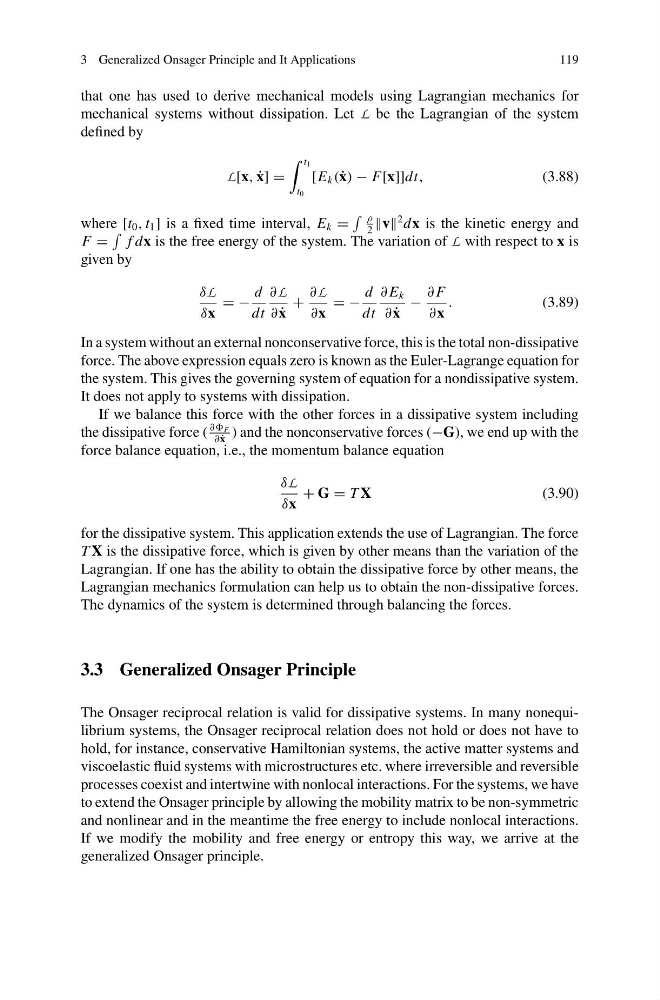
that one has used to derive mechanical models using Lagrangian mechanics for
mechanical systems without dissipation. Let L be the Lagrangian of the system
defined by
L[x, ˙
x] =
t 1
t 0
[E k (˙ x) − F[x]]dt,
(3.88)
where [t 0 , t 1 ] is a fixed time interval, E k =
ρ
2
v
2 dx is the kinetic energy and
F =
f dx is the free energy of the system. The variation of L with respect to x is
given by
δL
δx
= −
d
dt
∂L
∂ ˙
x
+
∂L
∂x
= −
d
dt
∂ E k
∂ ˙
x
−
∂ F
∂x
.
(3.89)
In a system without an external nonconservative force, this is the total non-dissipative
force. The above expression equals zero is known as the Euler-Lagrange equation for
the system. This gives the governing system of equation for a nondissipative system.
It does not apply to systems with dissipation.
If we balance this force with the other forces in a dissipative system including
the dissipative force (
∂∂ F
∂ ˙
x
) and the nonconservative forces (−G), we end up with the
force balance equation, i.e., the momentum balance equation
δL
δx
+ G = T X
(3.90)
for the dissipative system. This application extends the use of Lagrangian. The force
T X is the dissipative force, which is given by other means than the variation of the
Lagrangian. If one has the ability to obtain the dissipative force by other means, the
Lagrangian mechanics formulation can help us to obtain the non-dissipative forces.
The dynamics of the system is determined through balancing the forces.
3.3 Generalized Onsager Principle
The Onsager reciprocal relation is valid for dissipative systems. In many nonequilibrium systems, the Onsager reciprocal relation does not hold or does not have to
hold, for instance, conservative Hamiltonian systems, the active matter systems and
viscoelastic fluid systems with microstructures etc. where irreversible and reversible
processes coexist and intertwine with nonlocal interactions. For the systems, we have
to extend the Onsager principle by allowing the mobility matrix to be non-symmetric
and nonlinear and in the meantime the free energy to include nonlocal interactions.
If we modify the mobility and free energy or entropy this way, we arrive at the
generalized Onsager principle.
119
that one has used to derive mechanical models using Lagrangian mechanics for
mechanical systems without dissipation. Let L be the Lagrangian of the system
defined by
L[x, ˙
x] =
t 1
t 0
[E k (˙ x) − F[x]]dt,
(3.88)
where [t 0 , t 1 ] is a fixed time interval, E k =
ρ
2
v
2 dx is the kinetic energy and
F =
f dx is the free energy of the system. The variation of L with respect to x is
given by
δL
δx
= −
d
dt
∂L
∂ ˙
x
+
∂L
∂x
= −
d
dt
∂ E k
∂ ˙
x
−
∂ F
∂x
.
(3.89)
In a system without an external nonconservative force, this is the total non-dissipative
force. The above expression equals zero is known as the Euler-Lagrange equation for
the system. This gives the governing system of equation for a nondissipative system.
It does not apply to systems with dissipation.
If we balance this force with the other forces in a dissipative system including
the dissipative force (
∂∂ F
∂ ˙
x
) and the nonconservative forces (−G), we end up with the
force balance equation, i.e., the momentum balance equation
δL
δx
+ G = T X
(3.90)
for the dissipative system. This application extends the use of Lagrangian. The force
T X is the dissipative force, which is given by other means than the variation of the
Lagrangian. If one has the ability to obtain the dissipative force by other means, the
Lagrangian mechanics formulation can help us to obtain the non-dissipative forces.
The dynamics of the system is determined through balancing the forces.
3.3 Generalized Onsager Principle
The Onsager reciprocal relation is valid for dissipative systems. In many nonequilibrium systems, the Onsager reciprocal relation does not hold or does not have to
hold, for instance, conservative Hamiltonian systems, the active matter systems and
viscoelastic fluid systems with microstructures etc. where irreversible and reversible
processes coexist and intertwine with nonlocal interactions. For the systems, we have
to extend the Onsager principle by allowing the mobility matrix to be non-symmetric
and nonlinear and in the meantime the free energy to include nonlocal interactions.
If we modify the mobility and free energy or entropy this way, we arrive at the
generalized Onsager principle.