

110
Q. Wang
O = X · ˙
x − S = ˙
S − S , ˙
S = −
1
T
[
δ F
δx
+
d
dt
∂ E k
∂ ˙
x
]˙ x.
(3.40)
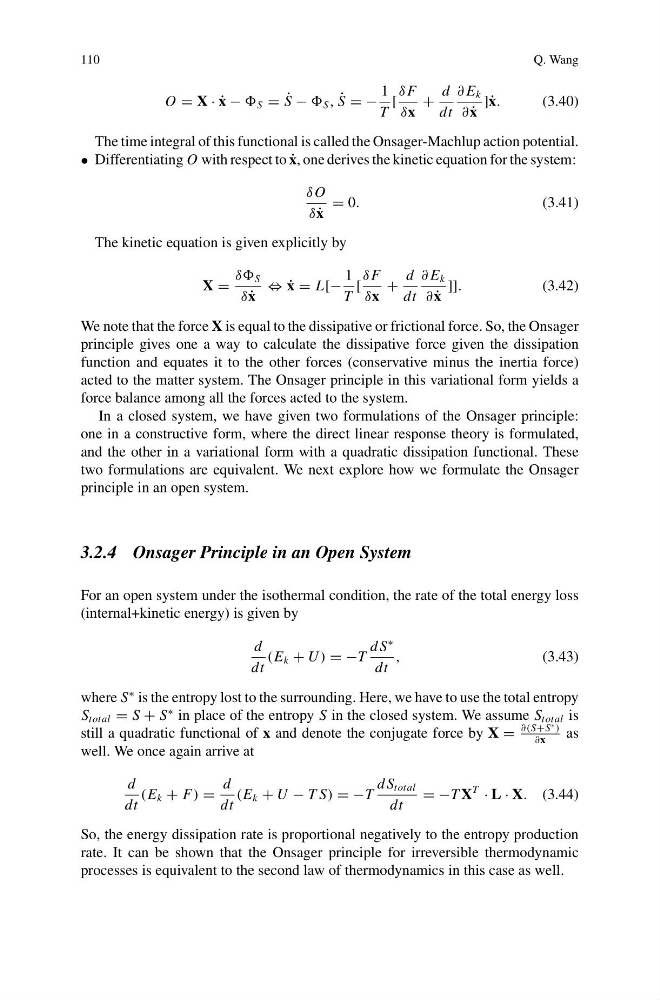
The time integral of this functional is called the Onsager-Machlup action potential.
• Differentiating O with respect to ˙
x, one derives the kinetic equation for the system:
δ O
δ ˙
x
= 0.
(3.41)
The kinetic equation is given explicitly by
X =
δδ S
δ ˙
x
⇔ ˙
x = L[−
1
T
[
δ F
δx
+
d
dt
∂ E k
∂ ˙
x
]].
(3.42)
We note that the force X is equal to the dissipative or frictional force. So, the Onsager
principle gives one a way to calculate the dissipative force given the dissipation
function and equates it to the other forces (conservative minus the inertia force)
acted to the matter system. The Onsager principle in this variational form yields a
force balance among all the forces acted to the system.
In a closed system, we have given two formulations of the Onsager principle:
one in a constructive form, where the direct linear response theory is formulated,
and the other in a variational form with a quadratic dissipation functional. These
two formulations are equivalent. We next explore how we formulate the Onsager
principle in an open system.
3.2.4 Onsager Principle in an Open System
For an open system under the isothermal condition, the rate of the total energy loss
(internal+kinetic energy) is given by
d
dt
(E k + U ) = −T
d S
∗
dt
,
(3.43)
where S
∗ is the entropy lost to the surrounding. Here, we have to use the total entropy
S total = S + S
∗ in place of the entropy S in the closed system. We assume S total is
still a quadratic functional of x and denote the conjugate force by X =
∂(S+S
∗ )
∂x
as
well. We once again arrive at
d
dt
(E k + F) =
d
dt
(E k + U − T S) = −T
d S total
dt
= −T X
T
· L · X. (3.44)
So, the energy dissipation rate is proportional negatively to the entropy production
rate. It can be shown that the Onsager principle for irreversible thermodynamic
processes is equivalent to the second law of thermodynamics in this case as well.
Q. Wang
O = X · ˙
x − S = ˙
S − S , ˙
S = −
1
T
[
δ F
δx
+
d
dt
∂ E k
∂ ˙
x
]˙ x.
(3.40)
The time integral of this functional is called the Onsager-Machlup action potential.
• Differentiating O with respect to ˙
x, one derives the kinetic equation for the system:
δ O
δ ˙
x
= 0.
(3.41)
The kinetic equation is given explicitly by
X =
δδ S
δ ˙
x
⇔ ˙
x = L[−
1
T
[
δ F
δx
+
d
dt
∂ E k
∂ ˙
x
]].
(3.42)
We note that the force X is equal to the dissipative or frictional force. So, the Onsager
principle gives one a way to calculate the dissipative force given the dissipation
function and equates it to the other forces (conservative minus the inertia force)
acted to the matter system. The Onsager principle in this variational form yields a
force balance among all the forces acted to the system.
In a closed system, we have given two formulations of the Onsager principle:
one in a constructive form, where the direct linear response theory is formulated,
and the other in a variational form with a quadratic dissipation functional. These
two formulations are equivalent. We next explore how we formulate the Onsager
principle in an open system.
3.2.4 Onsager Principle in an Open System
For an open system under the isothermal condition, the rate of the total energy loss
(internal+kinetic energy) is given by
d
dt
(E k + U ) = −T
d S
∗
dt
,
(3.43)
where S
∗ is the entropy lost to the surrounding. Here, we have to use the total entropy
S total = S + S
∗ in place of the entropy S in the closed system. We assume S total is
still a quadratic functional of x and denote the conjugate force by X =
∂(S+S
∗ )
∂x
as
well. We once again arrive at
d
dt
(E k + F) =
d
dt
(E k + U − T S) = −T
d S total
dt
= −T X
T
· L · X. (3.44)
So, the energy dissipation rate is proportional negatively to the entropy production
rate. It can be shown that the Onsager principle for irreversible thermodynamic
processes is equivalent to the second law of thermodynamics in this case as well.