

3 Generalized Onsager Principle and It Applications
109
In fact, if R = L
−1
> 0 and R is symmetric, R = (R
1/2
)
2
. Then,
O M =
t
t 0
[X · ˙
x −
1
2
˙
x
T
· R · x]dτ
=
t
t 0
[X · ˙
x −
1
2
R
1
2 · x
2
]dτ
=
t
t 0
[
1
2
R
−1/2
· X
2
−
1
2
R
1
2 · ˙
x − R
−1/2
· X
2
]dτ.
(3.34)
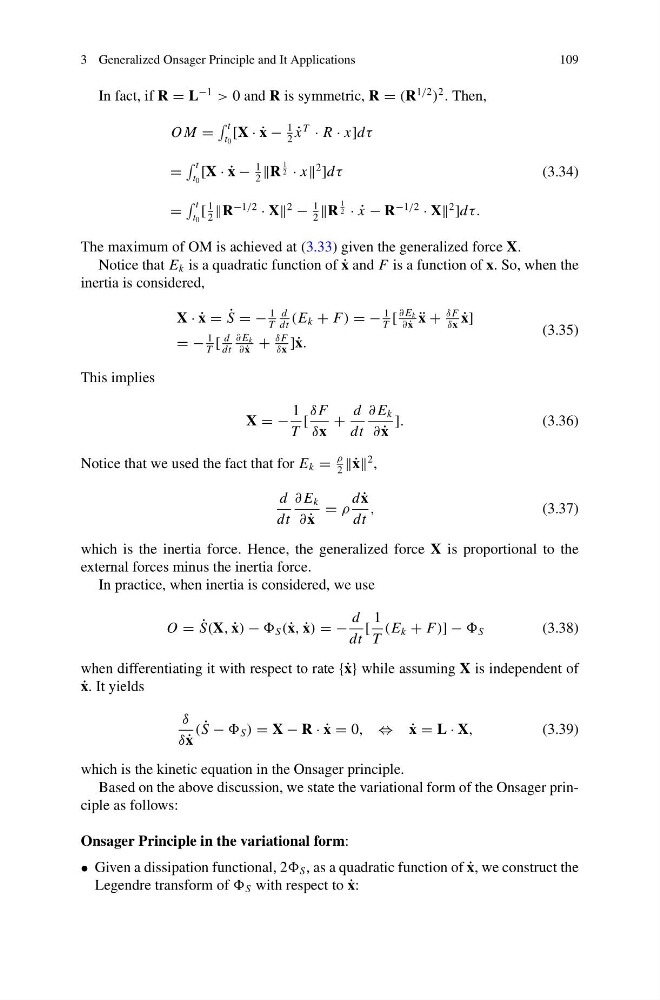
The maximum of OM is achieved at (3.33) given the generalized force X.
Notice that E k is a quadratic function of ˙
x and F is a function of x. So, when the
inertia is considered,
X · ˙
x = ˙
S = −
1
T
d
dt
(E k + F) = −
1
T
[
∂ E k
∂ ˙
x
¨
x +
δ F
δx
˙
x]
= −
1
T
[
d
dt
∂ E k
∂ ˙
x
+
δ F
δx
]˙ x.
(3.35)
This implies
X = −
1
T
[
δ F
δx
+
d
dt
∂ E k
∂ ˙
x
].
(3.36)
Notice that we used the fact that for E k =
ρ
2
˙ x
2 ,
d
dt
∂ E k
∂ ˙
x
= ρ
d ˙
x
dt
,
(3.37)
which is the inertia force. Hence, the generalized force X is proportional to the
external forces minus the inertia force.
In practice, when inertia is considered, we use
O = ˙
S(X, ˙
x) − S (˙ x, ˙
x) = −
d
dt
[
1
T
(E k + F)] − S
(3.38)
when differentiating it with respect to rate {˙ x} while assuming X is independent of
˙
x. It yields
δ
δ ˙
x
( ˙
S − S ) = X − R · ˙
x = 0, ⇔ ˙
x = L · X,
(3.39)
which is the kinetic equation in the Onsager principle.
Based on the above discussion, we state the variational form of the Onsager principle as follows:
Onsager Principle in the variational form:
• Given a dissipation functional, 2 S , as a quadratic function of ˙
x, we construct the
Legendre transform of S with respect to ˙
x:
109
In fact, if R = L
−1
> 0 and R is symmetric, R = (R
1/2
)
2
. Then,
O M =
t
t 0
[X · ˙
x −
1
2
˙
x
T
· R · x]dτ
=
t
t 0
[X · ˙
x −
1
2
R
1
2 · x
2
]dτ
=
t
t 0
[
1
2
R
−1/2
· X
2
−
1
2
R
1
2 · ˙
x − R
−1/2
· X
2
]dτ.
(3.34)
The maximum of OM is achieved at (3.33) given the generalized force X.
Notice that E k is a quadratic function of ˙
x and F is a function of x. So, when the
inertia is considered,
X · ˙
x = ˙
S = −
1
T
d
dt
(E k + F) = −
1
T
[
∂ E k
∂ ˙
x
¨
x +
δ F
δx
˙
x]
= −
1
T
[
d
dt
∂ E k
∂ ˙
x
+
δ F
δx
]˙ x.
(3.35)
This implies
X = −
1
T
[
δ F
δx
+
d
dt
∂ E k
∂ ˙
x
].
(3.36)
Notice that we used the fact that for E k =
ρ
2
˙ x
2 ,
d
dt
∂ E k
∂ ˙
x
= ρ
d ˙
x
dt
,
(3.37)
which is the inertia force. Hence, the generalized force X is proportional to the
external forces minus the inertia force.
In practice, when inertia is considered, we use
O = ˙
S(X, ˙
x) − S (˙ x, ˙
x) = −
d
dt
[
1
T
(E k + F)] − S
(3.38)
when differentiating it with respect to rate {˙ x} while assuming X is independent of
˙
x. It yields
δ
δ ˙
x
( ˙
S − S ) = X − R · ˙
x = 0, ⇔ ˙
x = L · X,
(3.39)
which is the kinetic equation in the Onsager principle.
Based on the above discussion, we state the variational form of the Onsager principle as follows:
Onsager Principle in the variational form:
• Given a dissipation functional, 2 S , as a quadratic function of ˙
x, we construct the
Legendre transform of S with respect to ˙
x: