

108
Q. Wang
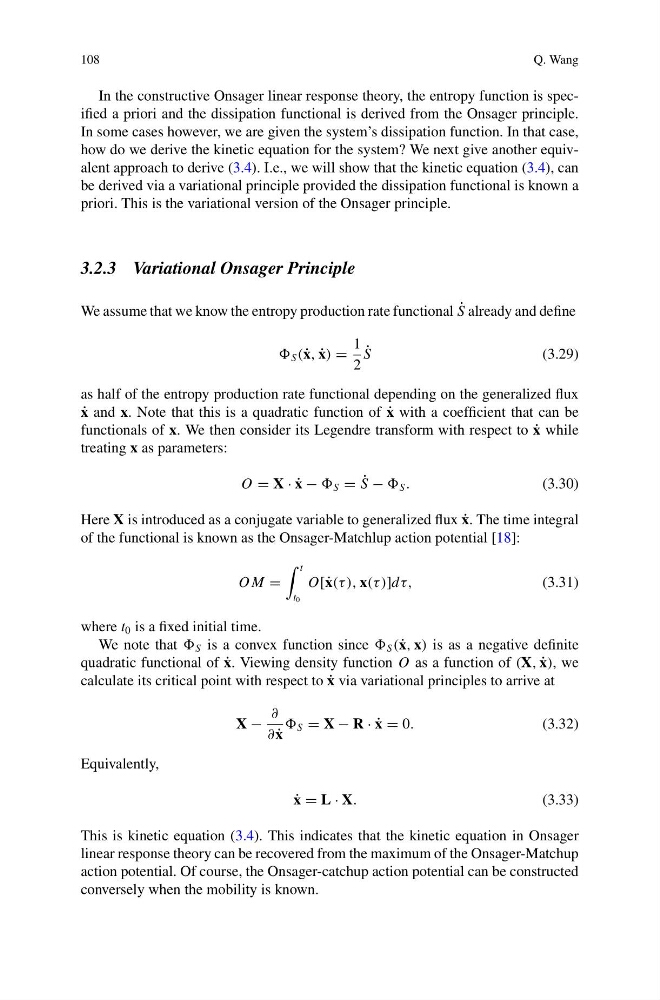
In the constructive Onsager linear response theory, the entropy function is specified a priori and the dissipation functional is derived from the Onsager principle.
In some cases however, we are given the system’s dissipation function. In that case,
how do we derive the kinetic equation for the system? We next give another equivalent approach to derive (3.4). I.e., we will show that the kinetic equation (3.4), can
be derived via a variational principle provided the dissipation functional is known a
priori. This is the variational version of the Onsager principle.
3.2.3 Variational Onsager Principle
We assume that we know the entropy production rate functional ˙
S already and define
S (˙ x, ˙
x) =
1
2
˙
S
(3.29)
as half of the entropy production rate functional depending on the generalized flux
˙
x and x. Note that this is a quadratic function of ˙
x with a coefficient that can be
functionals of x. We then consider its Legendre transform with respect to ˙
x while
treating x as parameters:
O = X · ˙
x − S = ˙
S − S .
(3.30)
Here X is introduced as a conjugate variable to generalized flux ˙
x. The time integral
of the functional is known as the Onsager-Matchlup action potential [18]:
O M =
t
t 0
O[˙ x(τ ), x(τ )]dτ,
(3.31)
where t 0 is a fixed initial time.
We note that S is a convex function since S (˙ x, x) is as a negative definite
quadratic functional of ˙
x. Viewing density function O as a function of (X, ˙
x), we
calculate its critical point with respect to ˙
x via variational principles to arrive at
X −
∂
∂ ˙
x
S = X − R · ˙
x = 0.
(3.32)
Equivalently,
˙
x = L · X.
(3.33)
This is kinetic equation (3.4). This indicates that the kinetic equation in Onsager
linear response theory can be recovered from the maximum of the Onsager-Matchup
action potential. Of course, the Onsager-catchup action potential can be constructed
conversely when the mobility is known.
Q. Wang
In the constructive Onsager linear response theory, the entropy function is specified a priori and the dissipation functional is derived from the Onsager principle.
In some cases however, we are given the system’s dissipation function. In that case,
how do we derive the kinetic equation for the system? We next give another equivalent approach to derive (3.4). I.e., we will show that the kinetic equation (3.4), can
be derived via a variational principle provided the dissipation functional is known a
priori. This is the variational version of the Onsager principle.
3.2.3 Variational Onsager Principle
We assume that we know the entropy production rate functional ˙
S already and define
S (˙ x, ˙
x) =
1
2
˙
S
(3.29)
as half of the entropy production rate functional depending on the generalized flux
˙
x and x. Note that this is a quadratic function of ˙
x with a coefficient that can be
functionals of x. We then consider its Legendre transform with respect to ˙
x while
treating x as parameters:
O = X · ˙
x − S = ˙
S − S .
(3.30)
Here X is introduced as a conjugate variable to generalized flux ˙
x. The time integral
of the functional is known as the Onsager-Matchlup action potential [18]:
O M =
t
t 0
O[˙ x(τ ), x(τ )]dτ,
(3.31)
where t 0 is a fixed initial time.
We note that S is a convex function since S (˙ x, x) is as a negative definite
quadratic functional of ˙
x. Viewing density function O as a function of (X, ˙
x), we
calculate its critical point with respect to ˙
x via variational principles to arrive at
X −
∂
∂ ˙
x
S = X − R · ˙
x = 0.
(3.32)
Equivalently,
˙
x = L · X.
(3.33)
This is kinetic equation (3.4). This indicates that the kinetic equation in Onsager
linear response theory can be recovered from the maximum of the Onsager-Matchup
action potential. Of course, the Onsager-catchup action potential can be constructed
conversely when the mobility is known.