

82
3 Buzzing Lips: Sound Generation in Brass Instruments
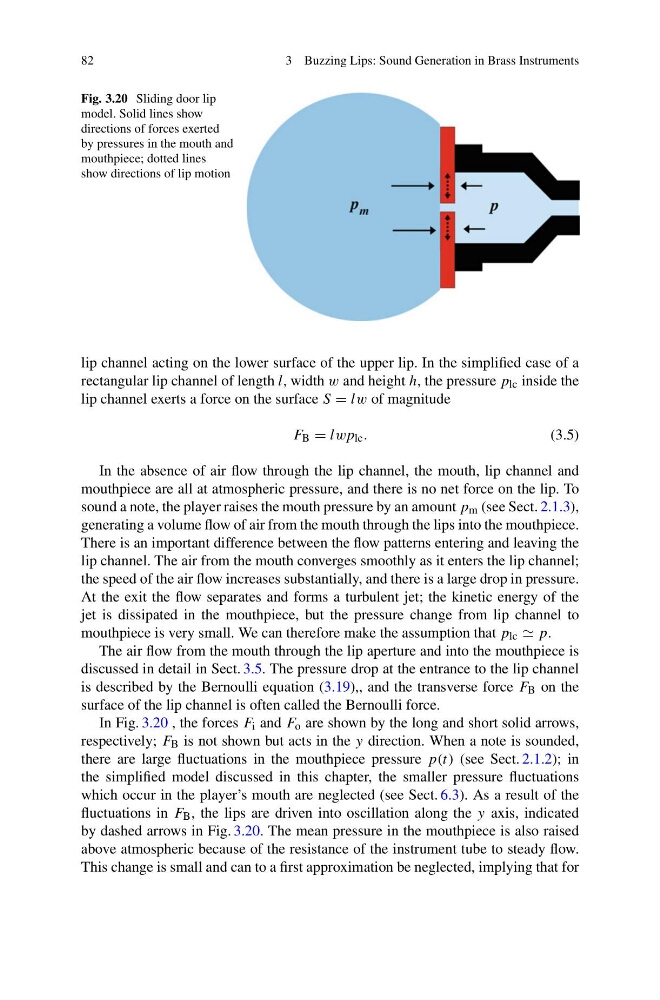
Fig. 3.20 Sliding door lip
model. Solid lines show
directions of forces exerted
by pressures in the mouth and
mouthpiece; dotted lines
show directions of lip motion
lip channel acting on the lower surface of the upper lip. In the simplified case of a
rectangular lip channel of length l, width w and height h, the pressure p lc inside the
lip channel exerts a force on the surface S = lw of magnitude
F B = lwp lc .
(3.5)
In the absence of air flow through the lip channel, the mouth, lip channel and
mouthpiece are all at atmospheric pressure, and there is no net force on the lip. To
sound a note, the player raises the mouth pressure by an amount p m (see Sect. 2.1.3),
generating a volume flow of air from the mouth through the lips into the mouthpiece.
There is an important difference between the flow patterns entering and leaving the
lip channel. The air from the mouth converges smoothly as it enters the lip channel;
the speed of the air flow increases substantially, and there is a large drop in pressure.
At the exit the flow separates and forms a turbulent jet; the kinetic energy of the
jet is dissipated in the mouthpiece, but the pressure change from lip channel to
mouthpiece is very small. We can therefore make the assumption that p lc p.
The air flow from the mouth through the lip aperture and into the mouthpiece is
discussed in detail in Sect. 3.5. The pressure drop at the entrance to the lip channel
is described by the Bernoulli equation (3.19),, and the transverse force F B on the
surface of the lip channel is often called the Bernoulli force.
In Fig. 3.20 , the forces F i and F o are shown by the long and short solid arrows,
respectively; F B is not shown but acts in the y direction. When a note is sounded,
there are large fluctuations in the mouthpiece pressure p(t) (see Sect. 2.1.2); in
the simplified model discussed in this chapter, the smaller pressure fluctuations
which occur in the player’s mouth are neglected (see Sect. 6.3). As a result of the
fluctuations in F B , the lips are driven into oscillation along the y axis, indicated
by dashed arrows in Fig. 3.20. The mean pressure in the mouthpiece is also raised
above atmospheric because of the resistance of the instrument tube to steady flow.
This change is small and can to a first approximation be neglected, implying that for
3 Buzzing Lips: Sound Generation in Brass Instruments
Fig. 3.20 Sliding door lip
model. Solid lines show
directions of forces exerted
by pressures in the mouth and
mouthpiece; dotted lines
show directions of lip motion
lip channel acting on the lower surface of the upper lip. In the simplified case of a
rectangular lip channel of length l, width w and height h, the pressure p lc inside the
lip channel exerts a force on the surface S = lw of magnitude
F B = lwp lc .
(3.5)
In the absence of air flow through the lip channel, the mouth, lip channel and
mouthpiece are all at atmospheric pressure, and there is no net force on the lip. To
sound a note, the player raises the mouth pressure by an amount p m (see Sect. 2.1.3),
generating a volume flow of air from the mouth through the lips into the mouthpiece.
There is an important difference between the flow patterns entering and leaving the
lip channel. The air from the mouth converges smoothly as it enters the lip channel;
the speed of the air flow increases substantially, and there is a large drop in pressure.
At the exit the flow separates and forms a turbulent jet; the kinetic energy of the
jet is dissipated in the mouthpiece, but the pressure change from lip channel to
mouthpiece is very small. We can therefore make the assumption that p lc p.
The air flow from the mouth through the lip aperture and into the mouthpiece is
discussed in detail in Sect. 3.5. The pressure drop at the entrance to the lip channel
is described by the Bernoulli equation (3.19),, and the transverse force F B on the
surface of the lip channel is often called the Bernoulli force.
In Fig. 3.20 , the forces F i and F o are shown by the long and short solid arrows,
respectively; F B is not shown but acts in the y direction. When a note is sounded,
there are large fluctuations in the mouthpiece pressure p(t) (see Sect. 2.1.2); in
the simplified model discussed in this chapter, the smaller pressure fluctuations
which occur in the player’s mouth are neglected (see Sect. 6.3). As a result of the
fluctuations in F B , the lips are driven into oscillation along the y axis, indicated
by dashed arrows in Fig. 3.20. The mean pressure in the mouthpiece is also raised
above atmospheric because of the resistance of the instrument tube to steady flow.
This change is small and can to a first approximation be neglected, implying that for