

3.2 An Equation of Motion for the Lips
81
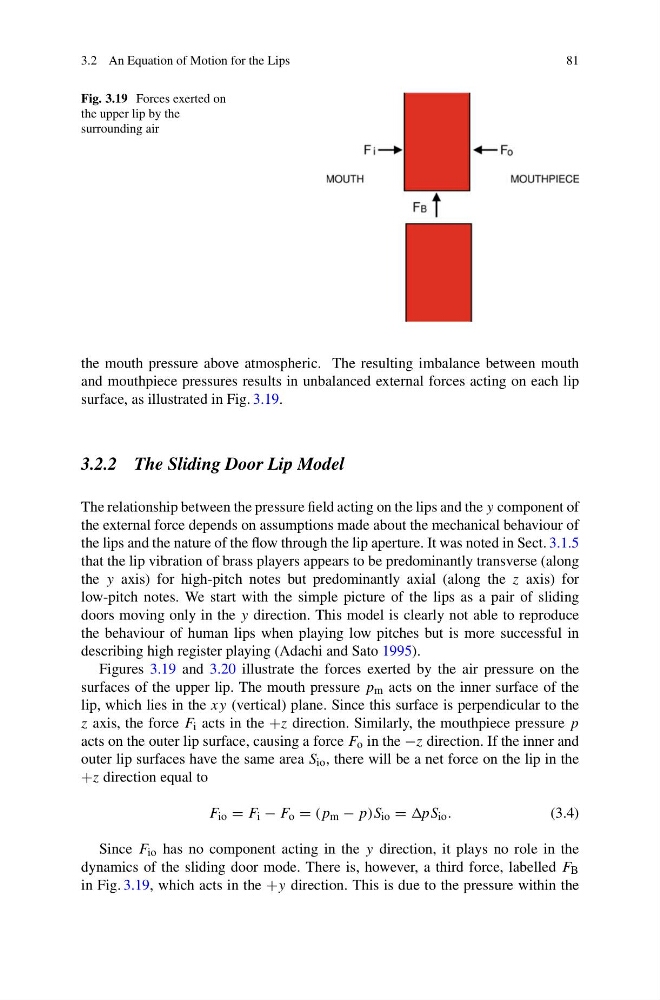
Fig. 3.19 Forces exerted on
the upper lip by the
surrounding air
the mouth pressure above atmospheric. The resulting imbalance between mouth
and mouthpiece pressures results in unbalanced external forces acting on each lip
surface, as illustrated in Fig. 3.19.
3.2.2 The Sliding Door Lip Model
The relationship between the pressure field acting on the lips and the y component of
the external force depends on assumptions made about the mechanical behaviour of
the lips and the nature of the flow through the lip aperture. It was noted in Sect. 3.1.5
that the lip vibration of brass players appears to be predominantly transverse (along
the y axis) for high-pitch notes but predominantly axial (along the z axis) for
low-pitch notes. We start with the simple picture of the lips as a pair of sliding
doors moving only in the y direction. This model is clearly not able to reproduce
the behaviour of human lips when playing low pitches but is more successful in
describing high register playing (Adachi and Sato 1995).
Figures 3.19 and 3.20 illustrate the forces exerted by the air pressure on the
surfaces of the upper lip. The mouth pressure p m acts on the inner surface of the
lip, which lies in the xy (vertical) plane. Since this surface is perpendicular to the
z axis, the force F i acts in the +z direction. Similarly, the mouthpiece pressure p
acts on the outer lip surface, causing a force F o in the −z direction. If the inner and
outer lip surfaces have the same area S io , there will be a net force on the lip in the
+z direction equal to
F io = F i − F o = (p m − p)S io = io .
(3.4)
Since F io has no component acting in the y direction, it plays no role in the
dynamics of the sliding door mode. There is, however, a third force, labelled F B
in Fig. 3.19, which acts in the +y direction. This is due to the pressure within the
81
Fig. 3.19 Forces exerted on
the upper lip by the
surrounding air
the mouth pressure above atmospheric. The resulting imbalance between mouth
and mouthpiece pressures results in unbalanced external forces acting on each lip
surface, as illustrated in Fig. 3.19.
3.2.2 The Sliding Door Lip Model
The relationship between the pressure field acting on the lips and the y component of
the external force depends on assumptions made about the mechanical behaviour of
the lips and the nature of the flow through the lip aperture. It was noted in Sect. 3.1.5
that the lip vibration of brass players appears to be predominantly transverse (along
the y axis) for high-pitch notes but predominantly axial (along the z axis) for
low-pitch notes. We start with the simple picture of the lips as a pair of sliding
doors moving only in the y direction. This model is clearly not able to reproduce
the behaviour of human lips when playing low pitches but is more successful in
describing high register playing (Adachi and Sato 1995).
Figures 3.19 and 3.20 illustrate the forces exerted by the air pressure on the
surfaces of the upper lip. The mouth pressure p m acts on the inner surface of the
lip, which lies in the xy (vertical) plane. Since this surface is perpendicular to the
z axis, the force F i acts in the +z direction. Similarly, the mouthpiece pressure p
acts on the outer lip surface, causing a force F o in the −z direction. If the inner and
outer lip surfaces have the same area S io , there will be a net force on the lip in the
+z direction equal to
F io = F i − F o = (p m − p)S io = io .
(3.4)
Since F io has no component acting in the y direction, it plays no role in the
dynamics of the sliding door mode. There is, however, a third force, labelled F B
in Fig. 3.19, which acts in the +y direction. This is due to the pressure within the