

3.2 An Equation of Motion for the Lips
83
this sliding door model, the equilibrium lip opening height h eq is independent of the
mouth pressure.
The expression for F B given by Eq. 3.5 can be substituted in Eq. 3.3 to give a
version of the equation of motion of the lip containing only the two dependent
variables h(t) and p(t):
d 2 h(t)
dt 2 +
ω l
Q l
dh(t)
dt
+ ω
2
l (h(t) − h eq ) =
lwp(t)
m
=
p(t)
μ
,
(3.6)
where μ = m/ lw is an effective mass per unit area of the vibrating lips.
The simplified model described above does not account for collisions between
the lips. If the amplitude of vibration reaches the value h eq , the lips come into
contact during the inward part of the vibration cycle. A strong deceleration force
can be added to Eq. 3.6 to incorporate this behaviour (Adachi and Sato 1995).
3.2.3 The Swinging Door Lip Model
The experimental results described in Sect. 3.1.5 demonstrate clearly that the simple
sliding door model is inadequate to describe the motion of a brass player’s lips
during performance. The trajectories of a trombonist’s lip in Fig. 3.14 confirm that
motion along the z axis becomes increasingly important for lower-pitched notes: for
the pedal B 1 whose lip motion is illustrated in Fig. 3.13, the vertical and axial lip
displacements are comparable in magnitude. In such cases the lip motion resembles
an outward swinging door more than a sliding door, and a simple ‘swinging door
model’ has been developed to describe this motion (Adachi and Sato 1995).
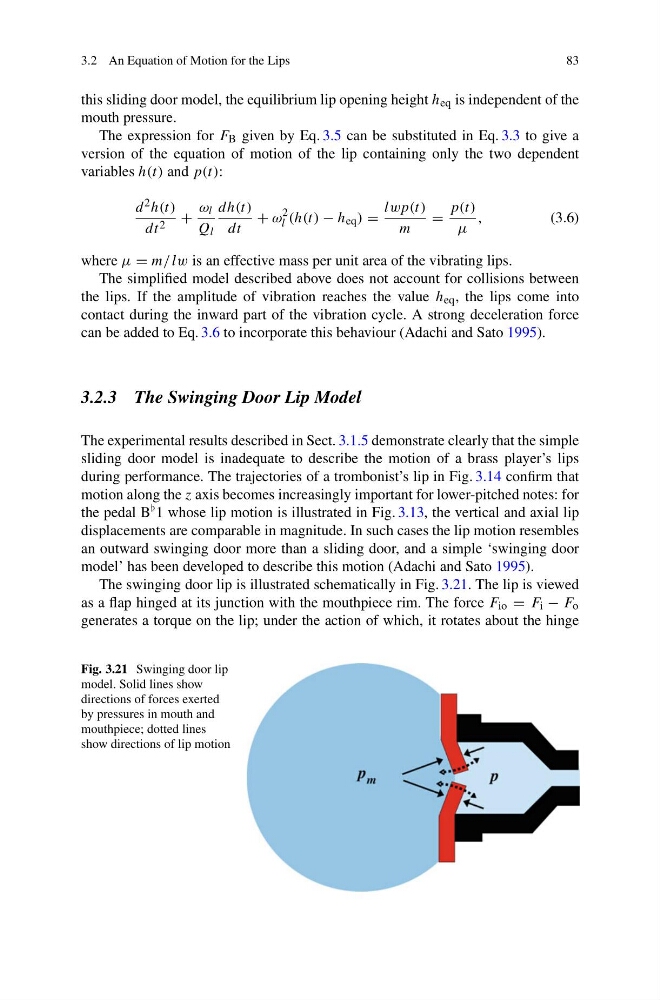
The swinging door lip is illustrated schematically in Fig. 3.21. The lip is viewed
as a flap hinged at its junction with the mouthpiece rim. The force F io = F i − F o
generates a torque on the lip; under the action of which, it rotates about the hinge
Fig. 3.21 Swinging door lip
model. Solid lines show
directions of forces exerted
by pressures in mouth and
mouthpiece; dotted lines
show directions of lip motion
83
this sliding door model, the equilibrium lip opening height h eq is independent of the
mouth pressure.
The expression for F B given by Eq. 3.5 can be substituted in Eq. 3.3 to give a
version of the equation of motion of the lip containing only the two dependent
variables h(t) and p(t):
d 2 h(t)
dt 2 +
ω l
Q l
dh(t)
dt
+ ω
2
l (h(t) − h eq ) =
lwp(t)
m
=
p(t)
μ
,
(3.6)
where μ = m/ lw is an effective mass per unit area of the vibrating lips.
The simplified model described above does not account for collisions between
the lips. If the amplitude of vibration reaches the value h eq , the lips come into
contact during the inward part of the vibration cycle. A strong deceleration force
can be added to Eq. 3.6 to incorporate this behaviour (Adachi and Sato 1995).
3.2.3 The Swinging Door Lip Model
The experimental results described in Sect. 3.1.5 demonstrate clearly that the simple
sliding door model is inadequate to describe the motion of a brass player’s lips
during performance. The trajectories of a trombonist’s lip in Fig. 3.14 confirm that
motion along the z axis becomes increasingly important for lower-pitched notes: for
the pedal B 1 whose lip motion is illustrated in Fig. 3.13, the vertical and axial lip
displacements are comparable in magnitude. In such cases the lip motion resembles
an outward swinging door more than a sliding door, and a simple ‘swinging door
model’ has been developed to describe this motion (Adachi and Sato 1995).
The swinging door lip is illustrated schematically in Fig. 3.21. The lip is viewed
as a flap hinged at its junction with the mouthpiece rim. The force F io = F i − F o
generates a torque on the lip; under the action of which, it rotates about the hinge
Fig. 3.21 Swinging door lip
model. Solid lines show
directions of forces exerted
by pressures in mouth and
mouthpiece; dotted lines
show directions of lip motion