

68
3 Buzzing Lips: Sound Generation in Brass Instruments
diameter of the mouthpiece rim. The gap between the lips has a maximum value of
around 5 mm and a minimum value close to zero (in the fifth image). The shape of
the lip opening changes significantly during the cycle, and at some stages (images 3
and 4), there is a strong right-left asymmetry.
Video recordings of many different brass players have been made with apparatus
similar to that used in obtaining Fig. 3.4. Since each brass player has a unique set
of lips, it is not surprising that images from performances of the same note by
different players differ in detail. In particular, the degree of lateral asymmetry can
vary substantially from one player to another, even although the radiated sounds are
almost indistinguishable. The explanation for the fact that the same sounds can be
generated by different shapes of lip opening lies in the nature of the valve effect
source, discussed in detail in Sect. 3.5.1. The acoustic pressure generated in the
mouthpiece cup depends on the volume flow of air through the lip aperture, and this
volume flow is controlled mainly by the effective area between the two lips rather
than the shape of the opening.
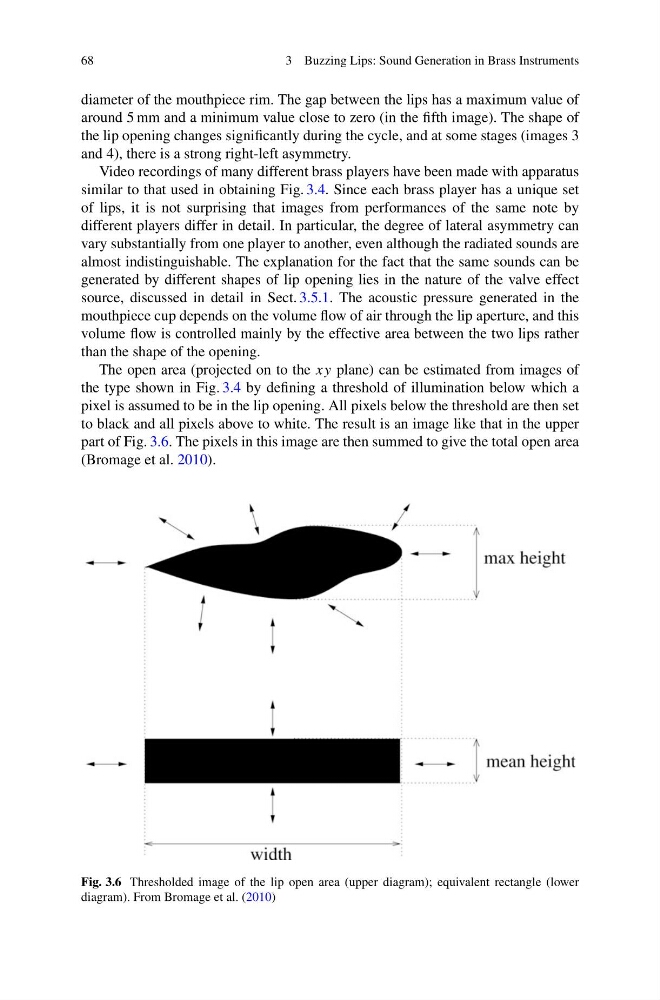
The open area (projected on to the xy plane) can be estimated from images of
the type shown in Fig. 3.4 by defining a threshold of illumination below which a
pixel is assumed to be in the lip opening. All pixels below the threshold are then set
to black and all pixels above to white. The result is an image like that in the upper
part of Fig. 3.6. The pixels in this image are then summed to give the total open area
(Bromage et al. 2010).
Fig. 3.6 Thresholded image of the lip open area (upper diagram); equivalent rectangle (lower
diagram). From Bromage et al. (2010)
3 Buzzing Lips: Sound Generation in Brass Instruments
diameter of the mouthpiece rim. The gap between the lips has a maximum value of
around 5 mm and a minimum value close to zero (in the fifth image). The shape of
the lip opening changes significantly during the cycle, and at some stages (images 3
and 4), there is a strong right-left asymmetry.
Video recordings of many different brass players have been made with apparatus
similar to that used in obtaining Fig. 3.4. Since each brass player has a unique set
of lips, it is not surprising that images from performances of the same note by
different players differ in detail. In particular, the degree of lateral asymmetry can
vary substantially from one player to another, even although the radiated sounds are
almost indistinguishable. The explanation for the fact that the same sounds can be
generated by different shapes of lip opening lies in the nature of the valve effect
source, discussed in detail in Sect. 3.5.1. The acoustic pressure generated in the
mouthpiece cup depends on the volume flow of air through the lip aperture, and this
volume flow is controlled mainly by the effective area between the two lips rather
than the shape of the opening.
The open area (projected on to the xy plane) can be estimated from images of
the type shown in Fig. 3.4 by defining a threshold of illumination below which a
pixel is assumed to be in the lip opening. All pixels below the threshold are then set
to black and all pixels above to white. The result is an image like that in the upper
part of Fig. 3.6. The pixels in this image are then summed to give the total open area
(Bromage et al. 2010).
Fig. 3.6 Thresholded image of the lip open area (upper diagram); equivalent rectangle (lower
diagram). From Bromage et al. (2010)