

44
2 The Scientist’s Perspective on Brass Instrument Behaviour
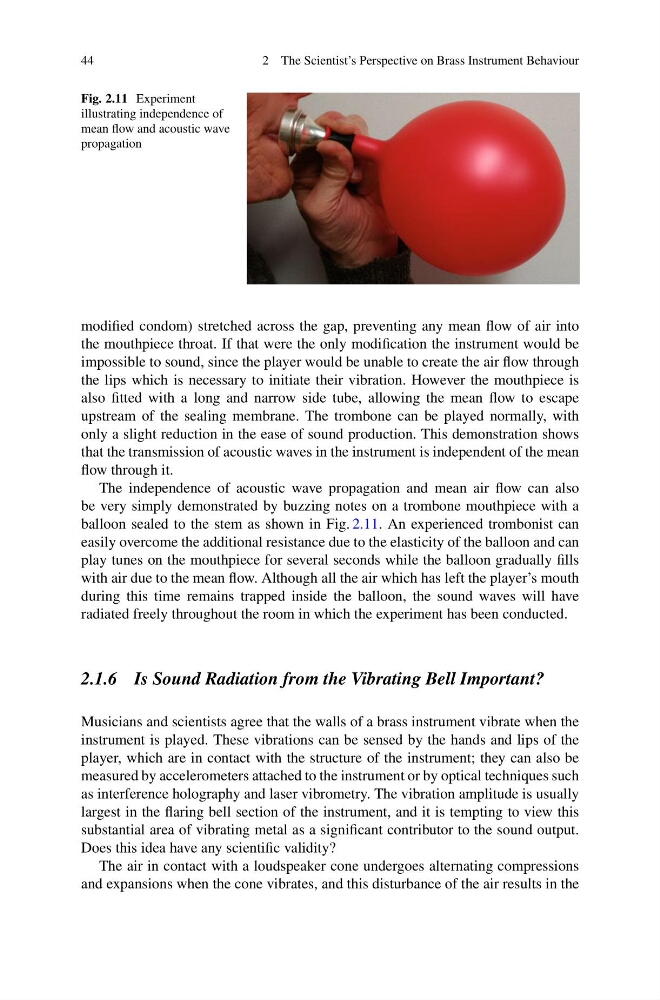
Fig. 2.11 Experiment
illustrating independence of
mean flow and acoustic wave
propagation
modified condom) stretched across the gap, preventing any mean flow of air into
the mouthpiece throat. If that were the only modification the instrument would be
impossible to sound, since the player would be unable to create the air flow through
the lips which is necessary to initiate their vibration. However the mouthpiece is
also fitted with a long and narrow side tube, allowing the mean flow to escape
upstream of the sealing membrane. The trombone can be played normally, with
only a slight reduction in the ease of sound production. This demonstration shows
that the transmission of acoustic waves in the instrument is independent of the mean
flow through it.
The independence of acoustic wave propagation and mean air flow can also
be very simply demonstrated by buzzing notes on a trombone mouthpiece with a
balloon sealed to the stem as shown in Fig. 2.11. An experienced trombonist can
easily overcome the additional resistance due to the elasticity of the balloon and can
play tunes on the mouthpiece for several seconds while the balloon gradually fills
with air due to the mean flow. Although all the air which has left the player’s mouth
during this time remains trapped inside the balloon, the sound waves will have
radiated freely throughout the room in which the experiment has been conducted.
2.1.6 Is Sound Radiation from the Vibrating Bell Important?
Musicians and scientists agree that the walls of a brass instrument vibrate when the
instrument is played. These vibrations can be sensed by the hands and lips of the
player, which are in contact with the structure of the instrument; they can also be
measured by accelerometers attached to the instrument or by optical techniques such
as interference holography and laser vibrometry. The vibration amplitude is usually
largest in the flaring bell section of the instrument, and it is tempting to view this
substantial area of vibrating metal as a significant contributor to the sound output.
Does this idea have any scientific validity?
The air in contact with a loudspeaker cone undergoes alternating compressions
and expansions when the cone vibrates, and this disturbance of the air results in the
2 The Scientist’s Perspective on Brass Instrument Behaviour
Fig. 2.11 Experiment
illustrating independence of
mean flow and acoustic wave
propagation
modified condom) stretched across the gap, preventing any mean flow of air into
the mouthpiece throat. If that were the only modification the instrument would be
impossible to sound, since the player would be unable to create the air flow through
the lips which is necessary to initiate their vibration. However the mouthpiece is
also fitted with a long and narrow side tube, allowing the mean flow to escape
upstream of the sealing membrane. The trombone can be played normally, with
only a slight reduction in the ease of sound production. This demonstration shows
that the transmission of acoustic waves in the instrument is independent of the mean
flow through it.
The independence of acoustic wave propagation and mean air flow can also
be very simply demonstrated by buzzing notes on a trombone mouthpiece with a
balloon sealed to the stem as shown in Fig. 2.11. An experienced trombonist can
easily overcome the additional resistance due to the elasticity of the balloon and can
play tunes on the mouthpiece for several seconds while the balloon gradually fills
with air due to the mean flow. Although all the air which has left the player’s mouth
during this time remains trapped inside the balloon, the sound waves will have
radiated freely throughout the room in which the experiment has been conducted.
2.1.6 Is Sound Radiation from the Vibrating Bell Important?
Musicians and scientists agree that the walls of a brass instrument vibrate when the
instrument is played. These vibrations can be sensed by the hands and lips of the
player, which are in contact with the structure of the instrument; they can also be
measured by accelerometers attached to the instrument or by optical techniques such
as interference holography and laser vibrometry. The vibration amplitude is usually
largest in the flaring bell section of the instrument, and it is tempting to view this
substantial area of vibrating metal as a significant contributor to the sound output.
Does this idea have any scientific validity?
The air in contact with a loudspeaker cone undergoes alternating compressions
and expansions when the cone vibrates, and this disturbance of the air results in the