

2.1 Scientific Measurements of Brass Instrument Behaviour
45
radiation of a sound wave. This is an example of a vibroacoustic sound source.
Almost all members of the stringed and percussion instrument families can be
described scientifically as vibroacoustic musical sound sources. On a violin, for
example, a string is set into vibration by bowing or plucking; the forces exerted by
the string on the bridge generate vibrations of the extended surfaces of the body of
the violin, and radiation from these surfaces provides almost all the sound output
of the instrument. In a similar way, the soundboard of a piano is the vibroacoustic
source of the sound radiation.
Wind instruments, including the brass instrument family, are described as
aerophones, a technical term which reminds us that the transmission of wave energy
in these instruments is primarily through sound waves in air rather than through
structural vibrations. Since powerful sound waves already exist in the air column
within a brass instrument tube, there is no need for a vibrating surface to act as
a sound source: an aperture in the tube which allows some of the sound energy
to escape will act as a powerful source of radiated sound waves. In most brass
instruments, the bell is the only opening, and this aperture is the source of almost
all the radiated sound.
It is the established scientific view that, while the vibrating bell does constitute a
vibroacoustic sound source in normal brass instruments, it is so weak in comparison
with the direct transmission of sound waves through the bell aperture that it is
unlikely to make a detectable contribution to the sound of the instrument. Many
musicians still find it difficult to accept that this can be true. To attempt to convince
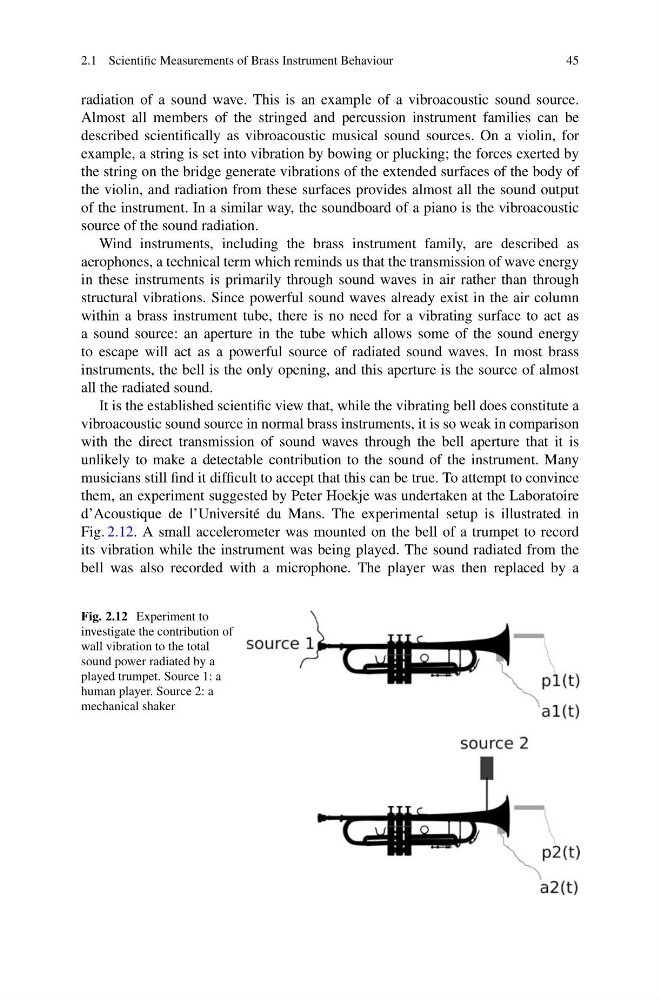
them, an experiment suggested by Peter Hoekje was undertaken at the Laboratoire
d’Acoustique de l’Université du Mans. The experimental setup is illustrated in
Fig. 2.12. A small accelerometer was mounted on the bell of a trumpet to record
its vibration while the instrument was being played. The sound radiated from the
bell was also recorded with a microphone. The player was then replaced by a
Fig. 2.12 Experiment to
investigate the contribution of
wall vibration to the total
sound power radiated by a
played trumpet. Source 1: a
human player. Source 2: a
mechanical shaker
45
radiation of a sound wave. This is an example of a vibroacoustic sound source.
Almost all members of the stringed and percussion instrument families can be
described scientifically as vibroacoustic musical sound sources. On a violin, for
example, a string is set into vibration by bowing or plucking; the forces exerted by
the string on the bridge generate vibrations of the extended surfaces of the body of
the violin, and radiation from these surfaces provides almost all the sound output
of the instrument. In a similar way, the soundboard of a piano is the vibroacoustic
source of the sound radiation.
Wind instruments, including the brass instrument family, are described as
aerophones, a technical term which reminds us that the transmission of wave energy
in these instruments is primarily through sound waves in air rather than through
structural vibrations. Since powerful sound waves already exist in the air column
within a brass instrument tube, there is no need for a vibrating surface to act as
a sound source: an aperture in the tube which allows some of the sound energy
to escape will act as a powerful source of radiated sound waves. In most brass
instruments, the bell is the only opening, and this aperture is the source of almost
all the radiated sound.
It is the established scientific view that, while the vibrating bell does constitute a
vibroacoustic sound source in normal brass instruments, it is so weak in comparison
with the direct transmission of sound waves through the bell aperture that it is
unlikely to make a detectable contribution to the sound of the instrument. Many
musicians still find it difficult to accept that this can be true. To attempt to convince
them, an experiment suggested by Peter Hoekje was undertaken at the Laboratoire
d’Acoustique de l’Université du Mans. The experimental setup is illustrated in
Fig. 2.12. A small accelerometer was mounted on the bell of a trumpet to record
its vibration while the instrument was being played. The sound radiated from the
bell was also recorded with a microphone. The player was then replaced by a
Fig. 2.12 Experiment to
investigate the contribution of
wall vibration to the total
sound power radiated by a
played trumpet. Source 1: a
human player. Source 2: a
mechanical shaker