

2.1 Scientific Measurements of Brass Instrument Behaviour
43
2.1.5 Is Air Flow Through the Instrument Tube Important?
The flow of air between the lips is essential to the sound production in a brass
instrument, since it results in the lip vibration which generates sound power in the
mouthpiece. What about the air flow in the rest of the instrument? Air flow velocity
is more difficult to measure than pressure, but Elliott and Bowsher (1982) recorded
the velocity of the air flow in a specially modified trombone mouthpiece with a
hot wire probe inserted in the throat (the narrowest section). Elliott and Bowsher’s
measurement of the air flow velocity during the playing of a low note (B 2) is shown
in Fig. 2.9.
As expected, Fig. 2.9 shows that the flow through the throat has a periodic
vibration, dropping to zero once every cycle as the lips close. However there is
clearly a mean positive flow into the main bore. The mean flow can also be observed
emerging from the bell using the optical technique of schlieren photography
explained in Chap. 6: it is responsible for the cloud-like turbulent flow in Fig. 6.5.
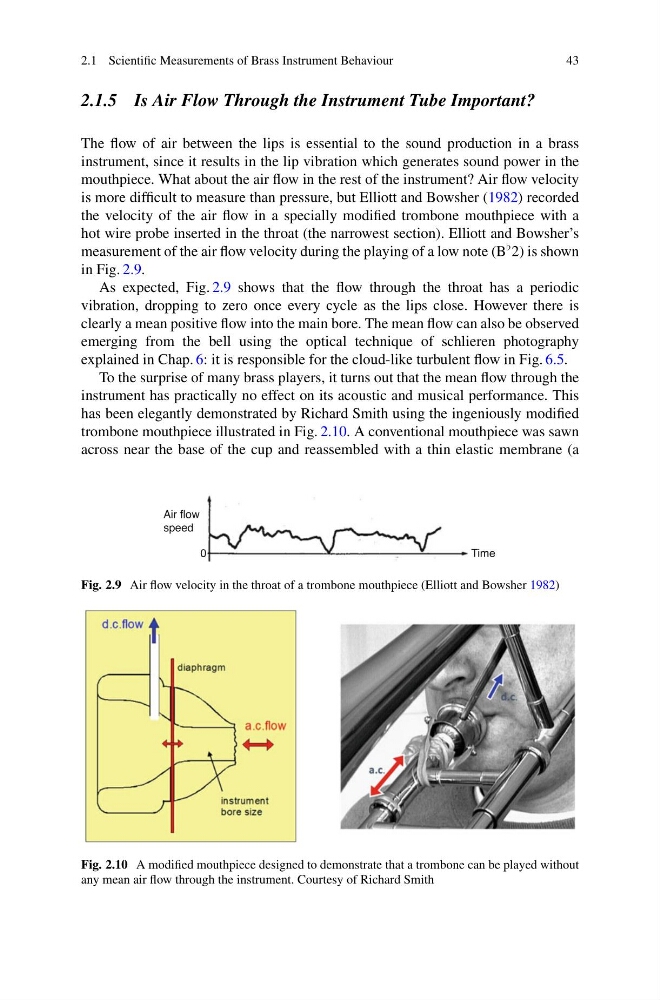
To the surprise of many brass players, it turns out that the mean flow through the
instrument has practically no effect on its acoustic and musical performance. This
has been elegantly demonstrated by Richard Smith using the ingeniously modified
trombone mouthpiece illustrated in Fig. 2.10. A conventional mouthpiece was sawn
across near the base of the cup and reassembled with a thin elastic membrane (a
Air flow
speed
0
Time
Fig. 2.9 Air flow velocity in the throat of a trombone mouthpiece (Elliott and Bowsher 1982)
Fig. 2.10 A modified mouthpiece designed to demonstrate that a trombone can be played without
any mean air flow through the instrument. Courtesy of Richard Smith
43
2.1.5 Is Air Flow Through the Instrument Tube Important?
The flow of air between the lips is essential to the sound production in a brass
instrument, since it results in the lip vibration which generates sound power in the
mouthpiece. What about the air flow in the rest of the instrument? Air flow velocity
is more difficult to measure than pressure, but Elliott and Bowsher (1982) recorded
the velocity of the air flow in a specially modified trombone mouthpiece with a
hot wire probe inserted in the throat (the narrowest section). Elliott and Bowsher’s
measurement of the air flow velocity during the playing of a low note (B 2) is shown
in Fig. 2.9.
As expected, Fig. 2.9 shows that the flow through the throat has a periodic
vibration, dropping to zero once every cycle as the lips close. However there is
clearly a mean positive flow into the main bore. The mean flow can also be observed
emerging from the bell using the optical technique of schlieren photography
explained in Chap. 6: it is responsible for the cloud-like turbulent flow in Fig. 6.5.
To the surprise of many brass players, it turns out that the mean flow through the
instrument has practically no effect on its acoustic and musical performance. This
has been elegantly demonstrated by Richard Smith using the ingeniously modified
trombone mouthpiece illustrated in Fig. 2.10. A conventional mouthpiece was sawn
across near the base of the cup and reassembled with a thin elastic membrane (a
Air flow
speed
0
Time
Fig. 2.9 Air flow velocity in the throat of a trombone mouthpiece (Elliott and Bowsher 1982)
Fig. 2.10 A modified mouthpiece designed to demonstrate that a trombone can be played without
any mean air flow through the instrument. Courtesy of Richard Smith