

42
2 The Scientist’s Perspective on Brass Instrument Behaviour
case, the motion of the elastic strip forces the air which is in contact with it into
motion, generating a sound wave directly in the same way as the vibrating cone of
a loudspeaker. In the case of the buzzing lips, there is a similar direct displacement
of the air by the player’s lips, but it makes a very small contribution to the total
sound. To understand how a brass instrument can radiate enough sound power to
carry across a battlefield or thrill a concert audience of thousands, it is helpful to
study in detail the motion of the player’s lips using a high-speed video camera and
a specially designed transparent mouthpiece, as illustrated in Fig. 2.1.
We saw in Sect. 2.1.3 that during performance a brass player generates mouth
pressures up to and even beyond 10 kPa (10% of an atmosphere). This excess
pressure behind the lips forces a current of air through the aperture between them. In
Chap. 3 it will be explained that this air flow is responsible for creating a situation in
which the lips spontaneously start to vibrate. Figure 3.4, which was obtained using
a high-speed camera, shows that the open area of the lips increases and decreases
regularly during the vibration, effectively opening and closing the player’s mouth
once every cycle. In the sounding of the note F4 studied in Sects. 2.1.1–2.1.3, the
lips of the trombonist were opening and closing with the frequency of the played
note (350 Hz). In consequence the flow of air from the mouth into the mouthpiece
was periodically interrupted, and the modulated air flow injected a high level of
sound power into the instrument.
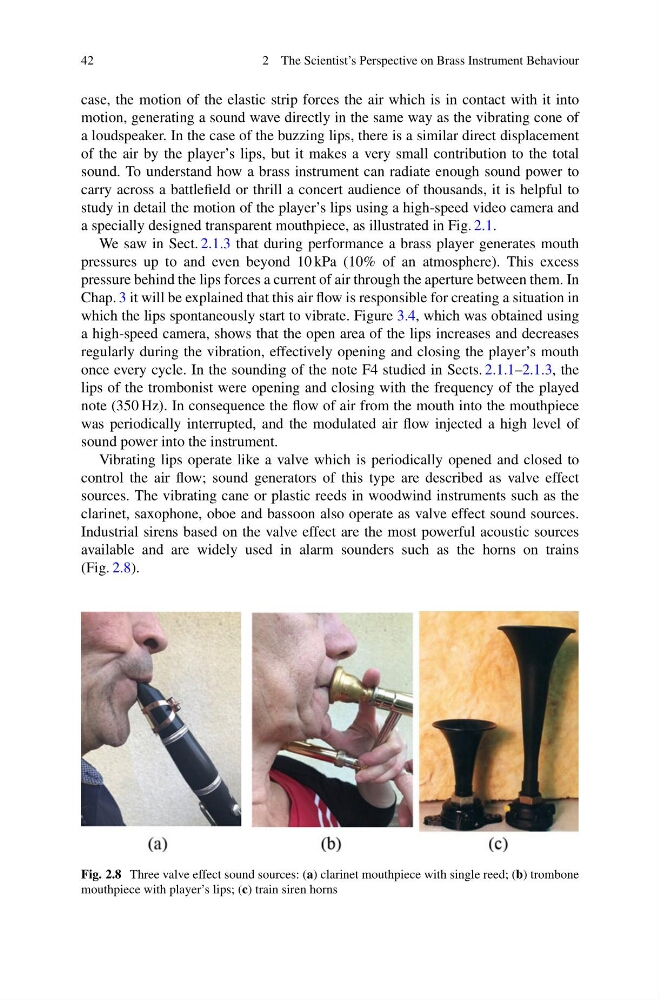
Vibrating lips operate like a valve which is periodically opened and closed to
control the air flow; sound generators of this type are described as valve effect
sources. The vibrating cane or plastic reeds in woodwind instruments such as the
clarinet, saxophone, oboe and bassoon also operate as valve effect sound sources.
Industrial sirens based on the valve effect are the most powerful acoustic sources
available and are widely used in alarm sounders such as the horns on trains
(Fig. 2.8).
Fig. 2.8 Three valve effect sound sources: (a) clarinet mouthpiece with single reed; (b) trombone
mouthpiece with player’s lips; (c) train siren horns
2 The Scientist’s Perspective on Brass Instrument Behaviour
case, the motion of the elastic strip forces the air which is in contact with it into
motion, generating a sound wave directly in the same way as the vibrating cone of
a loudspeaker. In the case of the buzzing lips, there is a similar direct displacement
of the air by the player’s lips, but it makes a very small contribution to the total
sound. To understand how a brass instrument can radiate enough sound power to
carry across a battlefield or thrill a concert audience of thousands, it is helpful to
study in detail the motion of the player’s lips using a high-speed video camera and
a specially designed transparent mouthpiece, as illustrated in Fig. 2.1.
We saw in Sect. 2.1.3 that during performance a brass player generates mouth
pressures up to and even beyond 10 kPa (10% of an atmosphere). This excess
pressure behind the lips forces a current of air through the aperture between them. In
Chap. 3 it will be explained that this air flow is responsible for creating a situation in
which the lips spontaneously start to vibrate. Figure 3.4, which was obtained using
a high-speed camera, shows that the open area of the lips increases and decreases
regularly during the vibration, effectively opening and closing the player’s mouth
once every cycle. In the sounding of the note F4 studied in Sects. 2.1.1–2.1.3, the
lips of the trombonist were opening and closing with the frequency of the played
note (350 Hz). In consequence the flow of air from the mouth into the mouthpiece
was periodically interrupted, and the modulated air flow injected a high level of
sound power into the instrument.
Vibrating lips operate like a valve which is periodically opened and closed to
control the air flow; sound generators of this type are described as valve effect
sources. The vibrating cane or plastic reeds in woodwind instruments such as the
clarinet, saxophone, oboe and bassoon also operate as valve effect sound sources.
Industrial sirens based on the valve effect are the most powerful acoustic sources
available and are widely used in alarm sounders such as the horns on trains
(Fig. 2.8).
Fig. 2.8 Three valve effect sound sources: (a) clarinet mouthpiece with single reed; (b) trombone
mouthpiece with player’s lips; (c) train siren horns