

2.1 Scientific Measurements of Brass Instrument Behaviour
41
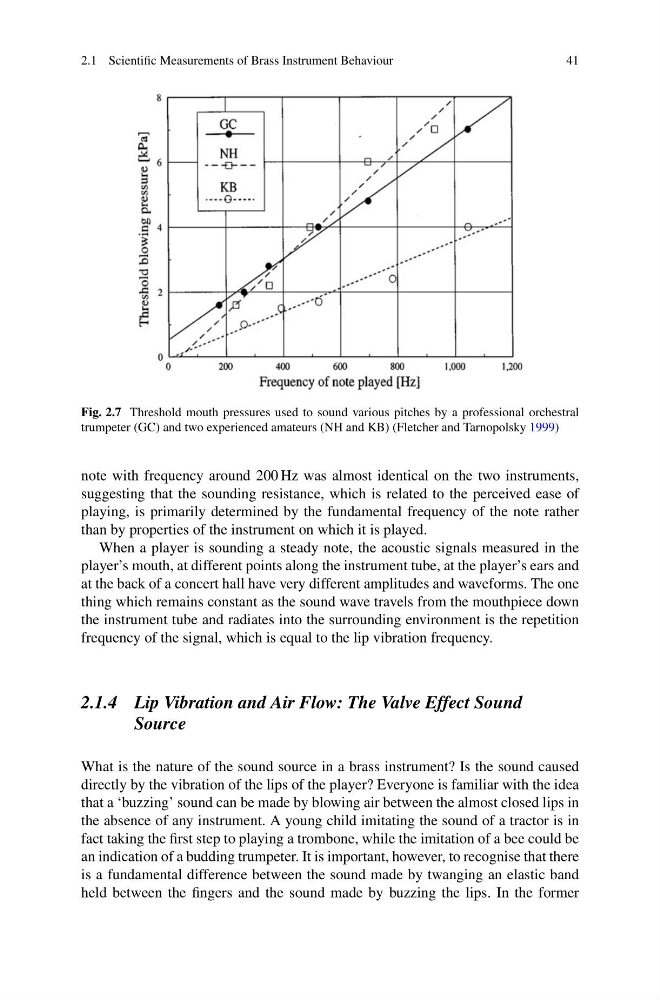
Fig. 2.7 Threshold mouth pressures used to sound various pitches by a professional orchestral
trumpeter (GC) and two experienced amateurs (NH and KB) (Fletcher and Tarnopolsky 1999)
note with frequency around 200 Hz was almost identical on the two instruments,
suggesting that the sounding resistance, which is related to the perceived ease of
playing, is primarily determined by the fundamental frequency of the note rather
than by properties of the instrument on which it is played.
When a player is sounding a steady note, the acoustic signals measured in the
player’s mouth, at different points along the instrument tube, at the player’s ears and
at the back of a concert hall have very different amplitudes and waveforms. The one
thing which remains constant as the sound wave travels from the mouthpiece down
the instrument tube and radiates into the surrounding environment is the repetition
frequency of the signal, which is equal to the lip vibration frequency.
2.1.4 Lip Vibration and Air Flow: The Valve Effect Sound
Source
What is the nature of the sound source in a brass instrument? Is the sound caused
directly by the vibration of the lips of the player? Everyone is familiar with the idea
that a ‘buzzing’ sound can be made by blowing air between the almost closed lips in
the absence of any instrument. A young child imitating the sound of a tractor is in
fact taking the first step to playing a trombone, while the imitation of a bee could be
an indication of a budding trumpeter. It is important, however, to recognise that there
is a fundamental difference between the sound made by twanging an elastic band
held between the fingers and the sound made by buzzing the lips. In the former
41
Fig. 2.7 Threshold mouth pressures used to sound various pitches by a professional orchestral
trumpeter (GC) and two experienced amateurs (NH and KB) (Fletcher and Tarnopolsky 1999)
note with frequency around 200 Hz was almost identical on the two instruments,
suggesting that the sounding resistance, which is related to the perceived ease of
playing, is primarily determined by the fundamental frequency of the note rather
than by properties of the instrument on which it is played.
When a player is sounding a steady note, the acoustic signals measured in the
player’s mouth, at different points along the instrument tube, at the player’s ears and
at the back of a concert hall have very different amplitudes and waveforms. The one
thing which remains constant as the sound wave travels from the mouthpiece down
the instrument tube and radiates into the surrounding environment is the repetition
frequency of the signal, which is equal to the lip vibration frequency.
2.1.4 Lip Vibration and Air Flow: The Valve Effect Sound
Source
What is the nature of the sound source in a brass instrument? Is the sound caused
directly by the vibration of the lips of the player? Everyone is familiar with the idea
that a ‘buzzing’ sound can be made by blowing air between the almost closed lips in
the absence of any instrument. A young child imitating the sound of a tractor is in
fact taking the first step to playing a trombone, while the imitation of a bee could be
an indication of a budding trumpeter. It is important, however, to recognise that there
is a fundamental difference between the sound made by twanging an elastic band
held between the fingers and the sound made by buzzing the lips. In the former