

40
2 The Scientist’s Perspective on Brass Instrument Behaviour
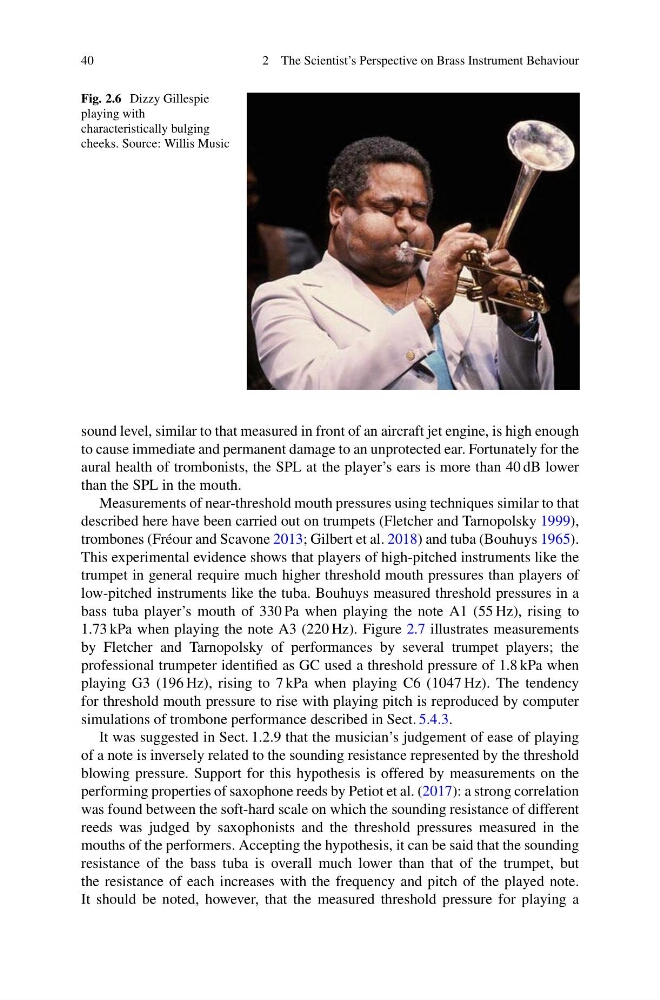
Fig. 2.6 Dizzy Gillespie
playing with
characteristically bulging
cheeks. Source: Willis Music
sound level, similar to that measured in front of an aircraft jet engine, is high enough
to cause immediate and permanent damage to an unprotected ear. Fortunately for the
aural health of trombonists, the SPL at the player’s ears is more than 40 dB lower
than the SPL in the mouth.
Measurements of near-threshold mouth pressures using techniques similar to that
described here have been carried out on trumpets (Fletcher and Tarnopolsky 1999),
trombones (Fréour and Scavone 2013; Gilbert et al. 2018) and tuba (Bouhuys 1965).
This experimental evidence shows that players of high-pitched instruments like the
trumpet in general require much higher threshold mouth pressures than players of
low-pitched instruments like the tuba. Bouhuys measured threshold pressures in a
bass tuba player’s mouth of 330 Pa when playing the note A1 (55 Hz), rising to
1.73 kPa when playing the note A3 (220 Hz). Figure 2.7 illustrates measurements
by Fletcher and Tarnopolsky of performances by several trumpet players; the
professional trumpeter identified as GC used a threshold pressure of 1.8 kPa when
playing G3 (196 Hz), rising to 7 kPa when playing C6 (1047 Hz). The tendency
for threshold mouth pressure to rise with playing pitch is reproduced by computer
simulations of trombone performance described in Sect. 5.4.3.
It was suggested in Sect. 1.2.9 that the musician’s judgement of ease of playing
of a note is inversely related to the sounding resistance represented by the threshold
blowing pressure. Support for this hypothesis is offered by measurements on the
performing properties of saxophone reeds by Petiot et al. (2017): a strong correlation
was found between the soft-hard scale on which the sounding resistance of different
reeds was judged by saxophonists and the threshold pressures measured in the
mouths of the performers. Accepting the hypothesis, it can be said that the sounding
resistance of the bass tuba is overall much lower than that of the trumpet, but
the resistance of each increases with the frequency and pitch of the played note.
It should be noted, however, that the measured threshold pressure for playing a
2 The Scientist’s Perspective on Brass Instrument Behaviour
Fig. 2.6 Dizzy Gillespie
playing with
characteristically bulging
cheeks. Source: Willis Music
sound level, similar to that measured in front of an aircraft jet engine, is high enough
to cause immediate and permanent damage to an unprotected ear. Fortunately for the
aural health of trombonists, the SPL at the player’s ears is more than 40 dB lower
than the SPL in the mouth.
Measurements of near-threshold mouth pressures using techniques similar to that
described here have been carried out on trumpets (Fletcher and Tarnopolsky 1999),
trombones (Fréour and Scavone 2013; Gilbert et al. 2018) and tuba (Bouhuys 1965).
This experimental evidence shows that players of high-pitched instruments like the
trumpet in general require much higher threshold mouth pressures than players of
low-pitched instruments like the tuba. Bouhuys measured threshold pressures in a
bass tuba player’s mouth of 330 Pa when playing the note A1 (55 Hz), rising to
1.73 kPa when playing the note A3 (220 Hz). Figure 2.7 illustrates measurements
by Fletcher and Tarnopolsky of performances by several trumpet players; the
professional trumpeter identified as GC used a threshold pressure of 1.8 kPa when
playing G3 (196 Hz), rising to 7 kPa when playing C6 (1047 Hz). The tendency
for threshold mouth pressure to rise with playing pitch is reproduced by computer
simulations of trombone performance described in Sect. 5.4.3.
It was suggested in Sect. 1.2.9 that the musician’s judgement of ease of playing
of a note is inversely related to the sounding resistance represented by the threshold
blowing pressure. Support for this hypothesis is offered by measurements on the
performing properties of saxophone reeds by Petiot et al. (2017): a strong correlation
was found between the soft-hard scale on which the sounding resistance of different
reeds was judged by saxophonists and the threshold pressures measured in the
mouths of the performers. Accepting the hypothesis, it can be said that the sounding
resistance of the bass tuba is overall much lower than that of the trumpet, but
the resistance of each increases with the frequency and pitch of the played note.
It should be noted, however, that the measured threshold pressure for playing a