

9.2 Brass Instruments in the Digital World
417
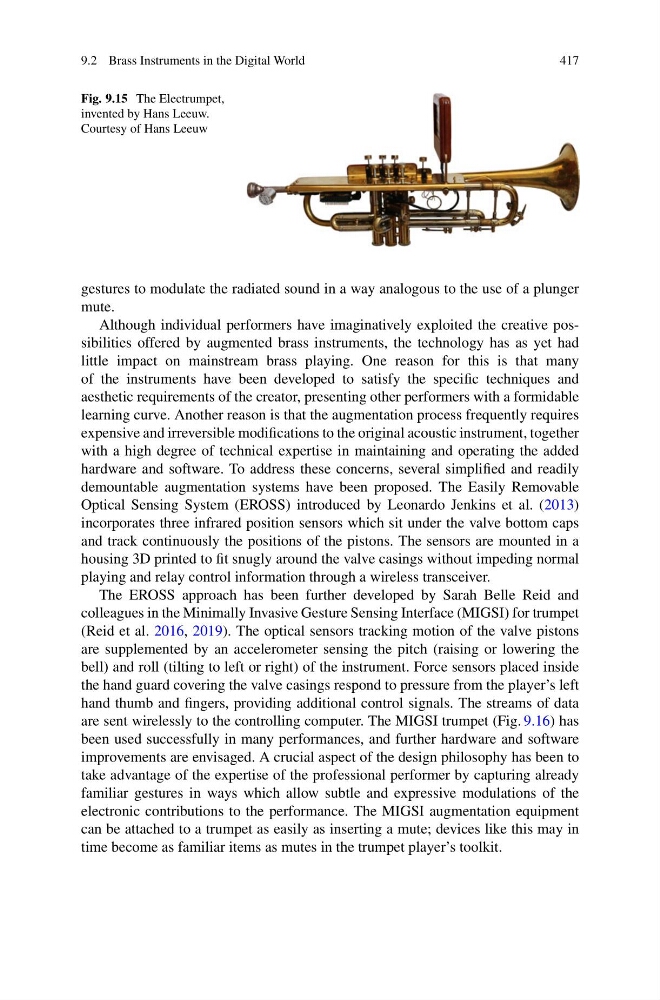
Fig. 9.15 The Electrumpet,
invented by Hans Leeuw.
Courtesy of Hans Leeuw
gestures to modulate the radiated sound in a way analogous to the use of a plunger
mute.
Although individual performers have imaginatively exploited the creative possibilities offered by augmented brass instruments, the technology has as yet had
little impact on mainstream brass playing. One reason for this is that many
of the instruments have been developed to satisfy the specific techniques and
aesthetic requirements of the creator, presenting other performers with a formidable
learning curve. Another reason is that the augmentation process frequently requires
expensive and irreversible modifications to the original acoustic instrument, together
with a high degree of technical expertise in maintaining and operating the added
hardware and software. To address these concerns, several simplified and readily
demountable augmentation systems have been proposed. The Easily Removable
Optical Sensing System (EROSS) introduced by Leonardo Jenkins et al. (2013)
incorporates three infrared position sensors which sit under the valve bottom caps
and track continuously the positions of the pistons. The sensors are mounted in a
housing 3D printed to fit snugly around the valve casings without impeding normal
playing and relay control information through a wireless transceiver.
The EROSS approach has been further developed by Sarah Belle Reid and
colleagues in the Minimally Invasive Gesture Sensing Interface (MIGSI) for trumpet
(Reid et al. 2016, 2019). The optical sensors tracking motion of the valve pistons
are supplemented by an accelerometer sensing the pitch (raising or lowering the
bell) and roll (tilting to left or right) of the instrument. Force sensors placed inside
the hand guard covering the valve casings respond to pressure from the player’s left
hand thumb and fingers, providing additional control signals. The streams of data
are sent wirelessly to the controlling computer. The MIGSI trumpet (Fig. 9.16) has
been used successfully in many performances, and further hardware and software
improvements are envisaged. A crucial aspect of the design philosophy has been to
take advantage of the expertise of the professional performer by capturing already
familiar gestures in ways which allow subtle and expressive modulations of the
electronic contributions to the performance. The MIGSI augmentation equipment
can be attached to a trumpet as easily as inserting a mute; devices like this may in
time become as familiar items as mutes in the trumpet player’s toolkit.
417
Fig. 9.15 The Electrumpet,
invented by Hans Leeuw.
Courtesy of Hans Leeuw
gestures to modulate the radiated sound in a way analogous to the use of a plunger
mute.
Although individual performers have imaginatively exploited the creative possibilities offered by augmented brass instruments, the technology has as yet had
little impact on mainstream brass playing. One reason for this is that many
of the instruments have been developed to satisfy the specific techniques and
aesthetic requirements of the creator, presenting other performers with a formidable
learning curve. Another reason is that the augmentation process frequently requires
expensive and irreversible modifications to the original acoustic instrument, together
with a high degree of technical expertise in maintaining and operating the added
hardware and software. To address these concerns, several simplified and readily
demountable augmentation systems have been proposed. The Easily Removable
Optical Sensing System (EROSS) introduced by Leonardo Jenkins et al. (2013)
incorporates three infrared position sensors which sit under the valve bottom caps
and track continuously the positions of the pistons. The sensors are mounted in a
housing 3D printed to fit snugly around the valve casings without impeding normal
playing and relay control information through a wireless transceiver.
The EROSS approach has been further developed by Sarah Belle Reid and
colleagues in the Minimally Invasive Gesture Sensing Interface (MIGSI) for trumpet
(Reid et al. 2016, 2019). The optical sensors tracking motion of the valve pistons
are supplemented by an accelerometer sensing the pitch (raising or lowering the
bell) and roll (tilting to left or right) of the instrument. Force sensors placed inside
the hand guard covering the valve casings respond to pressure from the player’s left
hand thumb and fingers, providing additional control signals. The streams of data
are sent wirelessly to the controlling computer. The MIGSI trumpet (Fig. 9.16) has
been used successfully in many performances, and further hardware and software
improvements are envisaged. A crucial aspect of the design philosophy has been to
take advantage of the expertise of the professional performer by capturing already
familiar gestures in ways which allow subtle and expressive modulations of the
electronic contributions to the performance. The MIGSI augmentation equipment
can be attached to a trumpet as easily as inserting a mute; devices like this may in
time become as familiar items as mutes in the trumpet player’s toolkit.