

416
9 Looking Back and Looking Forward
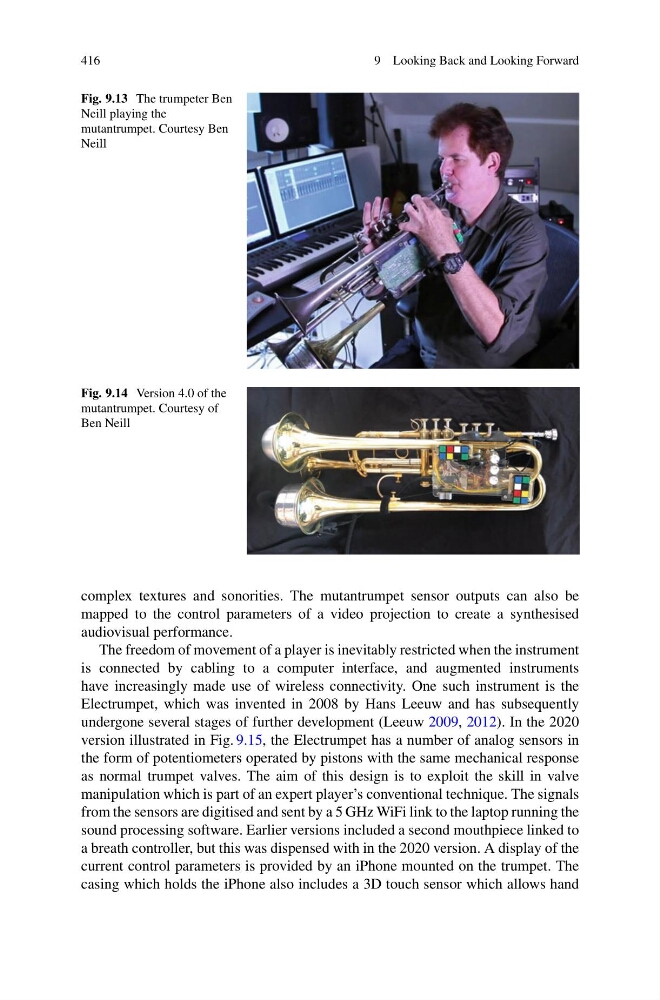
Fig. 9.13 The trumpeter Ben
Neill playing the
mutantrumpet. Courtesy Ben
Neill
Fig. 9.14 Version 4.0 of the
mutantrumpet. Courtesy of
Ben Neill
complex textures and sonorities. The mutantrumpet sensor outputs can also be
mapped to the control parameters of a video projection to create a synthesised
audiovisual performance.
The freedom of movement of a player is inevitably restricted when the instrument
is connected by cabling to a computer interface, and augmented instruments
have increasingly made use of wireless connectivity. One such instrument is the
Electrumpet, which was invented in 2008 by Hans Leeuw and has subsequently
undergone several stages of further development (Leeuw 2009, 2012). In the 2020
version illustrated in Fig. 9.15, the Electrumpet has a number of analog sensors in
the form of potentiometers operated by pistons with the same mechanical response
as normal trumpet valves. The aim of this design is to exploit the skill in valve
manipulation which is part of an expert player’s conventional technique. The signals
from the sensors are digitised and sent by a 5 GHz WiFi link to the laptop running the
sound processing software. Earlier versions included a second mouthpiece linked to
a breath controller, but this was dispensed with in the 2020 version. A display of the
current control parameters is provided by an iPhone mounted on the trumpet. The
casing which holds the iPhone also includes a 3D touch sensor which allows hand
9 Looking Back and Looking Forward
Fig. 9.13 The trumpeter Ben
Neill playing the
mutantrumpet. Courtesy Ben
Neill
Fig. 9.14 Version 4.0 of the
mutantrumpet. Courtesy of
Ben Neill
complex textures and sonorities. The mutantrumpet sensor outputs can also be
mapped to the control parameters of a video projection to create a synthesised
audiovisual performance.
The freedom of movement of a player is inevitably restricted when the instrument
is connected by cabling to a computer interface, and augmented instruments
have increasingly made use of wireless connectivity. One such instrument is the
Electrumpet, which was invented in 2008 by Hans Leeuw and has subsequently
undergone several stages of further development (Leeuw 2009, 2012). In the 2020
version illustrated in Fig. 9.15, the Electrumpet has a number of analog sensors in
the form of potentiometers operated by pistons with the same mechanical response
as normal trumpet valves. The aim of this design is to exploit the skill in valve
manipulation which is part of an expert player’s conventional technique. The signals
from the sensors are digitised and sent by a 5 GHz WiFi link to the laptop running the
sound processing software. Earlier versions included a second mouthpiece linked to
a breath controller, but this was dispensed with in the 2020 version. A display of the
current control parameters is provided by an iPhone mounted on the trumpet. The
casing which holds the iPhone also includes a 3D touch sensor which allows hand