

7.2 The Different Kinds of Brass Instrument
345
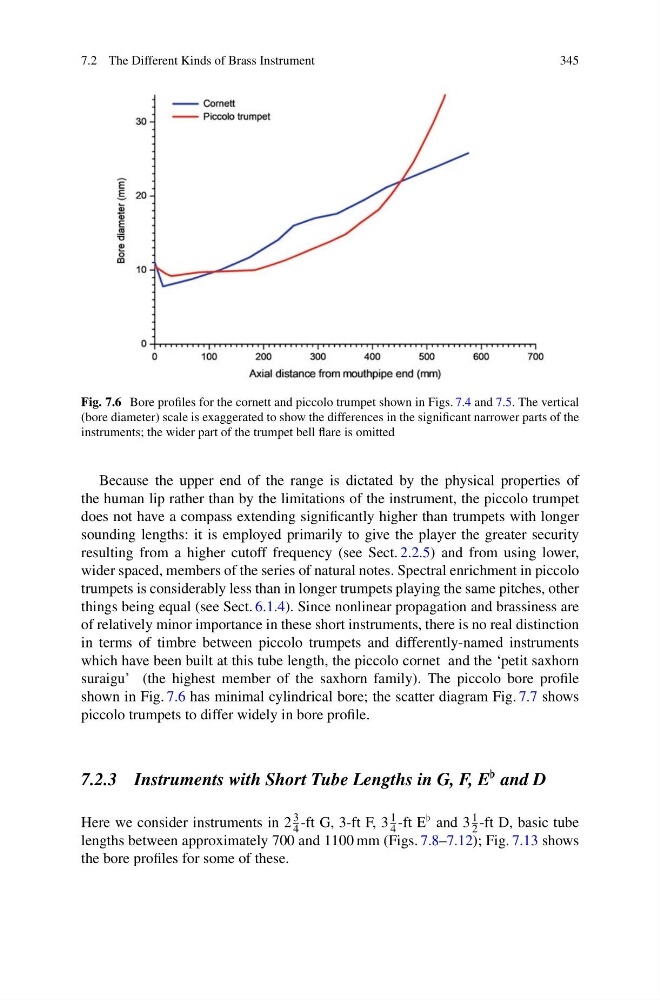
Fig. 7.6 Bore profiles for the cornett and piccolo trumpet shown in Figs. 7.4 and 7.5. The vertical
(bore diameter) scale is exaggerated to show the differences in the significant narrower parts of the
instruments; the wider part of the trumpet bell flare is omitted
Because the upper end of the range is dictated by the physical properties of
the human lip rather than by the limitations of the instrument, the piccolo trumpet
does not have a compass extending significantly higher than trumpets with longer
sounding lengths: it is employed primarily to give the player the greater security
resulting from a higher cutoff frequency (see Sect. 2.2.5) and from using lower,
wider spaced, members of the series of natural notes. Spectral enrichment in piccolo
trumpets is considerably less than in longer trumpets playing the same pitches, other
things being equal (see Sect. 6.1.4). Since nonlinear propagation and brassiness are
of relatively minor importance in these short instruments, there is no real distinction
in terms of timbre between piccolo trumpets and differently-named instruments
which have been built at this tube length, the piccolo cornet and the ‘petit saxhorn
suraigu’ (the highest member of the saxhorn family). The piccolo bore profile
shown in Fig. 7.6 has minimal cylindrical bore; the scatter diagram Fig. 7.7 shows
piccolo trumpets to differ widely in bore profile.
7.2.3 Instruments with Short Tube Lengths in G, F, E and D
Here we consider instruments in 2
3
4 -ft G, 3-ft F, 3
1
4 -ft E and 3
1
2 -ft D, basic tube
lengths between approximately 700 and 1100 mm (Figs. 7.8–7.12); Fig. 7.13 shows
the bore profiles for some of these.
345
Fig. 7.6 Bore profiles for the cornett and piccolo trumpet shown in Figs. 7.4 and 7.5. The vertical
(bore diameter) scale is exaggerated to show the differences in the significant narrower parts of the
instruments; the wider part of the trumpet bell flare is omitted
Because the upper end of the range is dictated by the physical properties of
the human lip rather than by the limitations of the instrument, the piccolo trumpet
does not have a compass extending significantly higher than trumpets with longer
sounding lengths: it is employed primarily to give the player the greater security
resulting from a higher cutoff frequency (see Sect. 2.2.5) and from using lower,
wider spaced, members of the series of natural notes. Spectral enrichment in piccolo
trumpets is considerably less than in longer trumpets playing the same pitches, other
things being equal (see Sect. 6.1.4). Since nonlinear propagation and brassiness are
of relatively minor importance in these short instruments, there is no real distinction
in terms of timbre between piccolo trumpets and differently-named instruments
which have been built at this tube length, the piccolo cornet and the ‘petit saxhorn
suraigu’ (the highest member of the saxhorn family). The piccolo bore profile
shown in Fig. 7.6 has minimal cylindrical bore; the scatter diagram Fig. 7.7 shows
piccolo trumpets to differ widely in bore profile.
7.2.3 Instruments with Short Tube Lengths in G, F, E and D
Here we consider instruments in 2
3
4 -ft G, 3-ft F, 3
1
4 -ft E and 3
1
2 -ft D, basic tube
lengths between approximately 700 and 1100 mm (Figs. 7.8–7.12); Fig. 7.13 shows
the bore profiles for some of these.