

346
7 The Amazing Diversity of Brass Instruments
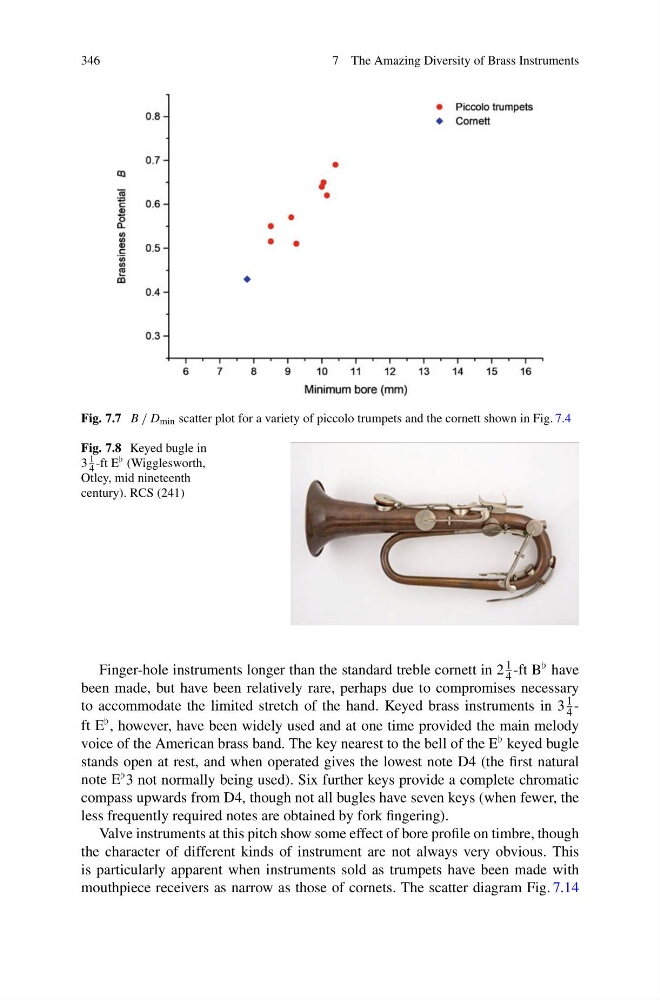
Fig. 7.7 B / D min scatter plot for a variety of piccolo trumpets and the cornett shown in Fig. 7.4
Fig. 7.8 Keyed bugle in
3
1
4 -ft E (Wigglesworth,
Otley, mid nineteenth
century). RCS (241)
Finger-hole instruments longer than the standard treble cornett in 2
1
4 -ft B have
been made, but have been relatively rare, perhaps due to compromises necessary
to accommodate the limited stretch of the hand. Keyed brass instruments in 3
1
4 -
ft E , however, have been widely used and at one time provided the main melody
voice of the American brass band. The key nearest to the bell of the E keyed bugle
stands open at rest, and when operated gives the lowest note D4 (the first natural
note E 3 not normally being used). Six further keys provide a complete chromatic
compass upwards from D4, though not all bugles have seven keys (when fewer, the
less frequently required notes are obtained by fork fingering).
Valve instruments at this pitch show some effect of bore profile on timbre, though
the character of different kinds of instrument are not always very obvious. This
is particularly apparent when instruments sold as trumpets have been made with
mouthpiece receivers as narrow as those of cornets. The scatter diagram Fig. 7.14
7 The Amazing Diversity of Brass Instruments
Fig. 7.7 B / D min scatter plot for a variety of piccolo trumpets and the cornett shown in Fig. 7.4
Fig. 7.8 Keyed bugle in
3
1
4 -ft E (Wigglesworth,
Otley, mid nineteenth
century). RCS (241)
Finger-hole instruments longer than the standard treble cornett in 2
1
4 -ft B have
been made, but have been relatively rare, perhaps due to compromises necessary
to accommodate the limited stretch of the hand. Keyed brass instruments in 3
1
4 -
ft E , however, have been widely used and at one time provided the main melody
voice of the American brass band. The key nearest to the bell of the E keyed bugle
stands open at rest, and when operated gives the lowest note D4 (the first natural
note E 3 not normally being used). Six further keys provide a complete chromatic
compass upwards from D4, though not all bugles have seven keys (when fewer, the
less frequently required notes are obtained by fork fingering).
Valve instruments at this pitch show some effect of bore profile on timbre, though
the character of different kinds of instrument are not always very obvious. This
is particularly apparent when instruments sold as trumpets have been made with
mouthpiece receivers as narrow as those of cornets. The scatter diagram Fig. 7.14