

344
7 The Amazing Diversity of Brass Instruments
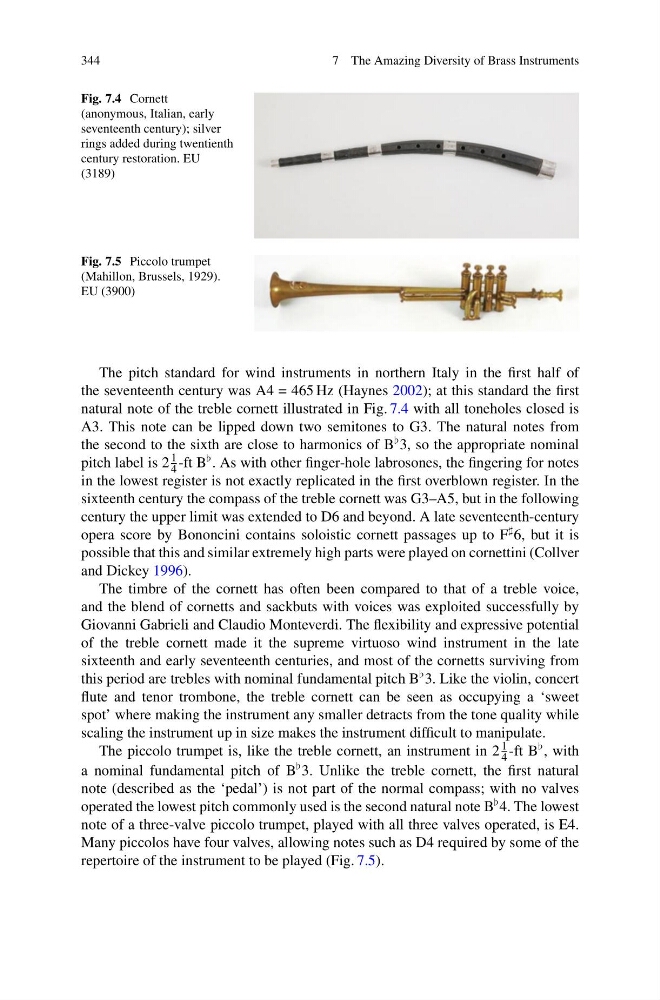
Fig. 7.4 Cornett
(anonymous, Italian, early
seventeenth century); silver
rings added during twentienth
century restoration. EU
(3189)
Fig. 7.5 Piccolo trumpet
(Mahillon, Brussels, 1929).
EU (3900)
The pitch standard for wind instruments in northern Italy in the first half of
the seventeenth century was A4 = 465 Hz (Haynes 2002); at this standard the first
natural note of the treble cornett illustrated in Fig. 7.4 with all toneholes closed is
A3. This note can be lipped down two semitones to G3. The natural notes from
the second to the sixth are close to harmonics of B 3, so the appropriate nominal
pitch label is 2
1
4 -ft B . As with other finger-hole labrosones, the fingering for notes
in the lowest register is not exactly replicated in the first overblown register. In the
sixteenth century the compass of the treble cornett was G3–A5, but in the following
century the upper limit was extended to D6 and beyond. A late seventeenth-century
opera score by Bononcini contains soloistic cornett passages up to F 6, but it is
possible that this and similar extremely high parts were played on cornettini (Collver
and Dickey 1996).
The timbre of the cornett has often been compared to that of a treble voice,
and the blend of cornetts and sackbuts with voices was exploited successfully by
Giovanni Gabrieli and Claudio Monteverdi. The flexibility and expressive potential
of the treble cornett made it the supreme virtuoso wind instrument in the late
sixteenth and early seventeenth centuries, and most of the cornetts surviving from
this period are trebles with nominal fundamental pitch B 3. Like the violin, concert
flute and tenor trombone, the treble cornett can be seen as occupying a ‘sweet
spot’ where making the instrument any smaller detracts from the tone quality while
scaling the instrument up in size makes the instrument difficult to manipulate.
The piccolo trumpet is, like the treble cornett, an instrument in 2
1
4 -ft B , with
a nominal fundamental pitch of B 3. Unlike the treble cornett, the first natural
note (described as the ‘pedal’) is not part of the normal compass; with no valves
operated the lowest pitch commonly used is the second natural note B 4. The lowest
note of a three-valve piccolo trumpet, played with all three valves operated, is E4.
Many piccolos have four valves, allowing notes such as D4 required by some of the
repertoire of the instrument to be played (Fig. 7.5).
7 The Amazing Diversity of Brass Instruments
Fig. 7.4 Cornett
(anonymous, Italian, early
seventeenth century); silver
rings added during twentienth
century restoration. EU
(3189)
Fig. 7.5 Piccolo trumpet
(Mahillon, Brussels, 1929).
EU (3900)
The pitch standard for wind instruments in northern Italy in the first half of
the seventeenth century was A4 = 465 Hz (Haynes 2002); at this standard the first
natural note of the treble cornett illustrated in Fig. 7.4 with all toneholes closed is
A3. This note can be lipped down two semitones to G3. The natural notes from
the second to the sixth are close to harmonics of B 3, so the appropriate nominal
pitch label is 2
1
4 -ft B . As with other finger-hole labrosones, the fingering for notes
in the lowest register is not exactly replicated in the first overblown register. In the
sixteenth century the compass of the treble cornett was G3–A5, but in the following
century the upper limit was extended to D6 and beyond. A late seventeenth-century
opera score by Bononcini contains soloistic cornett passages up to F 6, but it is
possible that this and similar extremely high parts were played on cornettini (Collver
and Dickey 1996).
The timbre of the cornett has often been compared to that of a treble voice,
and the blend of cornetts and sackbuts with voices was exploited successfully by
Giovanni Gabrieli and Claudio Monteverdi. The flexibility and expressive potential
of the treble cornett made it the supreme virtuoso wind instrument in the late
sixteenth and early seventeenth centuries, and most of the cornetts surviving from
this period are trebles with nominal fundamental pitch B 3. Like the violin, concert
flute and tenor trombone, the treble cornett can be seen as occupying a ‘sweet
spot’ where making the instrument any smaller detracts from the tone quality while
scaling the instrument up in size makes the instrument difficult to manipulate.
The piccolo trumpet is, like the treble cornett, an instrument in 2
1
4 -ft B , with
a nominal fundamental pitch of B 3. Unlike the treble cornett, the first natural
note (described as the ‘pedal’) is not part of the normal compass; with no valves
operated the lowest pitch commonly used is the second natural note B 4. The lowest
note of a three-valve piccolo trumpet, played with all three valves operated, is E4.
Many piccolos have four valves, allowing notes such as D4 required by some of the
repertoire of the instrument to be played (Fig. 7.5).