

7.2 The Different Kinds of Brass Instrument
343
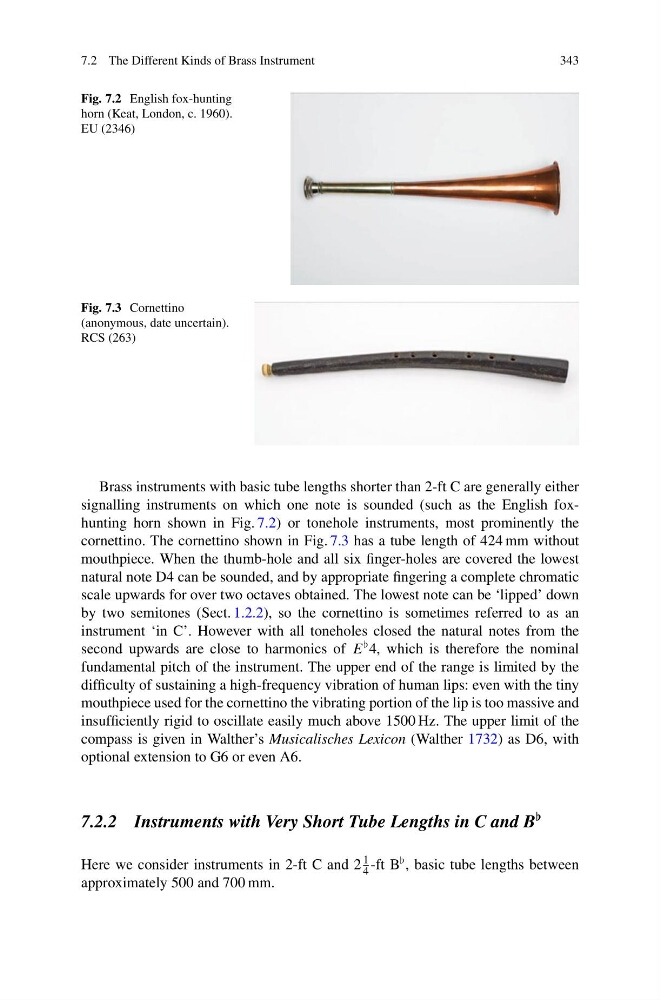
Fig. 7.2 English fox-hunting
horn (Keat, London, c. 1960).
EU (2346)
Fig. 7.3 Cornettino
(anonymous, date uncertain).
RCS (263)
Brass instruments with basic tube lengths shorter than 2-ft C are generally either
signalling instruments on which one note is sounded (such as the English foxhunting horn shown in Fig. 7.2) or tonehole instruments, most prominently the
cornettino. The cornettino shown in Fig. 7.3 has a tube length of 424 mm without
mouthpiece. When the thumb-hole and all six finger-holes are covered the lowest
natural note D4 can be sounded, and by appropriate fingering a complete chromatic
scale upwards for over two octaves obtained. The lowest note can be ‘lipped’ down
by two semitones (Sect. 1.2.2), so the cornettino is sometimes referred to as an
instrument ‘in C’. However with all toneholes closed the natural notes from the
second upwards are close to harmonics of E 4, which is therefore the nominal
fundamental pitch of the instrument. The upper end of the range is limited by the
difficulty of sustaining a high-frequency vibration of human lips: even with the tiny
mouthpiece used for the cornettino the vibrating portion of the lip is too massive and
insufficiently rigid to oscillate easily much above 1500 Hz. The upper limit of the
compass is given in Walther’s Musicalisches Lexicon (Walther 1732) as D6, with
optional extension to G6 or even A6.
7.2.2 Instruments with Very Short Tube Lengths in C and B
Here we consider instruments in 2-ft C and 2
1
4 -ft B , basic tube lengths between
approximately 500 and 700 mm.
343
Fig. 7.2 English fox-hunting
horn (Keat, London, c. 1960).
EU (2346)
Fig. 7.3 Cornettino
(anonymous, date uncertain).
RCS (263)
Brass instruments with basic tube lengths shorter than 2-ft C are generally either
signalling instruments on which one note is sounded (such as the English foxhunting horn shown in Fig. 7.2) or tonehole instruments, most prominently the
cornettino. The cornettino shown in Fig. 7.3 has a tube length of 424 mm without
mouthpiece. When the thumb-hole and all six finger-holes are covered the lowest
natural note D4 can be sounded, and by appropriate fingering a complete chromatic
scale upwards for over two octaves obtained. The lowest note can be ‘lipped’ down
by two semitones (Sect. 1.2.2), so the cornettino is sometimes referred to as an
instrument ‘in C’. However with all toneholes closed the natural notes from the
second upwards are close to harmonics of E 4, which is therefore the nominal
fundamental pitch of the instrument. The upper end of the range is limited by the
difficulty of sustaining a high-frequency vibration of human lips: even with the tiny
mouthpiece used for the cornettino the vibrating portion of the lip is too massive and
insufficiently rigid to oscillate easily much above 1500 Hz. The upper limit of the
compass is given in Walther’s Musicalisches Lexicon (Walther 1732) as D6, with
optional extension to G6 or even A6.
7.2.2 Instruments with Very Short Tube Lengths in C and B
Here we consider instruments in 2-ft C and 2
1
4 -ft B , basic tube lengths between
approximately 500 and 700 mm.