

342
7 The Amazing Diversity of Brass Instruments
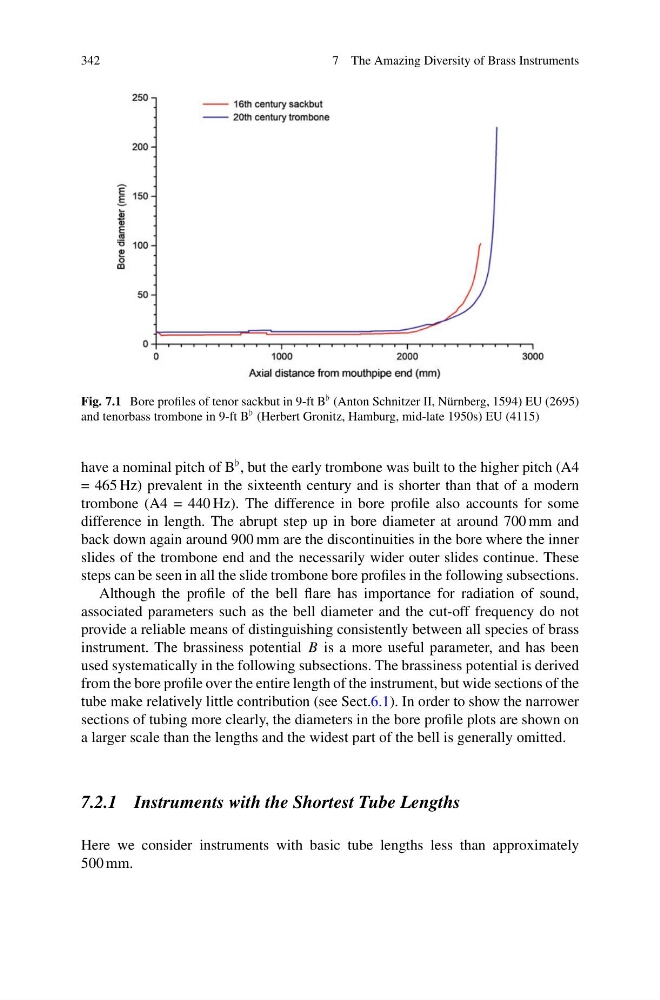
Fig. 7.1 Bore profiles of tenor sackbut in 9-ft B (Anton Schnitzer II, Nürnberg, 1594) EU (2695)
and tenorbass trombone in 9-ft B (Herbert Gronitz, Hamburg, mid-late 1950s) EU (4115)
have a nominal pitch of B , but the early trombone was built to the higher pitch (A4
= 465 Hz) prevalent in the sixteenth century and is shorter than that of a modern
trombone (A4 = 440 Hz). The difference in bore profile also accounts for some
difference in length. The abrupt step up in bore diameter at around 700 mm and
back down again around 900 mm are the discontinuities in the bore where the inner
slides of the trombone end and the necessarily wider outer slides continue. These
steps can be seen in all the slide trombone bore profiles in the following subsections.
Although the profile of the bell flare has importance for radiation of sound,
associated parameters such as the bell diameter and the cut-off frequency do not
provide a reliable means of distinguishing consistently between all species of brass
instrument. The brassiness potential B is a more useful parameter, and has been
used systematically in the following subsections. The brassiness potential is derived
from the bore profile over the entire length of the instrument, but wide sections of the
tube make relatively little contribution (see Sect.6.1). In order to show the narrower
sections of tubing more clearly, the diameters in the bore profile plots are shown on
a larger scale than the lengths and the widest part of the bell is generally omitted.
7.2.1 Instruments with the Shortest Tube Lengths
Here we consider instruments with basic tube lengths less than approximately
500 mm.
7 The Amazing Diversity of Brass Instruments
Fig. 7.1 Bore profiles of tenor sackbut in 9-ft B (Anton Schnitzer II, Nürnberg, 1594) EU (2695)
and tenorbass trombone in 9-ft B (Herbert Gronitz, Hamburg, mid-late 1950s) EU (4115)
have a nominal pitch of B , but the early trombone was built to the higher pitch (A4
= 465 Hz) prevalent in the sixteenth century and is shorter than that of a modern
trombone (A4 = 440 Hz). The difference in bore profile also accounts for some
difference in length. The abrupt step up in bore diameter at around 700 mm and
back down again around 900 mm are the discontinuities in the bore where the inner
slides of the trombone end and the necessarily wider outer slides continue. These
steps can be seen in all the slide trombone bore profiles in the following subsections.
Although the profile of the bell flare has importance for radiation of sound,
associated parameters such as the bell diameter and the cut-off frequency do not
provide a reliable means of distinguishing consistently between all species of brass
instrument. The brassiness potential B is a more useful parameter, and has been
used systematically in the following subsections. The brassiness potential is derived
from the bore profile over the entire length of the instrument, but wide sections of the
tube make relatively little contribution (see Sect.6.1). In order to show the narrower
sections of tubing more clearly, the diameters in the bore profile plots are shown on
a larger scale than the lengths and the widest part of the bell is generally omitted.
7.2.1 Instruments with the Shortest Tube Lengths
Here we consider instruments with basic tube lengths less than approximately
500 mm.