

298
6 Shocks and Surprises: Refining the Elementary Model
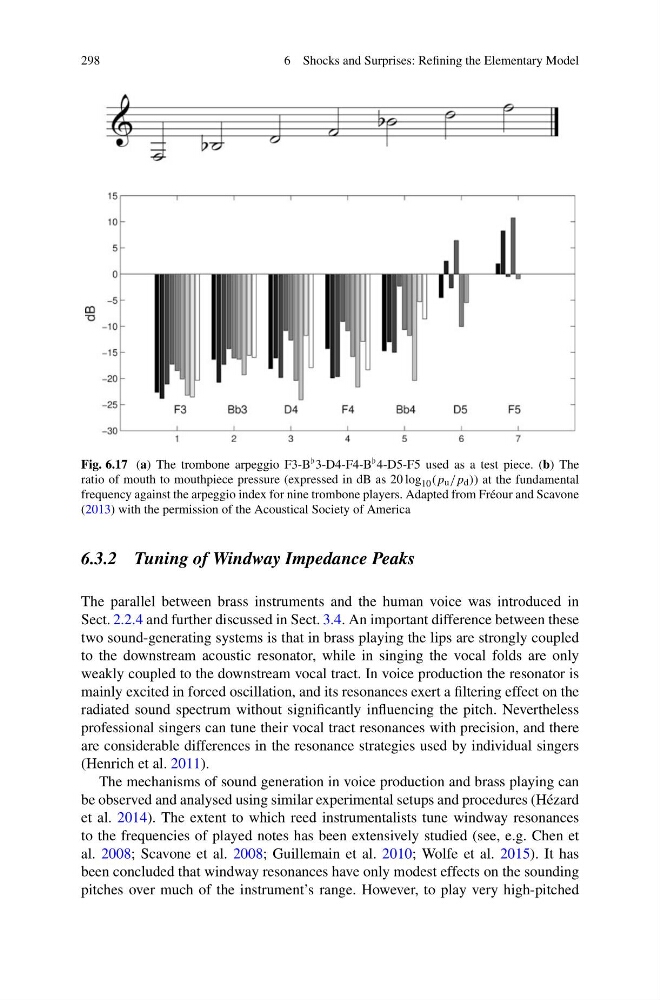
Fig. 6.17 (a) The trombone arpeggio F3-B 3-D4-F4-B 4-D5-F5 used as a test piece. (b) The
ratio of mouth to mouthpiece pressure (expressed in dB as 20 log 10 (p u /p d )) at the fundamental
frequency against the arpeggio index for nine trombone players. Adapted from Fréour and Scavone
(2013) with the permission of the Acoustical Society of America
6.3.2 Tuning of Windway Impedance Peaks
The parallel between brass instruments and the human voice was introduced in
Sect. 2.2.4 and further discussed in Sect. 3.4. An important difference between these
two sound-generating systems is that in brass playing the lips are strongly coupled
to the downstream acoustic resonator, while in singing the vocal folds are only
weakly coupled to the downstream vocal tract. In voice production the resonator is
mainly excited in forced oscillation, and its resonances exert a filtering effect on the
radiated sound spectrum without significantly influencing the pitch. Nevertheless
professional singers can tune their vocal tract resonances with precision, and there
are considerable differences in the resonance strategies used by individual singers
(Henrich et al. 2011).
The mechanisms of sound generation in voice production and brass playing can
be observed and analysed using similar experimental setups and procedures (Hézard
et al. 2014). The extent to which reed instrumentalists tune windway resonances
to the frequencies of played notes has been extensively studied (see, e.g. Chen et
al. 2008; Scavone et al. 2008; Guillemain et al. 2010; Wolfe et al. 2015). It has
been concluded that windway resonances have only modest effects on the sounding
pitches over much of the instrument’s range. However, to play very high-pitched
6 Shocks and Surprises: Refining the Elementary Model
Fig. 6.17 (a) The trombone arpeggio F3-B 3-D4-F4-B 4-D5-F5 used as a test piece. (b) The
ratio of mouth to mouthpiece pressure (expressed in dB as 20 log 10 (p u /p d )) at the fundamental
frequency against the arpeggio index for nine trombone players. Adapted from Fréour and Scavone
(2013) with the permission of the Acoustical Society of America
6.3.2 Tuning of Windway Impedance Peaks
The parallel between brass instruments and the human voice was introduced in
Sect. 2.2.4 and further discussed in Sect. 3.4. An important difference between these
two sound-generating systems is that in brass playing the lips are strongly coupled
to the downstream acoustic resonator, while in singing the vocal folds are only
weakly coupled to the downstream vocal tract. In voice production the resonator is
mainly excited in forced oscillation, and its resonances exert a filtering effect on the
radiated sound spectrum without significantly influencing the pitch. Nevertheless
professional singers can tune their vocal tract resonances with precision, and there
are considerable differences in the resonance strategies used by individual singers
(Henrich et al. 2011).
The mechanisms of sound generation in voice production and brass playing can
be observed and analysed using similar experimental setups and procedures (Hézard
et al. 2014). The extent to which reed instrumentalists tune windway resonances
to the frequencies of played notes has been extensively studied (see, e.g. Chen et
al. 2008; Scavone et al. 2008; Guillemain et al. 2010; Wolfe et al. 2015). It has
been concluded that windway resonances have only modest effects on the sounding
pitches over much of the instrument’s range. However, to play very high-pitched