

6.3 The Player’s Windway
299
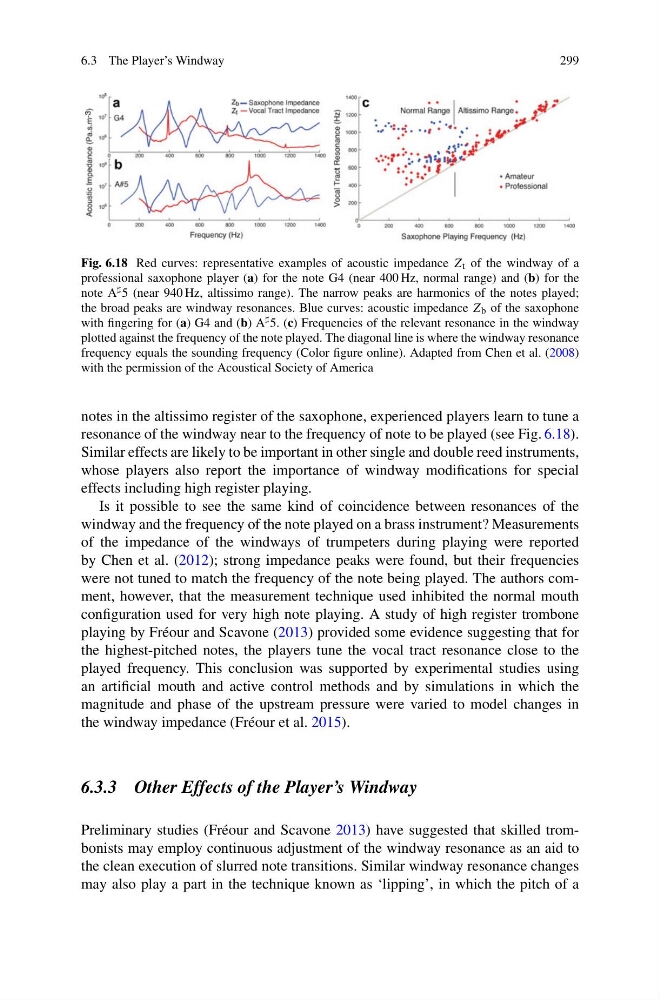
Fig. 6.18 Red curves: representative examples of acoustic impedance Z t of the windway of a
professional saxophone player (a) for the note G4 (near 400 Hz, normal range) and (b) for the
note A 5 (near 940 Hz, altissimo range). The narrow peaks are harmonics of the notes played;
the broad peaks are windway resonances. Blue curves: acoustic impedance Z b of the saxophone
with fingering for (a) G4 and (b) A 5. (c) Frequencies of the relevant resonance in the windway
plotted against the frequency of the note played. The diagonal line is where the windway resonance
frequency equals the sounding frequency (Color figure online). Adapted from Chen et al. (2008)
with the permission of the Acoustical Society of America
notes in the altissimo register of the saxophone, experienced players learn to tune a
resonance of the windway near to the frequency of note to be played (see Fig. 6.18).
Similar effects are likely to be important in other single and double reed instruments,
whose players also report the importance of windway modifications for special
effects including high register playing.
Is it possible to see the same kind of coincidence between resonances of the
windway and the frequency of the note played on a brass instrument? Measurements
of the impedance of the windways of trumpeters during playing were reported
by Chen et al. (2012); strong impedance peaks were found, but their frequencies
were not tuned to match the frequency of the note being played. The authors comment, however, that the measurement technique used inhibited the normal mouth
configuration used for very high note playing. A study of high register trombone
playing by Fréour and Scavone (2013) provided some evidence suggesting that for
the highest-pitched notes, the players tune the vocal tract resonance close to the
played frequency. This conclusion was supported by experimental studies using
an artificial mouth and active control methods and by simulations in which the
magnitude and phase of the upstream pressure were varied to model changes in
the windway impedance (Fréour et al. 2015).
6.3.3 Other Effects of the Player’s Windway
Preliminary studies (Fréour and Scavone 2013) have suggested that skilled trombonists may employ continuous adjustment of the windway resonance as an aid to
the clean execution of slurred note transitions. Similar windway resonance changes
may also play a part in the technique known as ‘lipping’, in which the pitch of a
299
Fig. 6.18 Red curves: representative examples of acoustic impedance Z t of the windway of a
professional saxophone player (a) for the note G4 (near 400 Hz, normal range) and (b) for the
note A 5 (near 940 Hz, altissimo range). The narrow peaks are harmonics of the notes played;
the broad peaks are windway resonances. Blue curves: acoustic impedance Z b of the saxophone
with fingering for (a) G4 and (b) A 5. (c) Frequencies of the relevant resonance in the windway
plotted against the frequency of the note played. The diagonal line is where the windway resonance
frequency equals the sounding frequency (Color figure online). Adapted from Chen et al. (2008)
with the permission of the Acoustical Society of America
notes in the altissimo register of the saxophone, experienced players learn to tune a
resonance of the windway near to the frequency of note to be played (see Fig. 6.18).
Similar effects are likely to be important in other single and double reed instruments,
whose players also report the importance of windway modifications for special
effects including high register playing.
Is it possible to see the same kind of coincidence between resonances of the
windway and the frequency of the note played on a brass instrument? Measurements
of the impedance of the windways of trumpeters during playing were reported
by Chen et al. (2012); strong impedance peaks were found, but their frequencies
were not tuned to match the frequency of the note being played. The authors comment, however, that the measurement technique used inhibited the normal mouth
configuration used for very high note playing. A study of high register trombone
playing by Fréour and Scavone (2013) provided some evidence suggesting that for
the highest-pitched notes, the players tune the vocal tract resonance close to the
played frequency. This conclusion was supported by experimental studies using
an artificial mouth and active control methods and by simulations in which the
magnitude and phase of the upstream pressure were varied to model changes in
the windway impedance (Fréour et al. 2015).
6.3.3 Other Effects of the Player’s Windway
Preliminary studies (Fréour and Scavone 2013) have suggested that skilled trombonists may employ continuous adjustment of the windway resonance as an aid to
the clean execution of slurred note transitions. Similar windway resonance changes
may also play a part in the technique known as ‘lipping’, in which the pitch of a