

286
6 Shocks and Surprises: Refining the Elementary Model
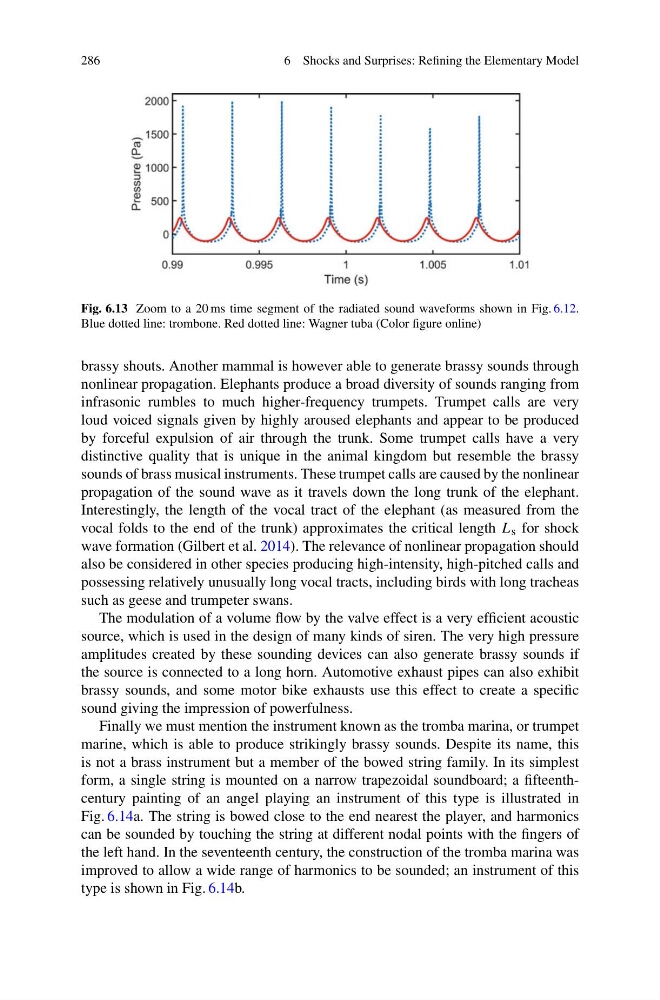
Fig. 6.13 Zoom to a 20 ms time segment of the radiated sound waveforms shown in Fig. 6.12.
Blue dotted line: trombone. Red dotted line: Wagner tuba (Color figure online)
brassy shouts. Another mammal is however able to generate brassy sounds through
nonlinear propagation. Elephants produce a broad diversity of sounds ranging from
infrasonic rumbles to much higher-frequency trumpets. Trumpet calls are very
loud voiced signals given by highly aroused elephants and appear to be produced
by forceful expulsion of air through the trunk. Some trumpet calls have a very
distinctive quality that is unique in the animal kingdom but resemble the brassy
sounds of brass musical instruments. These trumpet calls are caused by the nonlinear
propagation of the sound wave as it travels down the long trunk of the elephant.
Interestingly, the length of the vocal tract of the elephant (as measured from the
vocal folds to the end of the trunk) approximates the critical length L s for shock
wave formation (Gilbert et al. 2014). The relevance of nonlinear propagation should
also be considered in other species producing high-intensity, high-pitched calls and
possessing relatively unusually long vocal tracts, including birds with long tracheas
such as geese and trumpeter swans.
The modulation of a volume flow by the valve effect is a very efficient acoustic
source, which is used in the design of many kinds of siren. The very high pressure
amplitudes created by these sounding devices can also generate brassy sounds if
the source is connected to a long horn. Automotive exhaust pipes can also exhibit
brassy sounds, and some motor bike exhausts use this effect to create a specific
sound giving the impression of powerfulness.
Finally we must mention the instrument known as the tromba marina, or trumpet
marine, which is able to produce strikingly brassy sounds. Despite its name, this
is not a brass instrument but a member of the bowed string family. In its simplest
form, a single string is mounted on a narrow trapezoidal soundboard; a fifteenthcentury painting of an angel playing an instrument of this type is illustrated in
Fig. 6.14a. The string is bowed close to the end nearest the player, and harmonics
can be sounded by touching the string at different nodal points with the fingers of
the left hand. In the seventeenth century, the construction of the tromba marina was
improved to allow a wide range of harmonics to be sounded; an instrument of this
type is shown in Fig. 6.14b.
6 Shocks and Surprises: Refining the Elementary Model
Fig. 6.13 Zoom to a 20 ms time segment of the radiated sound waveforms shown in Fig. 6.12.
Blue dotted line: trombone. Red dotted line: Wagner tuba (Color figure online)
brassy shouts. Another mammal is however able to generate brassy sounds through
nonlinear propagation. Elephants produce a broad diversity of sounds ranging from
infrasonic rumbles to much higher-frequency trumpets. Trumpet calls are very
loud voiced signals given by highly aroused elephants and appear to be produced
by forceful expulsion of air through the trunk. Some trumpet calls have a very
distinctive quality that is unique in the animal kingdom but resemble the brassy
sounds of brass musical instruments. These trumpet calls are caused by the nonlinear
propagation of the sound wave as it travels down the long trunk of the elephant.
Interestingly, the length of the vocal tract of the elephant (as measured from the
vocal folds to the end of the trunk) approximates the critical length L s for shock
wave formation (Gilbert et al. 2014). The relevance of nonlinear propagation should
also be considered in other species producing high-intensity, high-pitched calls and
possessing relatively unusually long vocal tracts, including birds with long tracheas
such as geese and trumpeter swans.
The modulation of a volume flow by the valve effect is a very efficient acoustic
source, which is used in the design of many kinds of siren. The very high pressure
amplitudes created by these sounding devices can also generate brassy sounds if
the source is connected to a long horn. Automotive exhaust pipes can also exhibit
brassy sounds, and some motor bike exhausts use this effect to create a specific
sound giving the impression of powerfulness.
Finally we must mention the instrument known as the tromba marina, or trumpet
marine, which is able to produce strikingly brassy sounds. Despite its name, this
is not a brass instrument but a member of the bowed string family. In its simplest
form, a single string is mounted on a narrow trapezoidal soundboard; a fifteenthcentury painting of an angel playing an instrument of this type is illustrated in
Fig. 6.14a. The string is bowed close to the end nearest the player, and harmonics
can be sounded by touching the string at different nodal points with the fingers of
the left hand. In the seventeenth century, the construction of the tromba marina was
improved to allow a wide range of harmonics to be sounded; an instrument of this
type is shown in Fig. 6.14b.