

6.2 Going Further: Nonlinear Propagation
287
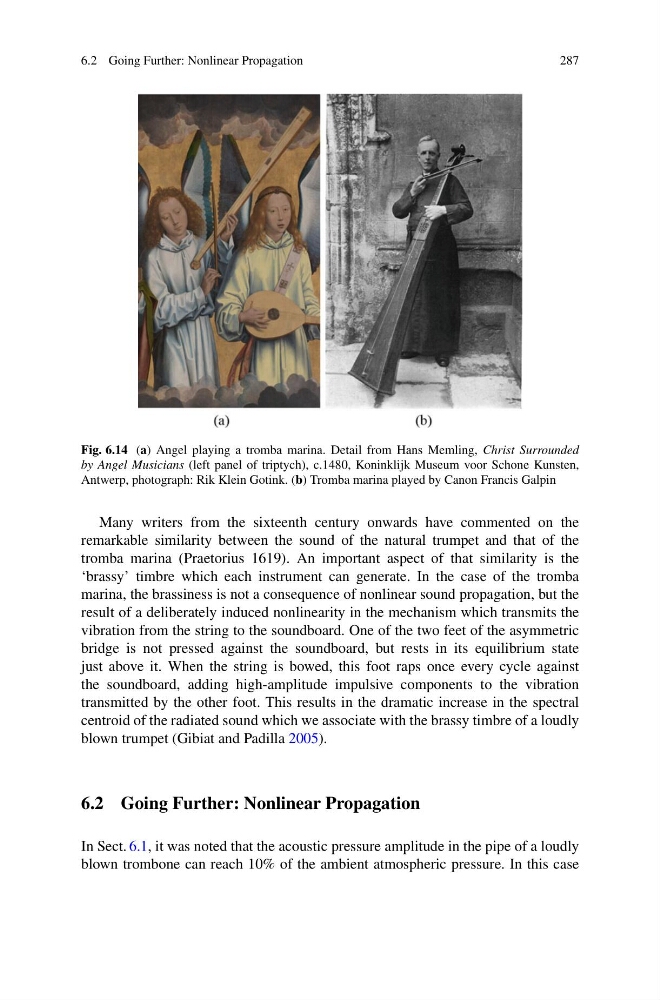
Fig. 6.14 (a) Angel playing a tromba marina. Detail from Hans Memling, Christ Surrounded
by Angel Musicians (left panel of triptych), c.1480, Koninklijk Museum voor Schone Kunsten,
Antwerp, photograph: Rik Klein Gotink. (b) Tromba marina played by Canon Francis Galpin
Many writers from the sixteenth century onwards have commented on the
remarkable similarity between the sound of the natural trumpet and that of the
tromba marina (Praetorius 1619). An important aspect of that similarity is the
‘brassy’ timbre which each instrument can generate. In the case of the tromba
marina, the brassiness is not a consequence of nonlinear sound propagation, but the
result of a deliberately induced nonlinearity in the mechanism which transmits the
vibration from the string to the soundboard. One of the two feet of the asymmetric
bridge is not pressed against the soundboard, but rests in its equilibrium state
just above it. When the string is bowed, this foot raps once every cycle against
the soundboard, adding high-amplitude impulsive components to the vibration
transmitted by the other foot. This results in the dramatic increase in the spectral
centroid of the radiated sound which we associate with the brassy timbre of a loudly
blown trumpet (Gibiat and Padilla 2005).
6.2 Going Further: Nonlinear Propagation
In Sect. 6.1, it was noted that the acoustic pressure amplitude in the pipe of a loudly
blown trombone can reach 10% of the ambient atmospheric pressure. In this case
287
Fig. 6.14 (a) Angel playing a tromba marina. Detail from Hans Memling, Christ Surrounded
by Angel Musicians (left panel of triptych), c.1480, Koninklijk Museum voor Schone Kunsten,
Antwerp, photograph: Rik Klein Gotink. (b) Tromba marina played by Canon Francis Galpin
Many writers from the sixteenth century onwards have commented on the
remarkable similarity between the sound of the natural trumpet and that of the
tromba marina (Praetorius 1619). An important aspect of that similarity is the
‘brassy’ timbre which each instrument can generate. In the case of the tromba
marina, the brassiness is not a consequence of nonlinear sound propagation, but the
result of a deliberately induced nonlinearity in the mechanism which transmits the
vibration from the string to the soundboard. One of the two feet of the asymmetric
bridge is not pressed against the soundboard, but rests in its equilibrium state
just above it. When the string is bowed, this foot raps once every cycle against
the soundboard, adding high-amplitude impulsive components to the vibration
transmitted by the other foot. This results in the dramatic increase in the spectral
centroid of the radiated sound which we associate with the brassy timbre of a loudly
blown trumpet (Gibiat and Padilla 2005).
6.2 Going Further: Nonlinear Propagation
In Sect. 6.1, it was noted that the acoustic pressure amplitude in the pipe of a loudly
blown trombone can reach 10% of the ambient atmospheric pressure. In this case