

6.1 Why Brass Instruments Sound Brassy
285
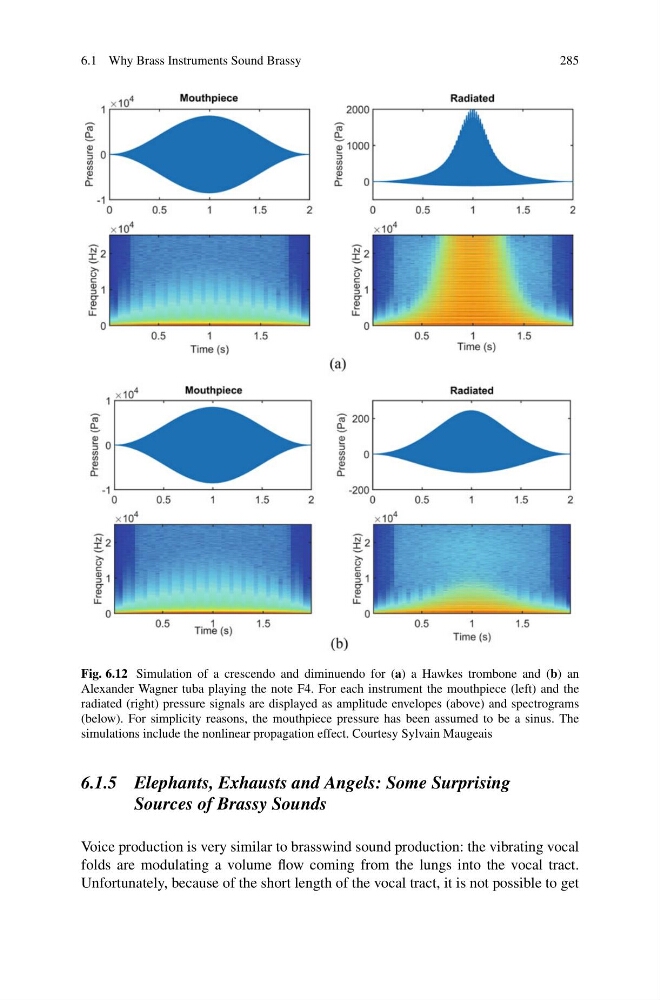
Fig. 6.12 Simulation of a crescendo and diminuendo for (a) a Hawkes trombone and (b) an
Alexander Wagner tuba playing the note F4. For each instrument the mouthpiece (left) and the
radiated (right) pressure signals are displayed as amplitude envelopes (above) and spectrograms
(below). For simplicity reasons, the mouthpiece pressure has been assumed to be a sinus. The
simulations include the nonlinear propagation effect. Courtesy Sylvain Maugeais
6.1.5 Elephants, Exhausts and Angels: Some Surprising
Sources of Brassy Sounds
Voice production is very similar to brasswind sound production: the vibrating vocal
folds are modulating a volume flow coming from the lungs into the vocal tract.
Unfortunately, because of the short length of the vocal tract, it is not possible to get
285
Fig. 6.12 Simulation of a crescendo and diminuendo for (a) a Hawkes trombone and (b) an
Alexander Wagner tuba playing the note F4. For each instrument the mouthpiece (left) and the
radiated (right) pressure signals are displayed as amplitude envelopes (above) and spectrograms
(below). For simplicity reasons, the mouthpiece pressure has been assumed to be a sinus. The
simulations include the nonlinear propagation effect. Courtesy Sylvain Maugeais
6.1.5 Elephants, Exhausts and Angels: Some Surprising
Sources of Brassy Sounds
Voice production is very similar to brasswind sound production: the vibrating vocal
folds are modulating a volume flow coming from the lungs into the vocal tract.
Unfortunately, because of the short length of the vocal tract, it is not possible to get