

6.1 Why Brass Instruments Sound Brassy
277
Fig. 6.6 Two plastic
hosepipe trumpets. Left: tube
length 3 m. Right: tube length
0.3 m
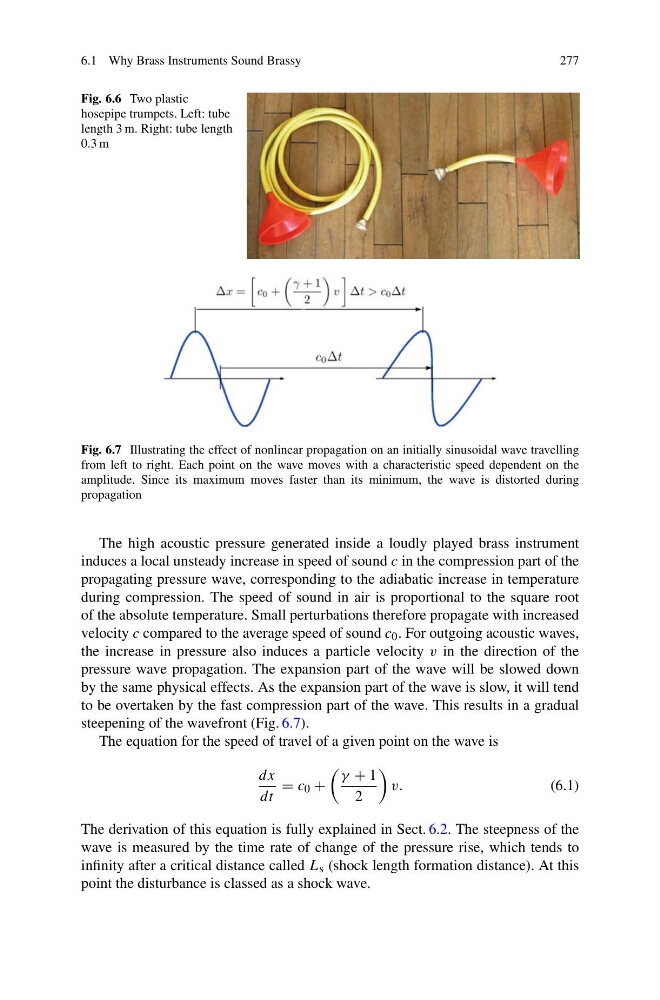
Fig. 6.7 Illustrating the effect of nonlinear propagation on an initially sinusoidal wave travelling
from left to right. Each point on the wave moves with a characteristic speed dependent on the
amplitude. Since its maximum moves faster than its minimum, the wave is distorted during
propagation
The high acoustic pressure generated inside a loudly played brass instrument
induces a local unsteady increase in speed of sound c in the compression part of the
propagating pressure wave, corresponding to the adiabatic increase in temperature
during compression. The speed of sound in air is proportional to the square root
of the absolute temperature. Small perturbations therefore propagate with increased
velocity c compared to the average speed of sound c 0 . For outgoing acoustic waves,
the increase in pressure also induces a particle velocity v in the direction of the
pressure wave propagation. The expansion part of the wave will be slowed down
by the same physical effects. As the expansion part of the wave is slow, it will tend
to be overtaken by the fast compression part of the wave. This results in a gradual
steepening of the wavefront (Fig. 6.7).
The equation for the speed of travel of a given point on the wave is
dx
dt
= c 0 +
γ + 1
2
v.
(6.1)
The derivation of this equation is fully explained in Sect. 6.2. The steepness of the
wave is measured by the time rate of change of the pressure rise, which tends to
infinity after a critical distance called L s (shock length formation distance). At this
point the disturbance is classed as a shock wave.
277
Fig. 6.6 Two plastic
hosepipe trumpets. Left: tube
length 3 m. Right: tube length
0.3 m
Fig. 6.7 Illustrating the effect of nonlinear propagation on an initially sinusoidal wave travelling
from left to right. Each point on the wave moves with a characteristic speed dependent on the
amplitude. Since its maximum moves faster than its minimum, the wave is distorted during
propagation
The high acoustic pressure generated inside a loudly played brass instrument
induces a local unsteady increase in speed of sound c in the compression part of the
propagating pressure wave, corresponding to the adiabatic increase in temperature
during compression. The speed of sound in air is proportional to the square root
of the absolute temperature. Small perturbations therefore propagate with increased
velocity c compared to the average speed of sound c 0 . For outgoing acoustic waves,
the increase in pressure also induces a particle velocity v in the direction of the
pressure wave propagation. The expansion part of the wave will be slowed down
by the same physical effects. As the expansion part of the wave is slow, it will tend
to be overtaken by the fast compression part of the wave. This results in a gradual
steepening of the wavefront (Fig. 6.7).
The equation for the speed of travel of a given point on the wave is
dx
dt
= c 0 +
γ + 1
2
v.
(6.1)
The derivation of this equation is fully explained in Sect. 6.2. The steepness of the
wave is measured by the time rate of change of the pressure rise, which tends to
infinity after a critical distance called L s (shock length formation distance). At this
point the disturbance is classed as a shock wave.