

5.4 Going Further: From Linear Stability Analysis to Oscillation Regimes
269
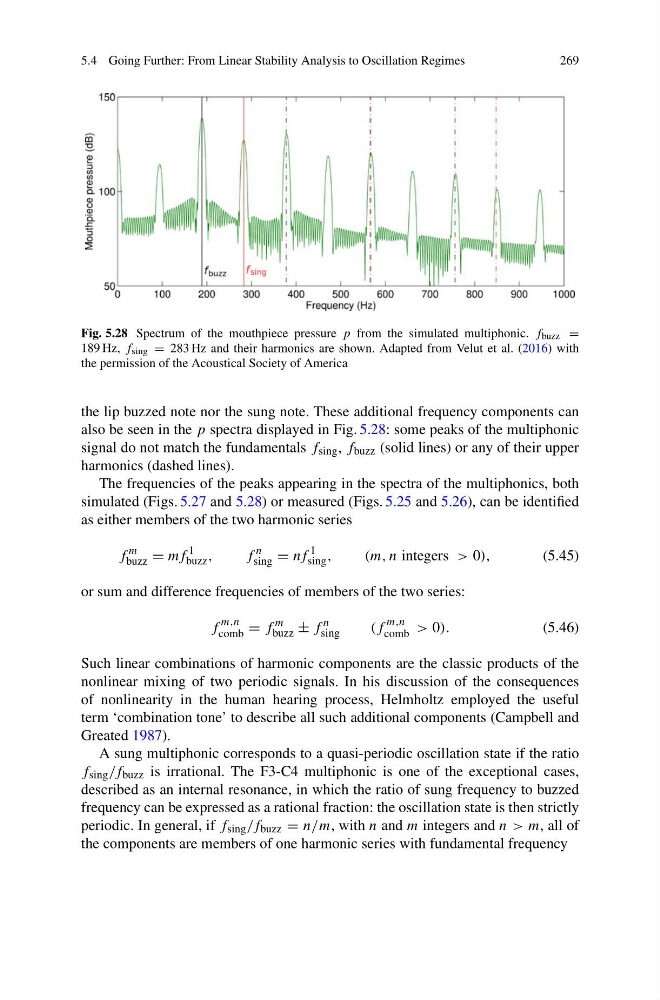
Fig. 5.28 Spectrum of the mouthpiece pressure p from the simulated multiphonic. f buzz =
189 Hz, f sing = 283 Hz and their harmonics are shown. Adapted from Velut et al. (2016) with
the permission of the Acoustical Society of America
the lip buzzed note nor the sung note. These additional frequency components can
also be seen in the p spectra displayed in Fig. 5.28: some peaks of the multiphonic
signal do not match the fundamentals f sing , f buzz (solid lines) or any of their upper
harmonics (dashed lines).
The frequencies of the peaks appearing in the spectra of the multiphonics, both
simulated (Figs. 5.27 and 5.28) or measured (Figs. 5.25 and 5.26), can be identified
as either members of the two harmonic series
f
m
buzz = mf
1
buzz ,
f
n
sing = nf
1
sing ,
(m,nintegers > 0),
(5.45)
or sum and difference frequencies of members of the two series:
f
m,n
comb = f
m
buzz ± f
n
sing
(f
m,n
comb > 0).
(5.46)
Such linear combinations of harmonic components are the classic products of the
nonlinear mixing of two periodic signals. In his discussion of the consequences
of nonlinearity in the human hearing process, Helmholtz employed the useful
term ‘combination tone’ to describe all such additional components (Campbell and
Greated 1987).
A sung multiphonic corresponds to a quasi-periodic oscillation state if the ratio
f sing /f buzz is irrational. The F3-C4 multiphonic is one of the exceptional cases,
described as an internal resonance, in which the ratio of sung frequency to buzzed
frequency can be expressed as a rational fraction: the oscillation state is then strictly
periodic. In general, if f sing /f buzz = n/m, with n and m integers and n > m, all of
the components are members of one harmonic series with fundamental frequency
269
Fig. 5.28 Spectrum of the mouthpiece pressure p from the simulated multiphonic. f buzz =
189 Hz, f sing = 283 Hz and their harmonics are shown. Adapted from Velut et al. (2016) with
the permission of the Acoustical Society of America
the lip buzzed note nor the sung note. These additional frequency components can
also be seen in the p spectra displayed in Fig. 5.28: some peaks of the multiphonic
signal do not match the fundamentals f sing , f buzz (solid lines) or any of their upper
harmonics (dashed lines).
The frequencies of the peaks appearing in the spectra of the multiphonics, both
simulated (Figs. 5.27 and 5.28) or measured (Figs. 5.25 and 5.26), can be identified
as either members of the two harmonic series
f
m
buzz = mf
1
buzz ,
f
n
sing = nf
1
sing ,
(m,nintegers > 0),
(5.45)
or sum and difference frequencies of members of the two series:
f
m,n
comb = f
m
buzz ± f
n
sing
(f
m,n
comb > 0).
(5.46)
Such linear combinations of harmonic components are the classic products of the
nonlinear mixing of two periodic signals. In his discussion of the consequences
of nonlinearity in the human hearing process, Helmholtz employed the useful
term ‘combination tone’ to describe all such additional components (Campbell and
Greated 1987).
A sung multiphonic corresponds to a quasi-periodic oscillation state if the ratio
f sing /f buzz is irrational. The F3-C4 multiphonic is one of the exceptional cases,
described as an internal resonance, in which the ratio of sung frequency to buzzed
frequency can be expressed as a rational fraction: the oscillation state is then strictly
periodic. In general, if f sing /f buzz = n/m, with n and m integers and n > m, all of
the components are members of one harmonic series with fundamental frequency