

270
5 Blow That Horn: An Elementary Model of Brass Playing
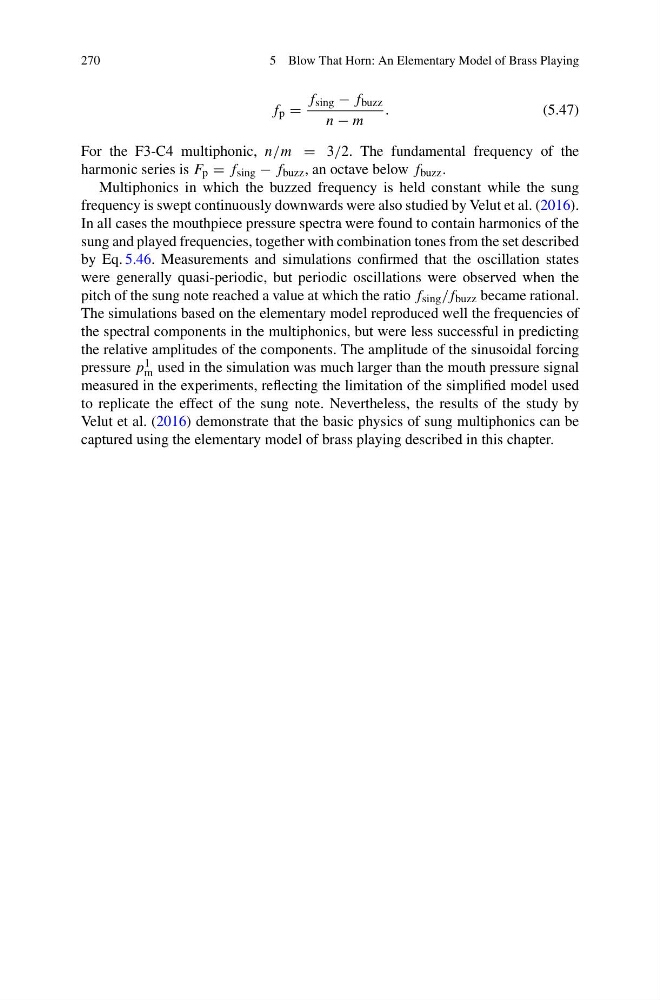
f p =
f sing − f buzz
n − m
.
(5.47)
For the F3-C4 multiphonic, n/m = 3/2. The fundamental frequency of the
harmonic series is F p = f sing − f buzz , an octave below f buzz .
Multiphonics in which the buzzed frequency is held constant while the sung
frequency is swept continuously downwards were also studied by Velut et al. (2016).
In all cases the mouthpiece pressure spectra were found to contain harmonics of the
sung and played frequencies, together with combination tones from the set described
by Eq. 5.46. Measurements and simulations confirmed that the oscillation states
were generally quasi-periodic, but periodic oscillations were observed when the
pitch of the sung note reached a value at which the ratio f sing /f buzz became rational.
The simulations based on the elementary model reproduced well the frequencies of
the spectral components in the multiphonics, but were less successful in predicting
the relative amplitudes of the components. The amplitude of the sinusoidal forcing
pressure p 1
m used in the simulation was much larger than the mouth pressure signal
measured in the experiments, reflecting the limitation of the simplified model used
to replicate the effect of the sung note. Nevertheless, the results of the study by
Velut et al. (2016) demonstrate that the basic physics of sung multiphonics can be
captured using the elementary model of brass playing described in this chapter.
5 Blow That Horn: An Elementary Model of Brass Playing
f p =
f sing − f buzz
n − m
.
(5.47)
For the F3-C4 multiphonic, n/m = 3/2. The fundamental frequency of the
harmonic series is F p = f sing − f buzz , an octave below f buzz .
Multiphonics in which the buzzed frequency is held constant while the sung
frequency is swept continuously downwards were also studied by Velut et al. (2016).
In all cases the mouthpiece pressure spectra were found to contain harmonics of the
sung and played frequencies, together with combination tones from the set described
by Eq. 5.46. Measurements and simulations confirmed that the oscillation states
were generally quasi-periodic, but periodic oscillations were observed when the
pitch of the sung note reached a value at which the ratio f sing /f buzz became rational.
The simulations based on the elementary model reproduced well the frequencies of
the spectral components in the multiphonics, but were less successful in predicting
the relative amplitudes of the components. The amplitude of the sinusoidal forcing
pressure p 1
m used in the simulation was much larger than the mouth pressure signal
measured in the experiments, reflecting the limitation of the simplified model used
to replicate the effect of the sung note. Nevertheless, the results of the study by
Velut et al. (2016) demonstrate that the basic physics of sung multiphonics can be
captured using the elementary model of brass playing described in this chapter.