

266
5 Blow That Horn: An Elementary Model of Brass Playing
harmonics corresponding to the higher pitch are sufficiently strong to maintain the
perception of a distinct sound at that pitch.
The choice of pitches in lip multiphonics is restricted by the necessity of
identifying suitable quasi-periodic states. This restriction does not apply to sung
multiphonics, since in principle any sung pitch can be combined with any played
note. Successful execution of a sung multiphonic clearly requires good control of
simultaneous vocal fold and lip vibrations. Depending on the voice range of the
performer, the pitch of the sung note can be chosen to be either above or below that
of the lip vibration.
It is not obvious that our elementary model of brass playing is capable of describing the production of a sung multiphonic. A full scientific treatment would involve
discussion of the mutual interactions of two pressure controlled valves (the vocal
folds and the lips) and two multimode acoustical resonators (the player’s windway
and the instrument air column). To explore the applicability of the elementary
model to sung multiphonics, a study including both experimental measurements on
trombone players and numerical simulations was undertaken by Velut et al. (2016).
One of the multiphonics examined, which requires the player to sound the pitch F3
using the lips while singing the pitch C4, is described as the ‘F3-C4 multiphonic’.
This is one of the most common multiphonics played by trombonists and is the first
exercise presented in the manual on sung multiphonics written by Sluchin (1995). In
physical terms, the player buzzes the lips at the frequency f buzz of the third natural
note of the trombone while simultaneously causing the vocal folds to vibrate at a
frequency f sing = 1.5f buzz .
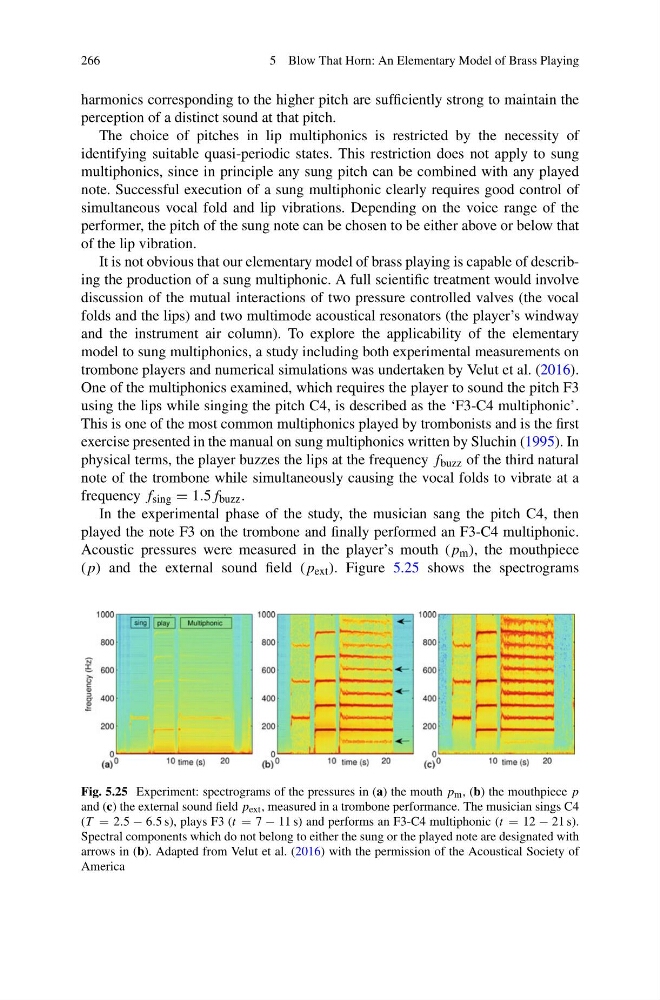
In the experimental phase of the study, the musician sang the pitch C4, then
played the note F3 on the trombone and finally performed an F3-C4 multiphonic.
Acoustic pressures were measured in the player’s mouth (p m ), the mouthpiece
(p) and the external sound field (p ext ). Figure 5.25 shows the spectrograms
Fig. 5.25 Experiment: spectrograms of the pressures in (a) the mouth p m , (b) the mouthpiece p
and (c) the external sound field p ext , measured in a trombone performance. The musician sings C4
(T = 2.5 − 6.5 s), plays F3 (t = 7 − 11 s) and performs an F3-C4 multiphonic (t = 12 − 21 s).
Spectral components which do not belong to either the sung or the played note are designated with
arrows in (b). Adapted from Velut et al. (2016) with the permission of the Acoustical Society of
America
5 Blow That Horn: An Elementary Model of Brass Playing
harmonics corresponding to the higher pitch are sufficiently strong to maintain the
perception of a distinct sound at that pitch.
The choice of pitches in lip multiphonics is restricted by the necessity of
identifying suitable quasi-periodic states. This restriction does not apply to sung
multiphonics, since in principle any sung pitch can be combined with any played
note. Successful execution of a sung multiphonic clearly requires good control of
simultaneous vocal fold and lip vibrations. Depending on the voice range of the
performer, the pitch of the sung note can be chosen to be either above or below that
of the lip vibration.
It is not obvious that our elementary model of brass playing is capable of describing the production of a sung multiphonic. A full scientific treatment would involve
discussion of the mutual interactions of two pressure controlled valves (the vocal
folds and the lips) and two multimode acoustical resonators (the player’s windway
and the instrument air column). To explore the applicability of the elementary
model to sung multiphonics, a study including both experimental measurements on
trombone players and numerical simulations was undertaken by Velut et al. (2016).
One of the multiphonics examined, which requires the player to sound the pitch F3
using the lips while singing the pitch C4, is described as the ‘F3-C4 multiphonic’.
This is one of the most common multiphonics played by trombonists and is the first
exercise presented in the manual on sung multiphonics written by Sluchin (1995). In
physical terms, the player buzzes the lips at the frequency f buzz of the third natural
note of the trombone while simultaneously causing the vocal folds to vibrate at a
frequency f sing = 1.5f buzz .
In the experimental phase of the study, the musician sang the pitch C4, then
played the note F3 on the trombone and finally performed an F3-C4 multiphonic.
Acoustic pressures were measured in the player’s mouth (p m ), the mouthpiece
(p) and the external sound field (p ext ). Figure 5.25 shows the spectrograms
Fig. 5.25 Experiment: spectrograms of the pressures in (a) the mouth p m , (b) the mouthpiece p
and (c) the external sound field p ext , measured in a trombone performance. The musician sings C4
(T = 2.5 − 6.5 s), plays F3 (t = 7 − 11 s) and performs an F3-C4 multiphonic (t = 12 − 21 s).
Spectral components which do not belong to either the sung or the played note are designated with
arrows in (b). Adapted from Velut et al. (2016) with the permission of the Acoustical Society of
America