

5.4 Going Further: From Linear Stability Analysis to Oscillation Regimes
265
on quasi-periodic regimes corresponding to specific choices of embouchure and/or
fingering (Gibiat and Castellengo 2000). Sounds of this type on brass instruments
are described as ‘lip multiphonics’. Brass instrument players can also produce
multiphonic sounds by singing while simultaneously buzzing the lips (Campbell
and Greated 1987; Sluchin 1995). Sounds in this second category are described as
‘sung multiphonics’. Didgeridoo players make extensive use of sung multiphonics
in their distinctive playing style (Wolfe and Smith 2008).
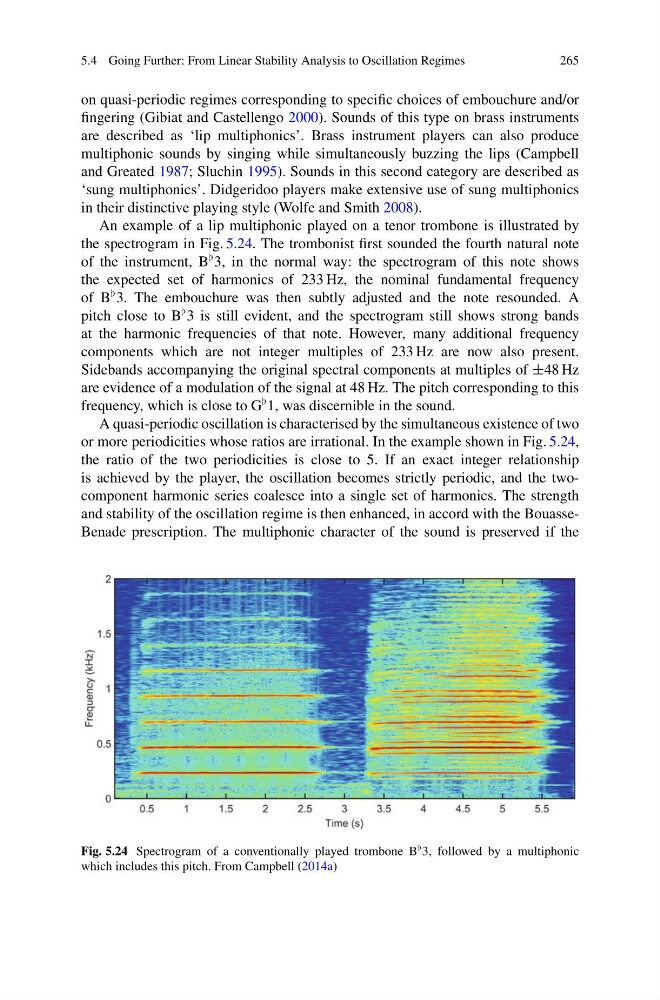
An example of a lip multiphonic played on a tenor trombone is illustrated by
the spectrogram in Fig. 5.24. The trombonist first sounded the fourth natural note
of the instrument, B 3, in the normal way: the spectrogram of this note shows
the expected set of harmonics of 233 Hz, the nominal fundamental frequency
of B 3. The embouchure was then subtly adjusted and the note resounded. A
pitch close to B 3 is still evident, and the spectrogram still shows strong bands
at the harmonic frequencies of that note. However, many additional frequency
components which are not integer multiples of 233 Hz are now also present.
Sidebands accompanying the original spectral components at multiples of ±48 Hz
are evidence of a modulation of the signal at 48 Hz. The pitch corresponding to this
frequency, which is close to G 1, was discernible in the sound.
A quasi-periodic oscillation is characterised by the simultaneous existence of two
or more periodicities whose ratios are irrational. In the example shown in Fig. 5.24,
the ratio of the two periodicities is close to 5. If an exact integer relationship
is achieved by the player, the oscillation becomes strictly periodic, and the twocomponent harmonic series coalesce into a single set of harmonics. The strength
and stability of the oscillation regime is then enhanced, in accord with the BouasseBenade prescription. The multiphonic character of the sound is preserved if the
Fig. 5.24 Spectrogram of a conventionally played trombone B 3, followed by a multiphonic
which includes this pitch. From Campbell (2014a)
265
on quasi-periodic regimes corresponding to specific choices of embouchure and/or
fingering (Gibiat and Castellengo 2000). Sounds of this type on brass instruments
are described as ‘lip multiphonics’. Brass instrument players can also produce
multiphonic sounds by singing while simultaneously buzzing the lips (Campbell
and Greated 1987; Sluchin 1995). Sounds in this second category are described as
‘sung multiphonics’. Didgeridoo players make extensive use of sung multiphonics
in their distinctive playing style (Wolfe and Smith 2008).
An example of a lip multiphonic played on a tenor trombone is illustrated by
the spectrogram in Fig. 5.24. The trombonist first sounded the fourth natural note
of the instrument, B 3, in the normal way: the spectrogram of this note shows
the expected set of harmonics of 233 Hz, the nominal fundamental frequency
of B 3. The embouchure was then subtly adjusted and the note resounded. A
pitch close to B 3 is still evident, and the spectrogram still shows strong bands
at the harmonic frequencies of that note. However, many additional frequency
components which are not integer multiples of 233 Hz are now also present.
Sidebands accompanying the original spectral components at multiples of ±48 Hz
are evidence of a modulation of the signal at 48 Hz. The pitch corresponding to this
frequency, which is close to G 1, was discernible in the sound.
A quasi-periodic oscillation is characterised by the simultaneous existence of two
or more periodicities whose ratios are irrational. In the example shown in Fig. 5.24,
the ratio of the two periodicities is close to 5. If an exact integer relationship
is achieved by the player, the oscillation becomes strictly periodic, and the twocomponent harmonic series coalesce into a single set of harmonics. The strength
and stability of the oscillation regime is then enhanced, in accord with the BouasseBenade prescription. The multiphonic character of the sound is preserved if the
Fig. 5.24 Spectrogram of a conventionally played trombone B 3, followed by a multiphonic
which includes this pitch. From Campbell (2014a)