

242
5 Blow That Horn: An Elementary Model of Brass Playing
of the second term on the left-hand side of each equation. For the simple harmonic
oscillator, ω 1
dp(t)
dt
is multiplied by the constant −γ ; if γ is negative the amplitude
is exponentially falling, while if γ is positive, it is exponentially rising. For the Van
der Pol oscillator, on the other hand, ω 1
dp(t)
dt
is multiplied by the function
γ −
p(t)
p ref
2
,
which contains a nonlinear term proportional to the square of the unknown variable
p(t). If γ is negative the amplitude is again falling. If γ is positive the amplitude
increases for small values of p(t), but once (p(t)/p ref ) 2 is higher than γ , the term
becomes dissipative, and the amplitude starts to fall again. As a consequence, stable
periodic self-sustained oscillations can be obtained in a permanent regime.
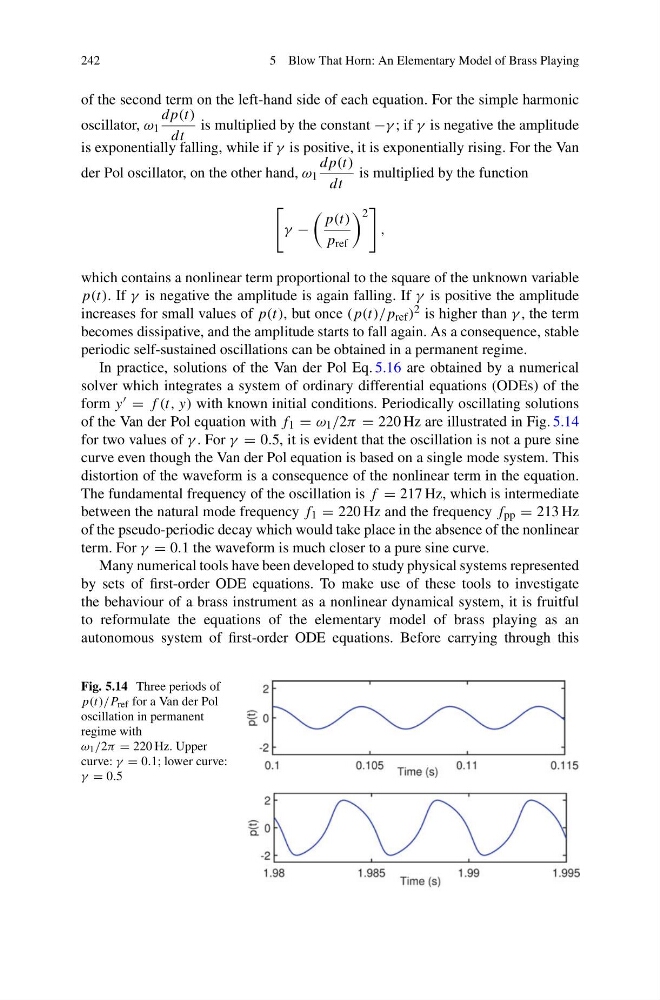
In practice, solutions of the Van der Pol Eq. 5.16 are obtained by a numerical
solver which integrates a system of ordinary differential equations (ODEs) of the
form y = f (t, y) with known initial conditions. Periodically oscillating solutions
of the Van der Pol equation with f 1 = ω 1 /2π = 220 Hz are illustrated in Fig. 5.14
for two values of γ . For γ = 0.5, it is evident that the oscillation is not a pure sine
curve even though the Van der Pol equation is based on a single mode system. This
distortion of the waveform is a consequence of the nonlinear term in the equation.
The fundamental frequency of the oscillation is f = 217 Hz, which is intermediate
between the natural mode frequency f 1 = 220 Hz and the frequency f pp = 213 Hz
of the pseudo-periodic decay which would take place in the absence of the nonlinear
term. For γ = 0.1 the waveform is much closer to a pure sine curve.
Many numerical tools have been developed to study physical systems represented
by sets of first-order ODE equations. To make use of these tools to investigate
the behaviour of a brass instrument as a nonlinear dynamical system, it is fruitful
to reformulate the equations of the elementary model of brass playing as an
autonomous system of first-order ODE equations. Before carrying through this
Fig. 5.14 Three periods of
p(t)/P ref for a Van der Pol
oscillation in permanent
regime with
ω 1 /2π = 220 Hz. Upper
curve: γ = 0.1; lower curve:
γ = 0.5
5 Blow That Horn: An Elementary Model of Brass Playing
of the second term on the left-hand side of each equation. For the simple harmonic
oscillator, ω 1
dp(t)
dt
is multiplied by the constant −γ ; if γ is negative the amplitude
is exponentially falling, while if γ is positive, it is exponentially rising. For the Van
der Pol oscillator, on the other hand, ω 1
dp(t)
dt
is multiplied by the function
γ −
p(t)
p ref
2
,
which contains a nonlinear term proportional to the square of the unknown variable
p(t). If γ is negative the amplitude is again falling. If γ is positive the amplitude
increases for small values of p(t), but once (p(t)/p ref ) 2 is higher than γ , the term
becomes dissipative, and the amplitude starts to fall again. As a consequence, stable
periodic self-sustained oscillations can be obtained in a permanent regime.
In practice, solutions of the Van der Pol Eq. 5.16 are obtained by a numerical
solver which integrates a system of ordinary differential equations (ODEs) of the
form y = f (t, y) with known initial conditions. Periodically oscillating solutions
of the Van der Pol equation with f 1 = ω 1 /2π = 220 Hz are illustrated in Fig. 5.14
for two values of γ . For γ = 0.5, it is evident that the oscillation is not a pure sine
curve even though the Van der Pol equation is based on a single mode system. This
distortion of the waveform is a consequence of the nonlinear term in the equation.
The fundamental frequency of the oscillation is f = 217 Hz, which is intermediate
between the natural mode frequency f 1 = 220 Hz and the frequency f pp = 213 Hz
of the pseudo-periodic decay which would take place in the absence of the nonlinear
term. For γ = 0.1 the waveform is much closer to a pure sine curve.
Many numerical tools have been developed to study physical systems represented
by sets of first-order ODE equations. To make use of these tools to investigate
the behaviour of a brass instrument as a nonlinear dynamical system, it is fruitful
to reformulate the equations of the elementary model of brass playing as an
autonomous system of first-order ODE equations. Before carrying through this
Fig. 5.14 Three periods of
p(t)/P ref for a Van der Pol
oscillation in permanent
regime with
ω 1 /2π = 220 Hz. Upper
curve: γ = 0.1; lower curve:
γ = 0.5