

5.4 Going Further: From Linear Stability Analysis to Oscillation Regimes
241
for optimising playability. In Sect. 5.4.6 the more complicated oscillation regimes
which correspond to multiphonics are also simulated and discussed.
5.4.1 Introduction: A Van der Pol Self-Sustained Oscillator
The equation for a variable p(t) performing damped simple harmonic oscillations
with equilibrium value p eq = 0 and no external forcing is
d 2 p(t)
dt 2 +
ω 1
q 1
dp(t)
dt
+ ω
2
1 p(t) = 0.
(5.12)
As in the similar Eq. 3.3 representing the lip as a 1DOF oscillator, f 1 = ω 1 /2π is
the natural resonance frequency of the oscillator, and q 1 is the quality factor of the
resonance. Since q 1 is positive, the second term on the left-hand side of the equation
represents the loss of energy through damping.
For consistency with the following discussion of the Van der Pol oscillator, we
choose to rewrite Eq. 5.12 as
d 2 p(t)
dt 2 − γ ω 1
dp(t)
dt
+ ω
2
1 p(t) = 0,
(5.13)
where γ = −1/q 1 . The general solution in free oscillation of the above equation is
p(t) = p 0 e
Re(λ)t cos(Im(λ)t + φ),
(5.14)
with
λ =
γ ω 1
2
+ jω 1
1 −
γ 2
4
,
(5.15)
p 0 and φ being determined by the initial conditions (p and
dp
dt
at t = 0). Since γ is
negative the amplitude is exponentially damped. If 1 − γ 2 /4 > 0, p(t) is pseudoperiodic, with frequency f pp = f 1
1 − γ 2 /4. If 1 − γ 2 /4 ≥ 0, λ is purely real,
and p(t) decays to zero without oscillation.
The Van der Pol equation can be written as
d 2 p(t)
dt 2 −
γ −
p(t)
P ref
2
ω 1
dp(t)
dt
+ ω
2
1 p(t) = 0.
(5.16)
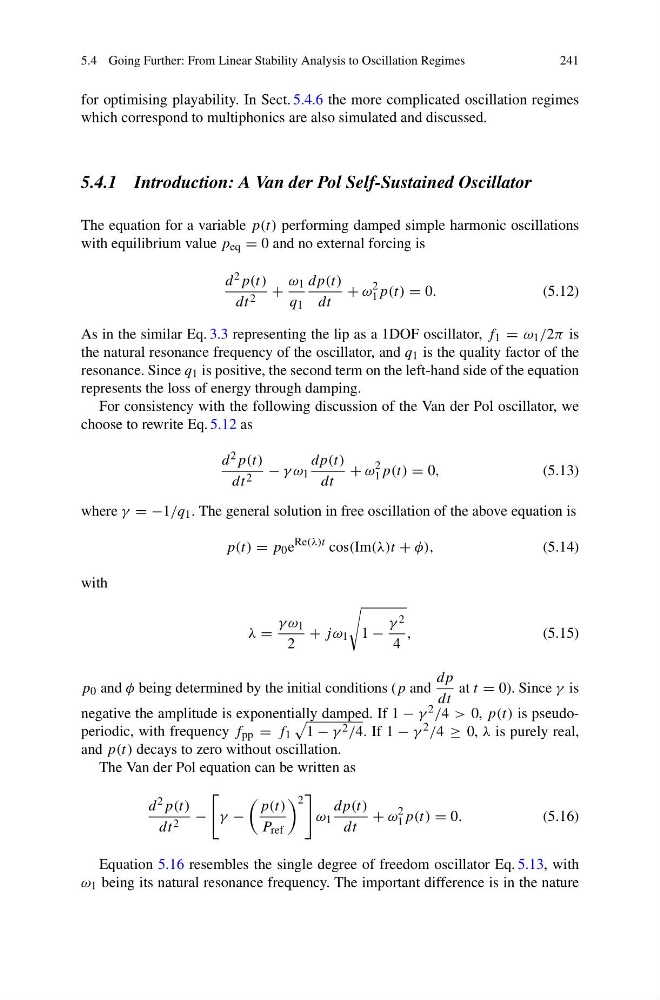
Equation 5.16 resembles the single degree of freedom oscillator Eq. 5.13, with
ω 1 being its natural resonance frequency. The important difference is in the nature
241
for optimising playability. In Sect. 5.4.6 the more complicated oscillation regimes
which correspond to multiphonics are also simulated and discussed.
5.4.1 Introduction: A Van der Pol Self-Sustained Oscillator
The equation for a variable p(t) performing damped simple harmonic oscillations
with equilibrium value p eq = 0 and no external forcing is
d 2 p(t)
dt 2 +
ω 1
q 1
dp(t)
dt
+ ω
2
1 p(t) = 0.
(5.12)
As in the similar Eq. 3.3 representing the lip as a 1DOF oscillator, f 1 = ω 1 /2π is
the natural resonance frequency of the oscillator, and q 1 is the quality factor of the
resonance. Since q 1 is positive, the second term on the left-hand side of the equation
represents the loss of energy through damping.
For consistency with the following discussion of the Van der Pol oscillator, we
choose to rewrite Eq. 5.12 as
d 2 p(t)
dt 2 − γ ω 1
dp(t)
dt
+ ω
2
1 p(t) = 0,
(5.13)
where γ = −1/q 1 . The general solution in free oscillation of the above equation is
p(t) = p 0 e
Re(λ)t cos(Im(λ)t + φ),
(5.14)
with
λ =
γ ω 1
2
+ jω 1
1 −
γ 2
4
,
(5.15)
p 0 and φ being determined by the initial conditions (p and
dp
dt
at t = 0). Since γ is
negative the amplitude is exponentially damped. If 1 − γ 2 /4 > 0, p(t) is pseudoperiodic, with frequency f pp = f 1
1 − γ 2 /4. If 1 − γ 2 /4 ≥ 0, λ is purely real,
and p(t) decays to zero without oscillation.
The Van der Pol equation can be written as
d 2 p(t)
dt 2 −
γ −
p(t)
P ref
2
ω 1
dp(t)
dt
+ ω
2
1 p(t) = 0.
(5.16)
Equation 5.16 resembles the single degree of freedom oscillator Eq. 5.13, with
ω 1 being its natural resonance frequency. The important difference is in the nature