

5.2 Crossing the Threshold: Small Amplitude Oscillating Solutions
227
swinging valve driven well below its resonance frequency. This phase difference
diminishes as the operating frequency rises, passing through π/2 at the resonance
and approaching zero for frequencies well above the resonance. The latter situation
is illustrated in Fig. 5.4c. Stage (ii) represents maximum outward suction on the
lips from the low mouthpiece pressure, but in response the lips have swung shut.
In Stage (iv) the mouthpiece pressure is exerting the maximum force on the outer
surfaces of the lips, but they have opened outwards instead of closing inwards. As a
consequence the pressure and air flow velocity are in phase, maximising the energy
transfer to the air column oscillation.
Yoshikawa (1995) attempted to measure directly the phase difference between
lip motion and mouthpiece pressure in horn and trumpet players. The experimental
method involved attaching a small strain gauge to the upper lip of the player, and
the interpretation of the results was complicated by the difficulty of establishing the
relationship between strain gauge signal and lip movement. Yoshikawa concluded
that the lip reed had an outward-striking character for the lowest played notes, but
changed to an inward-striking behaviour at around the third natural note.
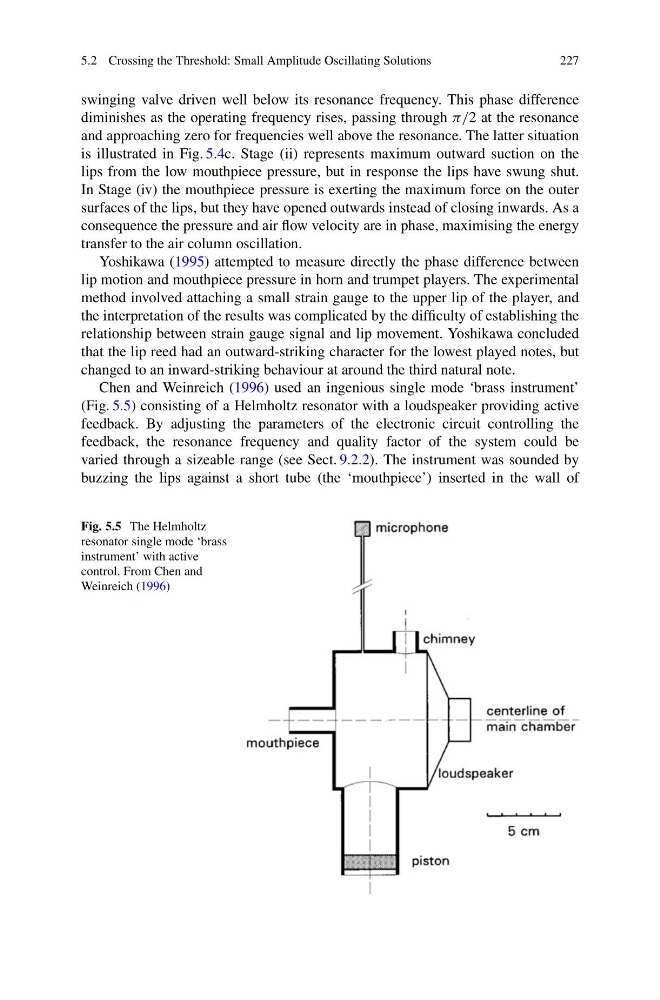
Chen and Weinreich (1996) used an ingenious single mode ‘brass instrument’
(Fig. 5.5) consisting of a Helmholtz resonator with a loudspeaker providing active
feedback. By adjusting the parameters of the electronic circuit controlling the
feedback, the resonance frequency and quality factor of the system could be
varied through a sizeable range (see Sect. 9.2.2). The instrument was sounded by
buzzing the lips against a short tube (the ‘mouthpiece’) inserted in the wall of
Fig. 5.5 The Helmholtz
resonator single mode ‘brass
instrument’ with active
control. From Chen and
Weinreich (1996)
227
swinging valve driven well below its resonance frequency. This phase difference
diminishes as the operating frequency rises, passing through π/2 at the resonance
and approaching zero for frequencies well above the resonance. The latter situation
is illustrated in Fig. 5.4c. Stage (ii) represents maximum outward suction on the
lips from the low mouthpiece pressure, but in response the lips have swung shut.
In Stage (iv) the mouthpiece pressure is exerting the maximum force on the outer
surfaces of the lips, but they have opened outwards instead of closing inwards. As a
consequence the pressure and air flow velocity are in phase, maximising the energy
transfer to the air column oscillation.
Yoshikawa (1995) attempted to measure directly the phase difference between
lip motion and mouthpiece pressure in horn and trumpet players. The experimental
method involved attaching a small strain gauge to the upper lip of the player, and
the interpretation of the results was complicated by the difficulty of establishing the
relationship between strain gauge signal and lip movement. Yoshikawa concluded
that the lip reed had an outward-striking character for the lowest played notes, but
changed to an inward-striking behaviour at around the third natural note.
Chen and Weinreich (1996) used an ingenious single mode ‘brass instrument’
(Fig. 5.5) consisting of a Helmholtz resonator with a loudspeaker providing active
feedback. By adjusting the parameters of the electronic circuit controlling the
feedback, the resonance frequency and quality factor of the system could be
varied through a sizeable range (see Sect. 9.2.2). The instrument was sounded by
buzzing the lips against a short tube (the ‘mouthpiece’) inserted in the wall of
Fig. 5.5 The Helmholtz
resonator single mode ‘brass
instrument’ with active
control. From Chen and
Weinreich (1996)