

228
5 Blow That Horn: An Elementary Model of Brass Playing
the resonator. The vibrating lips were identified as inward- or outward-striking by
noting whether the playing frequency was below or above the measured resonance
frequency of the resonator. They found that with extreme effort, the player could
sound notes either below or above the air cavity resonance, but that the most
comfortable note was almost always above. They concluded that the lips could not
be entirely modelled by a simple one degree of freedom model, but that the most
characteristic behaviour resembled that of an outward-striking reed. Ayers (2001)
used a different experimental procedure in order to compare the playing frequencies
with the resonant frequencies and came to a different conclusion.
Although these experiments were carefully conducted and analysed, their interpretation is far from straightforward. A human brass performer is able to lip a played
note over a wide range of frequencies, both above and below the acoustic resonance
frequency. It must also be borne in mind that the distinction between inwardand outward-striking lip valve behaviour is based on approximations valid only
for blowing pressures very near the threshold of oscillation and must therefore be
treated with caution in discussing playing at levels above pianissimo. Nevertheless, a
simplified lip model with only outward-striking behaviour is capable of reproducing
the most important features of brass instrument behaviour, including the generation
of sustained sounds, the dependence of loudness and timbre on blowing pressure
and the dependence of sounding pitch on lip frequency (Petiot and Gilbert 2013). In
the rest of this chapter, solutions of the elementary model equations will be explored
on the assumption that the lips behave as an outward-striking reed.
5.2.2 Silence or Sound? Stability Analysis of Brass
Instruments
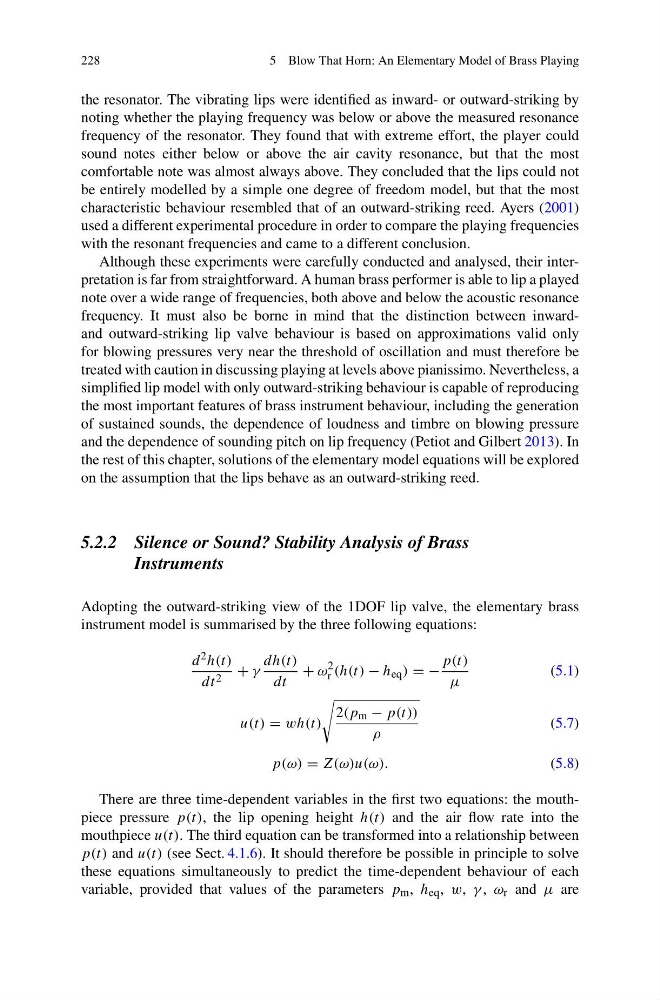
Adopting the outward-striking view of the 1DOF lip valve, the elementary brass
instrument model is summarised by the three following equations:
d 2 h(t)
dt 2 + γ
dh(t)
dt
+ ω
2
r (h(t) − h eq ) = −
p(t)
μ
(5.1)
u(t) = wh(t)
2(p m − p(t))
ρ
(5.7)
p(ω) = Z(ω)u(ω).
(5.8)
There are three time-dependent variables in the first two equations: the mouthpiece pressure p(t), the lip opening height h(t) and the air flow rate into the
mouthpiece u(t). The third equation can be transformed into a relationship between
p(t) and u(t) (see Sect. 4.1.6). It should therefore be possible in principle to solve
these equations simultaneously to predict the time-dependent behaviour of each
variable, provided that values of the parameters p m , h eq , w, γ , ω r and μ are
5 Blow That Horn: An Elementary Model of Brass Playing
the resonator. The vibrating lips were identified as inward- or outward-striking by
noting whether the playing frequency was below or above the measured resonance
frequency of the resonator. They found that with extreme effort, the player could
sound notes either below or above the air cavity resonance, but that the most
comfortable note was almost always above. They concluded that the lips could not
be entirely modelled by a simple one degree of freedom model, but that the most
characteristic behaviour resembled that of an outward-striking reed. Ayers (2001)
used a different experimental procedure in order to compare the playing frequencies
with the resonant frequencies and came to a different conclusion.
Although these experiments were carefully conducted and analysed, their interpretation is far from straightforward. A human brass performer is able to lip a played
note over a wide range of frequencies, both above and below the acoustic resonance
frequency. It must also be borne in mind that the distinction between inwardand outward-striking lip valve behaviour is based on approximations valid only
for blowing pressures very near the threshold of oscillation and must therefore be
treated with caution in discussing playing at levels above pianissimo. Nevertheless, a
simplified lip model with only outward-striking behaviour is capable of reproducing
the most important features of brass instrument behaviour, including the generation
of sustained sounds, the dependence of loudness and timbre on blowing pressure
and the dependence of sounding pitch on lip frequency (Petiot and Gilbert 2013). In
the rest of this chapter, solutions of the elementary model equations will be explored
on the assumption that the lips behave as an outward-striking reed.
5.2.2 Silence or Sound? Stability Analysis of Brass
Instruments
Adopting the outward-striking view of the 1DOF lip valve, the elementary brass
instrument model is summarised by the three following equations:
d 2 h(t)
dt 2 + γ
dh(t)
dt
+ ω
2
r (h(t) − h eq ) = −
p(t)
μ
(5.1)
u(t) = wh(t)
2(p m − p(t))
ρ
(5.7)
p(ω) = Z(ω)u(ω).
(5.8)
There are three time-dependent variables in the first two equations: the mouthpiece pressure p(t), the lip opening height h(t) and the air flow rate into the
mouthpiece u(t). The third equation can be transformed into a relationship between
p(t) and u(t) (see Sect. 4.1.6). It should therefore be possible in principle to solve
these equations simultaneously to predict the time-dependent behaviour of each
variable, provided that values of the parameters p m , h eq , w, γ , ω r and μ are