

226
5 Blow That Horn: An Elementary Model of Brass Playing
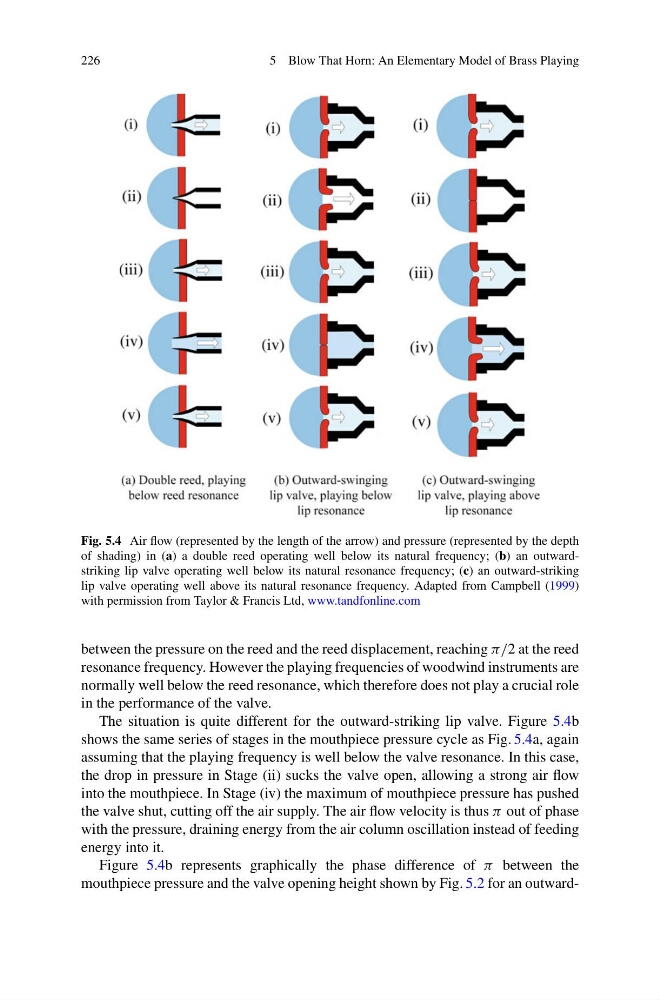
Fig. 5.4 Air flow (represented by the length of the arrow) and pressure (represented by the depth
of shading) in (a) a double reed operating well below its natural frequency; (b) an outwardstriking lip valve operating well below its natural resonance frequency; (c) an outward-striking
lip valve operating well above its natural resonance frequency. Adapted from Campbell (1999)
with permission from Taylor & Francis Ltd, www.tandfonline.com
between the pressure on the reed and the reed displacement, reaching π/2 at the reed
resonance frequency. However the playing frequencies of woodwind instruments are
normally well below the reed resonance, which therefore does not play a crucial role
in the performance of the valve.
The situation is quite different for the outward-striking lip valve. Figure 5.4b
shows the same series of stages in the mouthpiece pressure cycle as Fig. 5.4a, again
assuming that the playing frequency is well below the valve resonance. In this case,
the drop in pressure in Stage (ii) sucks the valve open, allowing a strong air flow
into the mouthpiece. In Stage (iv) the maximum of mouthpiece pressure has pushed
the valve shut, cutting off the air supply. The air flow velocity is thus π out of phase
with the pressure, draining energy from the air column oscillation instead of feeding
energy into it.
Figure 5.4b represents graphically the phase difference of π between the
mouthpiece pressure and the valve opening height shown by Fig. 5.2 for an outward-
5 Blow That Horn: An Elementary Model of Brass Playing
Fig. 5.4 Air flow (represented by the length of the arrow) and pressure (represented by the depth
of shading) in (a) a double reed operating well below its natural frequency; (b) an outwardstriking lip valve operating well below its natural resonance frequency; (c) an outward-striking
lip valve operating well above its natural resonance frequency. Adapted from Campbell (1999)
with permission from Taylor & Francis Ltd, www.tandfonline.com
between the pressure on the reed and the reed displacement, reaching π/2 at the reed
resonance frequency. However the playing frequencies of woodwind instruments are
normally well below the reed resonance, which therefore does not play a crucial role
in the performance of the valve.
The situation is quite different for the outward-striking lip valve. Figure 5.4b
shows the same series of stages in the mouthpiece pressure cycle as Fig. 5.4a, again
assuming that the playing frequency is well below the valve resonance. In this case,
the drop in pressure in Stage (ii) sucks the valve open, allowing a strong air flow
into the mouthpiece. In Stage (iv) the maximum of mouthpiece pressure has pushed
the valve shut, cutting off the air supply. The air flow velocity is thus π out of phase
with the pressure, draining energy from the air column oscillation instead of feeding
energy into it.
Figure 5.4b represents graphically the phase difference of π between the
mouthpiece pressure and the valve opening height shown by Fig. 5.2 for an outward-