

5.1 The Three Equations of the Brass Instrument Model
221
where k is the spring constant of the 1DOF oscillator. Multiplying both sides of
Eq. 5.3 by ω
2
= k/m = k/(μS eff ) leads to the relationship
ω
2 (h eff − h 0 ) =
p m
μ
.
(5.4)
Equation 5.4 can be used to write an alternative form of Eq. 5.1 which explicitly
includes the mouth pressure p m :
d 2 h(t)
dt 2 +
ω l
q l
dh(t)
dt
+ ω
2
l (h(t) − h 0 ) =
p m − p(t)
μ
.
(5.5)
5.1.2 The Second Constituent Equation: Flow Conditions
The second constituent equation, given in Sect. 3.5.1, describes the relationship
between pressure and flow in the lip channel:
u(t) = S lc (t)
2(p m − p(t))
ρ
.
(3.27)
In this equation, the mouth pressure p m and the air density ρ are parameters, while
the volume flow rate u(t), the cross-sectional area of the lip channel S lc (t) and
the mouthpiece pressure p(t) are dependent variables. If the pressure difference
under the square root becomes negative, we use the absolute value of the pressure
difference, with a negative sign in front of the square root. When the lips close
(S lc (t) = 0), the volume flow becomes zero regardless of the magnitude of the
pressure difference.
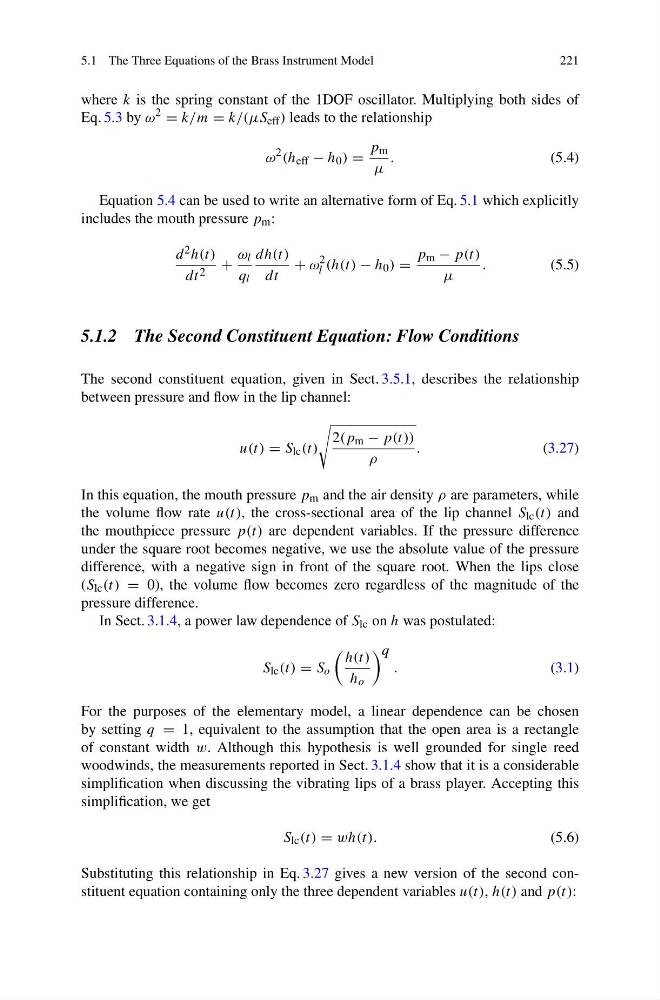
In Sect. 3.1.4, a power law dependence of S lc on h was postulated:
S lc (t) = S o
h(t)
h o
q
.
(3.1)
For the purposes of the elementary model, a linear dependence can be chosen
by setting q = 1, equivalent to the assumption that the open area is a rectangle
of constant width w. Although this hypothesis is well grounded for single reed
woodwinds, the measurements reported in Sect. 3.1.4 show that it is a considerable
simplification when discussing the vibrating lips of a brass player. Accepting this
simplification, we get
S lc (t) = wh(t).
(5.6)
Substituting this relationship in Eq. 3.27 gives a new version of the second constituent equation containing only the three dependent variables u(t), h(t) and p(t):
221
where k is the spring constant of the 1DOF oscillator. Multiplying both sides of
Eq. 5.3 by ω
2
= k/m = k/(μS eff ) leads to the relationship
ω
2 (h eff − h 0 ) =
p m
μ
.
(5.4)
Equation 5.4 can be used to write an alternative form of Eq. 5.1 which explicitly
includes the mouth pressure p m :
d 2 h(t)
dt 2 +
ω l
q l
dh(t)
dt
+ ω
2
l (h(t) − h 0 ) =
p m − p(t)
μ
.
(5.5)
5.1.2 The Second Constituent Equation: Flow Conditions
The second constituent equation, given in Sect. 3.5.1, describes the relationship
between pressure and flow in the lip channel:
u(t) = S lc (t)
2(p m − p(t))
ρ
.
(3.27)
In this equation, the mouth pressure p m and the air density ρ are parameters, while
the volume flow rate u(t), the cross-sectional area of the lip channel S lc (t) and
the mouthpiece pressure p(t) are dependent variables. If the pressure difference
under the square root becomes negative, we use the absolute value of the pressure
difference, with a negative sign in front of the square root. When the lips close
(S lc (t) = 0), the volume flow becomes zero regardless of the magnitude of the
pressure difference.
In Sect. 3.1.4, a power law dependence of S lc on h was postulated:
S lc (t) = S o
h(t)
h o
q
.
(3.1)
For the purposes of the elementary model, a linear dependence can be chosen
by setting q = 1, equivalent to the assumption that the open area is a rectangle
of constant width w. Although this hypothesis is well grounded for single reed
woodwinds, the measurements reported in Sect. 3.1.4 show that it is a considerable
simplification when discussing the vibrating lips of a brass player. Accepting this
simplification, we get
S lc (t) = wh(t).
(5.6)
Substituting this relationship in Eq. 3.27 gives a new version of the second constituent equation containing only the three dependent variables u(t), h(t) and p(t):