

220
5 Blow That Horn: An Elementary Model of Brass Playing
5.1.1 The First Constituent Equation: Lip Dynamics
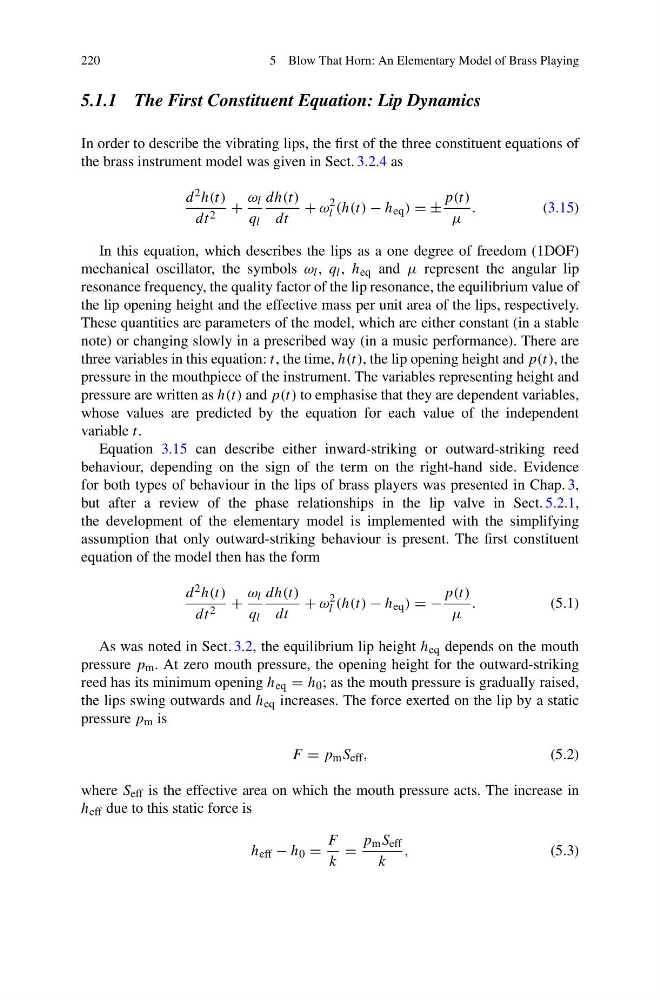
In order to describe the vibrating lips, the first of the three constituent equations of
the brass instrument model was given in Sect. 3.2.4 as
d 2 h(t)
dt 2 +
ω l
q l
dh(t)
dt
+ ω
2
l (h(t) − h eq ) = ±
p(t)
μ
.
(3.15)
In this equation, which describes the lips as a one degree of freedom (1DOF)
mechanical oscillator, the symbols ω l , q l , h eq and μ represent the angular lip
resonance frequency, the quality factor of the lip resonance, the equilibrium value of
the lip opening height and the effective mass per unit area of the lips, respectively.
These quantities are parameters of the model, which are either constant (in a stable
note) or changing slowly in a prescribed way (in a music performance). There are
three variables in this equation: t, the time, h(t), the lip opening height and p(t), the
pressure in the mouthpiece of the instrument. The variables representing height and
pressure are written as h(t) and p(t) to emphasise that they are dependent variables,
whose values are predicted by the equation for each value of the independent
variable t.
Equation 3.15 can describe either inward-striking or outward-striking reed
behaviour, depending on the sign of the term on the right-hand side. Evidence
for both types of behaviour in the lips of brass players was presented in Chap. 3,
but after a review of the phase relationships in the lip valve in Sect. 5.2.1,
the development of the elementary model is implemented with the simplifying
assumption that only outward-striking behaviour is present. The first constituent
equation of the model then has the form
d 2 h(t)
dt 2 +
ω l
q l
dh(t)
dt
+ ω
2
l (h(t) − h eq ) = −
p(t)
μ
.
(5.1)
As was noted in Sect. 3.2, the equilibrium lip height h eq depends on the mouth
pressure p m . At zero mouth pressure, the opening height for the outward-striking
reed has its minimum opening h eq = h 0 ; as the mouth pressure is gradually raised,
the lips swing outwards and h eq increases. The force exerted on the lip by a static
pressure p m is
F = p m S eff ,
(5.2)
where S eff is the effective area on which the mouth pressure acts. The increase in
h eff due to this static force is
h eff − h 0 =
F
k
=
p m S eff
k
,
(5.3)
5 Blow That Horn: An Elementary Model of Brass Playing
5.1.1 The First Constituent Equation: Lip Dynamics
In order to describe the vibrating lips, the first of the three constituent equations of
the brass instrument model was given in Sect. 3.2.4 as
d 2 h(t)
dt 2 +
ω l
q l
dh(t)
dt
+ ω
2
l (h(t) − h eq ) = ±
p(t)
μ
.
(3.15)
In this equation, which describes the lips as a one degree of freedom (1DOF)
mechanical oscillator, the symbols ω l , q l , h eq and μ represent the angular lip
resonance frequency, the quality factor of the lip resonance, the equilibrium value of
the lip opening height and the effective mass per unit area of the lips, respectively.
These quantities are parameters of the model, which are either constant (in a stable
note) or changing slowly in a prescribed way (in a music performance). There are
three variables in this equation: t, the time, h(t), the lip opening height and p(t), the
pressure in the mouthpiece of the instrument. The variables representing height and
pressure are written as h(t) and p(t) to emphasise that they are dependent variables,
whose values are predicted by the equation for each value of the independent
variable t.
Equation 3.15 can describe either inward-striking or outward-striking reed
behaviour, depending on the sign of the term on the right-hand side. Evidence
for both types of behaviour in the lips of brass players was presented in Chap. 3,
but after a review of the phase relationships in the lip valve in Sect. 5.2.1,
the development of the elementary model is implemented with the simplifying
assumption that only outward-striking behaviour is present. The first constituent
equation of the model then has the form
d 2 h(t)
dt 2 +
ω l
q l
dh(t)
dt
+ ω
2
l (h(t) − h eq ) = −
p(t)
μ
.
(5.1)
As was noted in Sect. 3.2, the equilibrium lip height h eq depends on the mouth
pressure p m . At zero mouth pressure, the opening height for the outward-striking
reed has its minimum opening h eq = h 0 ; as the mouth pressure is gradually raised,
the lips swing outwards and h eq increases. The force exerted on the lip by a static
pressure p m is
F = p m S eff ,
(5.2)
where S eff is the effective area on which the mouth pressure acts. The increase in
h eff due to this static force is
h eff − h 0 =
F
k
=
p m S eff
k
,
(5.3)