

222
5 Blow That Horn: An Elementary Model of Brass Playing
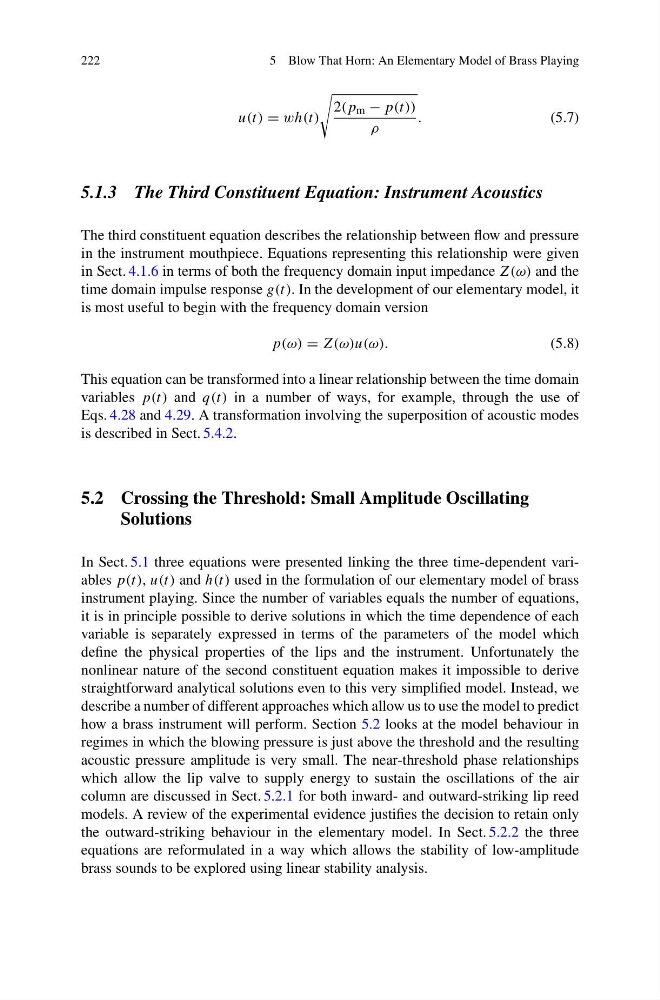
u(t) = wh(t)
2(p m − p(t))
ρ
.
(5.7)
5.1.3 The Third Constituent Equation: Instrument Acoustics
The third constituent equation describes the relationship between flow and pressure
in the instrument mouthpiece. Equations representing this relationship were given
in Sect. 4.1.6 in terms of both the frequency domain input impedance Z(ω) and the
time domain impulse response g(t). In the development of our elementary model, it
is most useful to begin with the frequency domain version
p(ω) = Z(ω)u(ω).
(5.8)
This equation can be transformed into a linear relationship between the time domain
variables p(t) and q(t) in a number of ways, for example, through the use of
Eqs. 4.28 and 4.29. A transformation involving the superposition of acoustic modes
is described in Sect. 5.4.2.
5.2 Crossing the Threshold: Small Amplitude Oscillating
Solutions
In Sect. 5.1 three equations were presented linking the three time-dependent variables p(t), u(t) and h(t) used in the formulation of our elementary model of brass
instrument playing. Since the number of variables equals the number of equations,
it is in principle possible to derive solutions in which the time dependence of each
variable is separately expressed in terms of the parameters of the model which
define the physical properties of the lips and the instrument. Unfortunately the
nonlinear nature of the second constituent equation makes it impossible to derive
straightforward analytical solutions even to this very simplified model. Instead, we
describe a number of different approaches which allow us to use the model to predict
how a brass instrument will perform. Section 5.2 looks at the model behaviour in
regimes in which the blowing pressure is just above the threshold and the resulting
acoustic pressure amplitude is very small. The near-threshold phase relationships
which allow the lip valve to supply energy to sustain the oscillations of the air
column are discussed in Sect. 5.2.1 for both inward- and outward-striking lip reed
models. A review of the experimental evidence justifies the decision to retain only
the outward-striking behaviour in the elementary model. In Sect. 5.2.2 the three
equations are reformulated in a way which allows the stability of low-amplitude
brass sounds to be explored using linear stability analysis.
5 Blow That Horn: An Elementary Model of Brass Playing
u(t) = wh(t)
2(p m − p(t))
ρ
.
(5.7)
5.1.3 The Third Constituent Equation: Instrument Acoustics
The third constituent equation describes the relationship between flow and pressure
in the instrument mouthpiece. Equations representing this relationship were given
in Sect. 4.1.6 in terms of both the frequency domain input impedance Z(ω) and the
time domain impulse response g(t). In the development of our elementary model, it
is most useful to begin with the frequency domain version
p(ω) = Z(ω)u(ω).
(5.8)
This equation can be transformed into a linear relationship between the time domain
variables p(t) and q(t) in a number of ways, for example, through the use of
Eqs. 4.28 and 4.29. A transformation involving the superposition of acoustic modes
is described in Sect. 5.4.2.
5.2 Crossing the Threshold: Small Amplitude Oscillating
Solutions
In Sect. 5.1 three equations were presented linking the three time-dependent variables p(t), u(t) and h(t) used in the formulation of our elementary model of brass
instrument playing. Since the number of variables equals the number of equations,
it is in principle possible to derive solutions in which the time dependence of each
variable is separately expressed in terms of the parameters of the model which
define the physical properties of the lips and the instrument. Unfortunately the
nonlinear nature of the second constituent equation makes it impossible to derive
straightforward analytical solutions even to this very simplified model. Instead, we
describe a number of different approaches which allow us to use the model to predict
how a brass instrument will perform. Section 5.2 looks at the model behaviour in
regimes in which the blowing pressure is just above the threshold and the resulting
acoustic pressure amplitude is very small. The near-threshold phase relationships
which allow the lip valve to supply energy to sustain the oscillations of the air
column are discussed in Sect. 5.2.1 for both inward- and outward-striking lip reed
models. A review of the experimental evidence justifies the decision to retain only
the outward-striking behaviour in the elementary model. In Sect. 5.2.2 the three
equations are reformulated in a way which allows the stability of low-amplitude
brass sounds to be explored using linear stability analysis.