

4.7 Going Further: Calculating Input Impedance
207
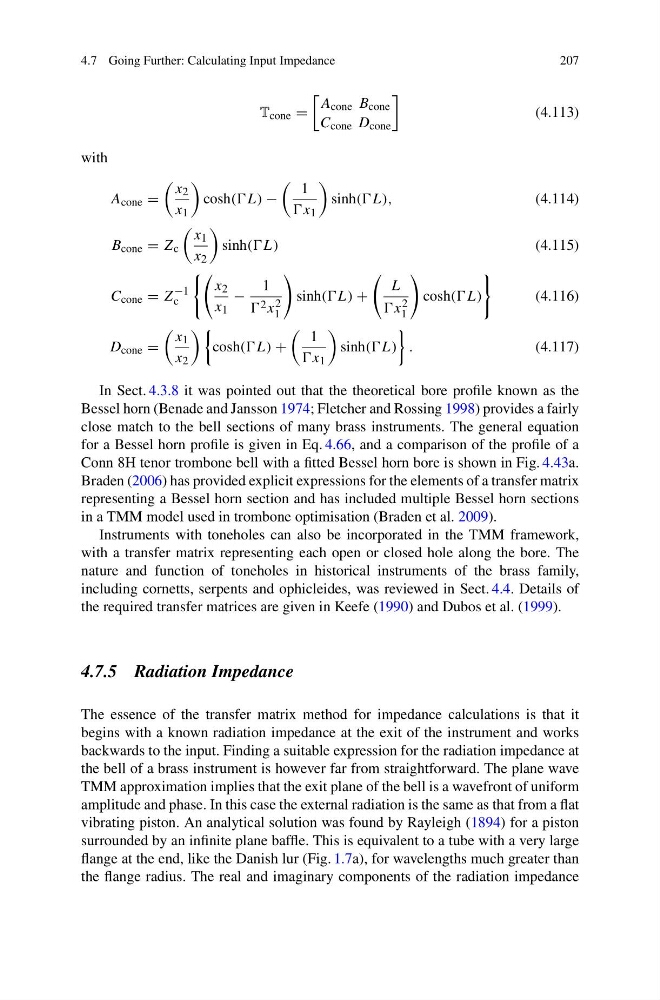
T cone =
A cone B cone
C cone D cone
(4.113)
with
A cone =
x 2
x 1
cosh((L) −
1
x 1
sinh((L),
(4.114)
B cone = Z c
x 1
x 2
sinh((L)
(4.115)
C cone = Z
−1
c
x 2
x 1
−
1
2 x 2
1
sinh((L) +
L
x 2
1
cosh((L)
(4.116)
D cone =
x 1
x 2
cosh((L) +
1
x 1
sinh((L)
.
(4.117)
In Sect. 4.3.8 it was pointed out that the theoretical bore profile known as the
Bessel horn (Benade and Jansson 1974; Fletcher and Rossing 1998) provides a fairly
close match to the bell sections of many brass instruments. The general equation
for a Bessel horn profile is given in Eq. 4.66, and a comparison of the profile of a
Conn 8H tenor trombone bell with a fitted Bessel horn bore is shown in Fig. 4.43a.
Braden (2006) has provided explicit expressions for the elements of a transfer matrix
representing a Bessel horn section and has included multiple Bessel horn sections
in a TMM model used in trombone optimisation (Braden et al. 2009).
Instruments with toneholes can also be incorporated in the TMM framework,
with a transfer matrix representing each open or closed hole along the bore. The
nature and function of toneholes in historical instruments of the brass family,
including cornetts, serpents and ophicleides, was reviewed in Sect. 4.4. Details of
the required transfer matrices are given in Keefe (1990) and Dubos et al. (1999).
4.7.5 Radiation Impedance
The essence of the transfer matrix method for impedance calculations is that it
begins with a known radiation impedance at the exit of the instrument and works
backwards to the input. Finding a suitable expression for the radiation impedance at
the bell of a brass instrument is however far from straightforward. The plane wave
TMM approximation implies that the exit plane of the bell is a wavefront of uniform
amplitude and phase. In this case the external radiation is the same as that from a flat
vibrating piston. An analytical solution was found by Rayleigh (1894) for a piston
surrounded by an infinite plane baffle. This is equivalent to a tube with a very large
flange at the end, like the Danish lur (Fig. 1.7a), for wavelengths much greater than
the flange radius. The real and imaginary components of the radiation impedance
207
T cone =
A cone B cone
C cone D cone
(4.113)
with
A cone =
x 2
x 1
cosh((L) −
1
x 1
sinh((L),
(4.114)
B cone = Z c
x 1
x 2
sinh((L)
(4.115)
C cone = Z
−1
c
x 2
x 1
−
1
2 x 2
1
sinh((L) +
L
x 2
1
cosh((L)
(4.116)
D cone =
x 1
x 2
cosh((L) +
1
x 1
sinh((L)
.
(4.117)
In Sect. 4.3.8 it was pointed out that the theoretical bore profile known as the
Bessel horn (Benade and Jansson 1974; Fletcher and Rossing 1998) provides a fairly
close match to the bell sections of many brass instruments. The general equation
for a Bessel horn profile is given in Eq. 4.66, and a comparison of the profile of a
Conn 8H tenor trombone bell with a fitted Bessel horn bore is shown in Fig. 4.43a.
Braden (2006) has provided explicit expressions for the elements of a transfer matrix
representing a Bessel horn section and has included multiple Bessel horn sections
in a TMM model used in trombone optimisation (Braden et al. 2009).
Instruments with toneholes can also be incorporated in the TMM framework,
with a transfer matrix representing each open or closed hole along the bore. The
nature and function of toneholes in historical instruments of the brass family,
including cornetts, serpents and ophicleides, was reviewed in Sect. 4.4. Details of
the required transfer matrices are given in Keefe (1990) and Dubos et al. (1999).
4.7.5 Radiation Impedance
The essence of the transfer matrix method for impedance calculations is that it
begins with a known radiation impedance at the exit of the instrument and works
backwards to the input. Finding a suitable expression for the radiation impedance at
the bell of a brass instrument is however far from straightforward. The plane wave
TMM approximation implies that the exit plane of the bell is a wavefront of uniform
amplitude and phase. In this case the external radiation is the same as that from a flat
vibrating piston. An analytical solution was found by Rayleigh (1894) for a piston
surrounded by an infinite plane baffle. This is equivalent to a tube with a very large
flange at the end, like the Danish lur (Fig. 1.7a), for wavelengths much greater than
the flange radius. The real and imaginary components of the radiation impedance