

208
4 After the Lips: Acoustic Resonances and Radiation
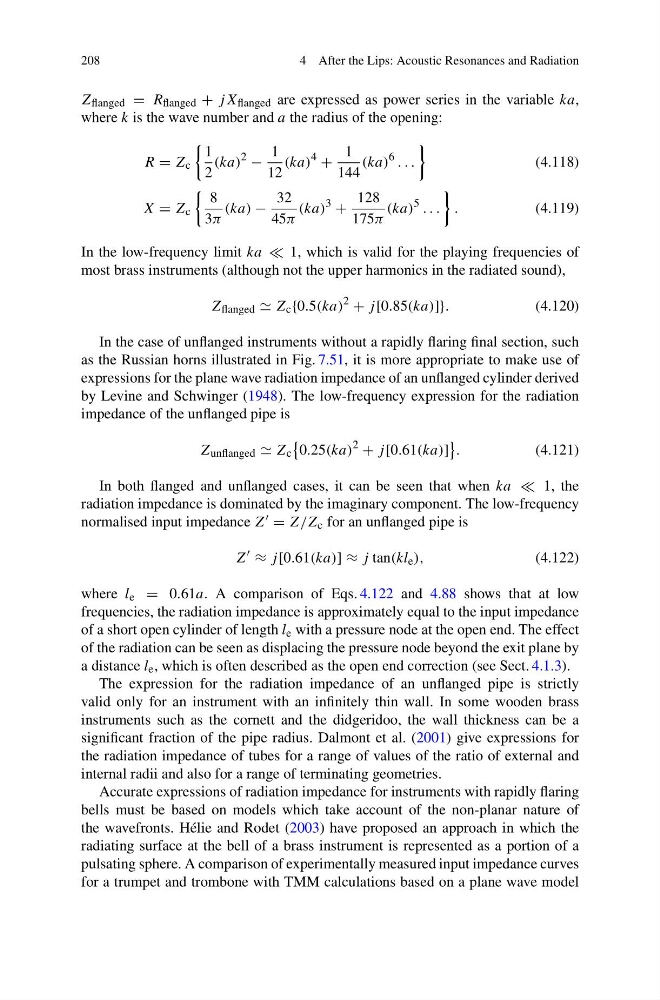
Z flanged = R flanged + jX flanged are expressed as power series in the variable ka,
where k is the wave number and a the radius of the opening:
R = Z c
1
2
(ka)
2
−
1
12
(ka)
4
+
1
144
(ka)
6 . . .
(4.118)
X = Z c
8
3π
(ka) −
32
45π
(ka)
3
+
128
175π
(ka)
5 . . .
.
(4.119)
In the low-frequency limit ka 1, which is valid for the playing frequencies of
most brass instruments (although not the upper harmonics in the radiated sound),
Z flanged Z c {0.5(ka)
2
+ j [0.85(ka)]}.
(4.120)
In the case of unflanged instruments without a rapidly flaring final section, such
as the Russian horns illustrated in Fig. 7.51, it is more appropriate to make use of
expressions for the plane wave radiation impedance of an unflanged cylinder derived
by Levine and Schwinger (1948). The low-frequency expression for the radiation
impedance of the unflanged pipe is
Z unflanged Z c
0.25(ka)
2
+ j [0.61(ka)]
.
(4.121)
In both flanged and unflanged cases, it can be seen that when ka 1, the
radiation impedance is dominated by the imaginary component. The low-frequency
normalised input impedance Z = Z/Z c for an unflanged pipe is
Z
≈ j [0.61(ka)] ≈ j tan(kl e ),
(4.122)
where l e = 0.61a. A comparison of Eqs. 4.122 and 4.88 shows that at low
frequencies, the radiation impedance is approximately equal to the input impedance
of a short open cylinder of length l e with a pressure node at the open end. The effect
of the radiation can be seen as displacing the pressure node beyond the exit plane by
a distance l e , which is often described as the open end correction (see Sect. 4.1.3).
The expression for the radiation impedance of an unflanged pipe is strictly
valid only for an instrument with an infinitely thin wall. In some wooden brass
instruments such as the cornett and the didgeridoo, the wall thickness can be a
significant fraction of the pipe radius. Dalmont et al. (2001) give expressions for
the radiation impedance of tubes for a range of values of the ratio of external and
internal radii and also for a range of terminating geometries.
Accurate expressions of radiation impedance for instruments with rapidly flaring
bells must be based on models which take account of the non-planar nature of
the wavefronts. Hélie and Rodet (2003) have proposed an approach in which the
radiating surface at the bell of a brass instrument is represented as a portion of a
pulsating sphere. A comparison of experimentally measured input impedance curves
for a trumpet and trombone with TMM calculations based on a plane wave model
4 After the Lips: Acoustic Resonances and Radiation
Z flanged = R flanged + jX flanged are expressed as power series in the variable ka,
where k is the wave number and a the radius of the opening:
R = Z c
1
2
(ka)
2
−
1
12
(ka)
4
+
1
144
(ka)
6 . . .
(4.118)
X = Z c
8
3π
(ka) −
32
45π
(ka)
3
+
128
175π
(ka)
5 . . .
.
(4.119)
In the low-frequency limit ka 1, which is valid for the playing frequencies of
most brass instruments (although not the upper harmonics in the radiated sound),
Z flanged Z c {0.5(ka)
2
+ j [0.85(ka)]}.
(4.120)
In the case of unflanged instruments without a rapidly flaring final section, such
as the Russian horns illustrated in Fig. 7.51, it is more appropriate to make use of
expressions for the plane wave radiation impedance of an unflanged cylinder derived
by Levine and Schwinger (1948). The low-frequency expression for the radiation
impedance of the unflanged pipe is
Z unflanged Z c
0.25(ka)
2
+ j [0.61(ka)]
.
(4.121)
In both flanged and unflanged cases, it can be seen that when ka 1, the
radiation impedance is dominated by the imaginary component. The low-frequency
normalised input impedance Z = Z/Z c for an unflanged pipe is
Z
≈ j [0.61(ka)] ≈ j tan(kl e ),
(4.122)
where l e = 0.61a. A comparison of Eqs. 4.122 and 4.88 shows that at low
frequencies, the radiation impedance is approximately equal to the input impedance
of a short open cylinder of length l e with a pressure node at the open end. The effect
of the radiation can be seen as displacing the pressure node beyond the exit plane by
a distance l e , which is often described as the open end correction (see Sect. 4.1.3).
The expression for the radiation impedance of an unflanged pipe is strictly
valid only for an instrument with an infinitely thin wall. In some wooden brass
instruments such as the cornett and the didgeridoo, the wall thickness can be a
significant fraction of the pipe radius. Dalmont et al. (2001) give expressions for
the radiation impedance of tubes for a range of values of the ratio of external and
internal radii and also for a range of terminating geometries.
Accurate expressions of radiation impedance for instruments with rapidly flaring
bells must be based on models which take account of the non-planar nature of
the wavefronts. Hélie and Rodet (2003) have proposed an approach in which the
radiating surface at the bell of a brass instrument is represented as a portion of a
pulsating sphere. A comparison of experimentally measured input impedance curves
for a trumpet and trombone with TMM calculations based on a plane wave model