

206
4 After the Lips: Acoustic Resonances and Radiation
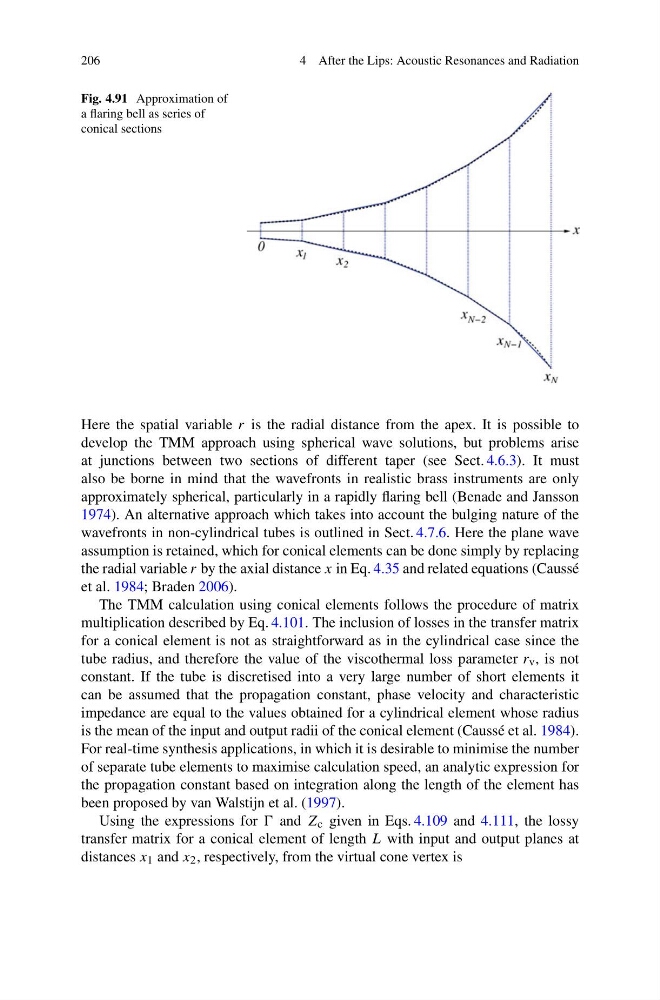
Fig. 4.91 Approximation of
a flaring bell as series of
conical sections
Here the spatial variable r is the radial distance from the apex. It is possible to
develop the TMM approach using spherical wave solutions, but problems arise
at junctions between two sections of different taper (see Sect. 4.6.3). It must
also be borne in mind that the wavefronts in realistic brass instruments are only
approximately spherical, particularly in a rapidly flaring bell (Benade and Jansson
1974). An alternative approach which takes into account the bulging nature of the
wavefronts in non-cylindrical tubes is outlined in Sect. 4.7.6. Here the plane wave
assumption is retained, which for conical elements can be done simply by replacing
the radial variable r by the axial distance x in Eq. 4.35 and related equations (Caussé
et al. 1984; Braden 2006).
The TMM calculation using conical elements follows the procedure of matrix
multiplication described by Eq. 4.101. The inclusion of losses in the transfer matrix
for a conical element is not as straightforward as in the cylindrical case since the
tube radius, and therefore the value of the viscothermal loss parameter r v , is not
constant. If the tube is discretised into a very large number of short elements it
can be assumed that the propagation constant, phase velocity and characteristic
impedance are equal to the values obtained for a cylindrical element whose radius
is the mean of the input and output radii of the conical element (Caussé et al. 1984).
For real-time synthesis applications, in which it is desirable to minimise the number
of separate tube elements to maximise calculation speed, an analytic expression for
the propagation constant based on integration along the length of the element has
been proposed by van Walstijn et al. (1997).
Using the expressions for and Z c given in Eqs. 4.109 and 4.111, the lossy
transfer matrix for a conical element of length L with input and output planes at
distances x 1 and x 2 , respectively, from the virtual cone vertex is
4 After the Lips: Acoustic Resonances and Radiation
Fig. 4.91 Approximation of
a flaring bell as series of
conical sections
Here the spatial variable r is the radial distance from the apex. It is possible to
develop the TMM approach using spherical wave solutions, but problems arise
at junctions between two sections of different taper (see Sect. 4.6.3). It must
also be borne in mind that the wavefronts in realistic brass instruments are only
approximately spherical, particularly in a rapidly flaring bell (Benade and Jansson
1974). An alternative approach which takes into account the bulging nature of the
wavefronts in non-cylindrical tubes is outlined in Sect. 4.7.6. Here the plane wave
assumption is retained, which for conical elements can be done simply by replacing
the radial variable r by the axial distance x in Eq. 4.35 and related equations (Caussé
et al. 1984; Braden 2006).
The TMM calculation using conical elements follows the procedure of matrix
multiplication described by Eq. 4.101. The inclusion of losses in the transfer matrix
for a conical element is not as straightforward as in the cylindrical case since the
tube radius, and therefore the value of the viscothermal loss parameter r v , is not
constant. If the tube is discretised into a very large number of short elements it
can be assumed that the propagation constant, phase velocity and characteristic
impedance are equal to the values obtained for a cylindrical element whose radius
is the mean of the input and output radii of the conical element (Caussé et al. 1984).
For real-time synthesis applications, in which it is desirable to minimise the number
of separate tube elements to maximise calculation speed, an analytic expression for
the propagation constant based on integration along the length of the element has
been proposed by van Walstijn et al. (1997).
Using the expressions for and Z c given in Eqs. 4.109 and 4.111, the lossy
transfer matrix for a conical element of length L with input and output planes at
distances x 1 and x 2 , respectively, from the virtual cone vertex is