

4.6 Radiation of Sound from Brass Instruments
193
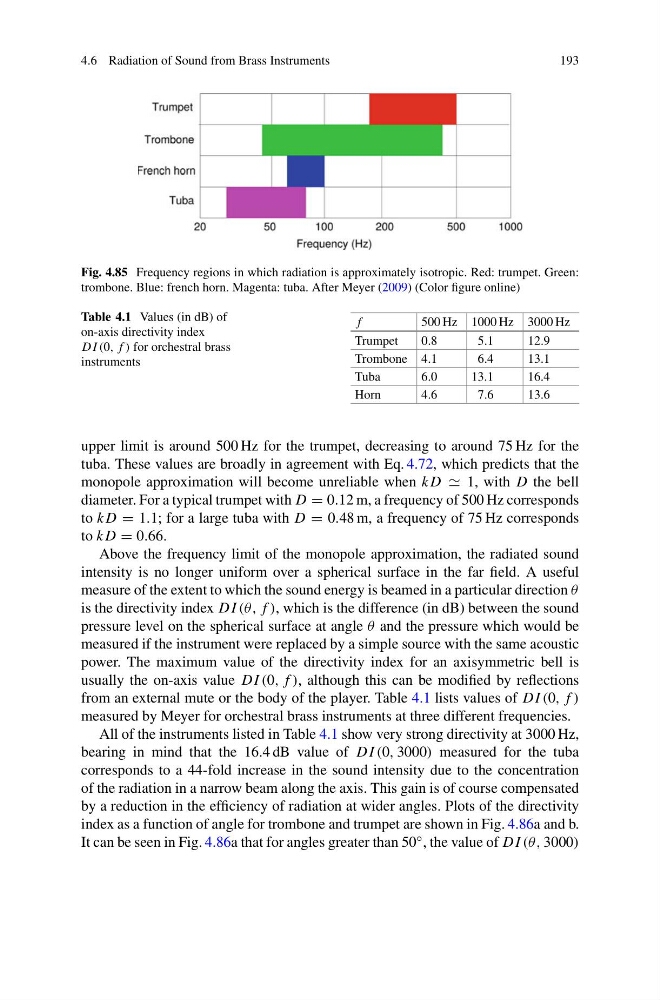
Fig. 4.85 Frequency regions in which radiation is approximately isotropic. Red: trumpet. Green:
trombone. Blue: french horn. Magenta: tuba. After Meyer (2009) (Color figure online)
Table 4.1 Values (in dB) of
on-axis directivity index
DI (0, f ) for orchestral brass
instruments
f
500 Hz 1000 Hz 3000 Hz
Trumpet
0.8
5.1
12.9
Trombone 4.1
6.4
13.1
Tuba
6.0
13.1
16.4
Horn
4.6
7.6
13.6
upper limit is around 500 Hz for the trumpet, decreasing to around 75 Hz for the
tuba. These values are broadly in agreement with Eq. 4.72, which predicts that the
monopole approximation will become unreliable when kD 1, with D the bell
diameter. For a typical trumpet with D = 0.12 m, a frequency of 500 Hz corresponds
to kD = 1.1; for a large tuba with D = 0.48 m, a frequency of 75 Hz corresponds
to kD = 0.66.
Above the frequency limit of the monopole approximation, the radiated sound
intensity is no longer uniform over a spherical surface in the far field. A useful
measure of the extent to which the sound energy is beamed in a particular direction θ
is the directivity index DI (θ, f ), which is the difference (in dB) between the sound
pressure level on the spherical surface at angle θ and the pressure which would be
measured if the instrument were replaced by a simple source with the same acoustic
power. The maximum value of the directivity index for an axisymmetric bell is
usually the on-axis value DI (0, f ), although this can be modified by reflections
from an external mute or the body of the player. Table 4.1 lists values of DI (0, f )
measured by Meyer for orchestral brass instruments at three different frequencies.
All of the instruments listed in Table 4.1 show very strong directivity at 3000 Hz,
bearing in mind that the 16.4 dB value of DI (0, 3000) measured for the tuba
corresponds to a 44-fold increase in the sound intensity due to the concentration
of the radiation in a narrow beam along the axis. This gain is of course compensated
by a reduction in the efficiency of radiation at wider angles. Plots of the directivity
index as a function of angle for trombone and trumpet are shown in Fig. 4.86a and b.
It can be seen in Fig. 4.86a that for angles greater than 50 ◦ , the value of DI (θ, 3000)
193
Fig. 4.85 Frequency regions in which radiation is approximately isotropic. Red: trumpet. Green:
trombone. Blue: french horn. Magenta: tuba. After Meyer (2009) (Color figure online)
Table 4.1 Values (in dB) of
on-axis directivity index
DI (0, f ) for orchestral brass
instruments
f
500 Hz 1000 Hz 3000 Hz
Trumpet
0.8
5.1
12.9
Trombone 4.1
6.4
13.1
Tuba
6.0
13.1
16.4
Horn
4.6
7.6
13.6
upper limit is around 500 Hz for the trumpet, decreasing to around 75 Hz for the
tuba. These values are broadly in agreement with Eq. 4.72, which predicts that the
monopole approximation will become unreliable when kD 1, with D the bell
diameter. For a typical trumpet with D = 0.12 m, a frequency of 500 Hz corresponds
to kD = 1.1; for a large tuba with D = 0.48 m, a frequency of 75 Hz corresponds
to kD = 0.66.
Above the frequency limit of the monopole approximation, the radiated sound
intensity is no longer uniform over a spherical surface in the far field. A useful
measure of the extent to which the sound energy is beamed in a particular direction θ
is the directivity index DI (θ, f ), which is the difference (in dB) between the sound
pressure level on the spherical surface at angle θ and the pressure which would be
measured if the instrument were replaced by a simple source with the same acoustic
power. The maximum value of the directivity index for an axisymmetric bell is
usually the on-axis value DI (0, f ), although this can be modified by reflections
from an external mute or the body of the player. Table 4.1 lists values of DI (0, f )
measured by Meyer for orchestral brass instruments at three different frequencies.
All of the instruments listed in Table 4.1 show very strong directivity at 3000 Hz,
bearing in mind that the 16.4 dB value of DI (0, 3000) measured for the tuba
corresponds to a 44-fold increase in the sound intensity due to the concentration
of the radiation in a narrow beam along the axis. This gain is of course compensated
by a reduction in the efficiency of radiation at wider angles. Plots of the directivity
index as a function of angle for trombone and trumpet are shown in Fig. 4.86a and b.
It can be seen in Fig. 4.86a that for angles greater than 50 ◦ , the value of DI (θ, 3000)