

4.6 Radiation of Sound from Brass Instruments
181
Sect. 4.6.6). In this low-frequency region, the far field radiation has wavefronts
which are concentric spherical surfaces, with pressure amplitude independent of
angle and inversely proportional to r. This type of sound field is described as
‘monopole radiation’, since in theory it can be considered as emanating from a
single point or monopole.
4.6.2 Monopole Radiation
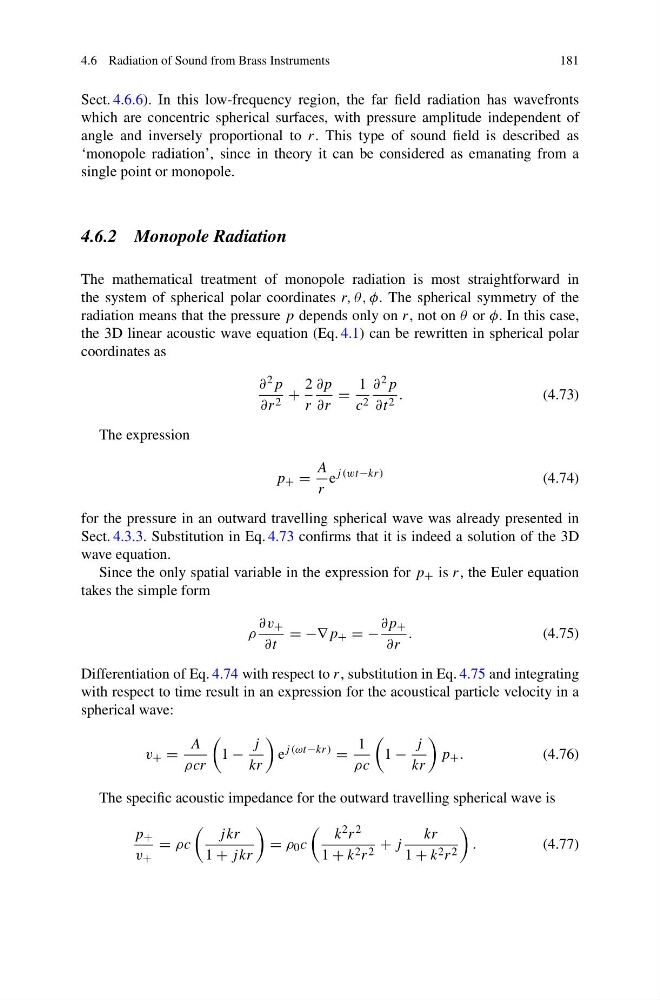
The mathematical treatment of monopole radiation is most straightforward in
the system of spherical polar coordinates r, θ, φ. The spherical symmetry of the
radiation means that the pressure p depends only on r, not on θ or φ. In this case,
the 3D linear acoustic wave equation (Eq. 4.1) can be rewritten in spherical polar
coordinates as
∂ 2 p
∂r 2 +
2
r
∂p
∂r
=
1
c 2
∂ 2 p
∂t 2 .
(4.73)
The expression
p + =
A
r
e
j (wt−kr)
(4.74)
for the pressure in an outward travelling spherical wave was already presented in
Sect. 4.3.3. Substitution in Eq. 4.73 confirms that it is indeed a solution of the 3D
wave equation.
Since the only spatial variable in the expression for p + is r, the Euler equation
takes the simple form
ρ
∂v +
∂t
= −∇p + = −
∂p +
∂r
.
(4.75)
Differentiation of Eq. 4.74 with respect to r, substitution in Eq. 4.75 and integrating
with respect to time result in an expression for the acoustical particle velocity in a
spherical wave:
v + =
A
ρcr
1 −
j
kr
e
j (ωt−kr)
=
1
ρc
1 −
j
kr
p + .
(4.76)
The specific acoustic impedance for the outward travelling spherical wave is
p +
v +
= ρc
jkr
1 + jkr
= ρ 0 c
k 2 r 2
1 + k 2 r 2 + j
kr
1 + k 2 r 2
.
(4.77)
181
Sect. 4.6.6). In this low-frequency region, the far field radiation has wavefronts
which are concentric spherical surfaces, with pressure amplitude independent of
angle and inversely proportional to r. This type of sound field is described as
‘monopole radiation’, since in theory it can be considered as emanating from a
single point or monopole.
4.6.2 Monopole Radiation
The mathematical treatment of monopole radiation is most straightforward in
the system of spherical polar coordinates r, θ, φ. The spherical symmetry of the
radiation means that the pressure p depends only on r, not on θ or φ. In this case,
the 3D linear acoustic wave equation (Eq. 4.1) can be rewritten in spherical polar
coordinates as
∂ 2 p
∂r 2 +
2
r
∂p
∂r
=
1
c 2
∂ 2 p
∂t 2 .
(4.73)
The expression
p + =
A
r
e
j (wt−kr)
(4.74)
for the pressure in an outward travelling spherical wave was already presented in
Sect. 4.3.3. Substitution in Eq. 4.73 confirms that it is indeed a solution of the 3D
wave equation.
Since the only spatial variable in the expression for p + is r, the Euler equation
takes the simple form
ρ
∂v +
∂t
= −∇p + = −
∂p +
∂r
.
(4.75)
Differentiation of Eq. 4.74 with respect to r, substitution in Eq. 4.75 and integrating
with respect to time result in an expression for the acoustical particle velocity in a
spherical wave:
v + =
A
ρcr
1 −
j
kr
e
j (ωt−kr)
=
1
ρc
1 −
j
kr
p + .
(4.76)
The specific acoustic impedance for the outward travelling spherical wave is
p +
v +
= ρc
jkr
1 + jkr
= ρ 0 c
k 2 r 2
1 + k 2 r 2 + j
kr
1 + k 2 r 2
.
(4.77)