

182
4 After the Lips: Acoustic Resonances and Radiation
The impedance has both a real part and an imaginary part, showing that in general
the particle velocity is not in phase with the pressure in a spherical wave. The phase
difference θ is given by the expression
tan θ =
1
kr
.
(4.78)
When kr 1, the phase difference between pressure and particle velocity is
almost 90 ◦ . At a distance r = λ/2π from the monopole source, kr = 1 and θ = 45 ◦ .
When kr 1, the pressure and particle velocity are almost in phase, as they are for
plane waves (see Sect. 4.1.2). This is to be expected, since at very large distances
from the source, the spherical wavefronts are almost indistinguishable from plane
waves.
A monopole is a mathematical abstraction, since any acoustic source must in
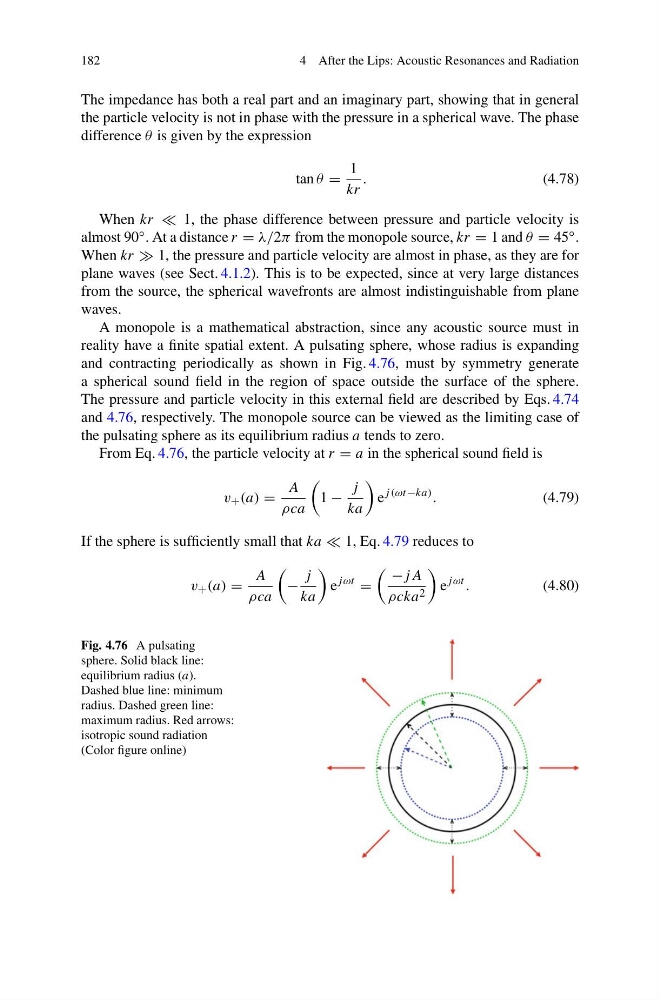
reality have a finite spatial extent. A pulsating sphere, whose radius is expanding
and contracting periodically as shown in Fig. 4.76, must by symmetry generate
a spherical sound field in the region of space outside the surface of the sphere.
The pressure and particle velocity in this external field are described by Eqs. 4.74
and 4.76, respectively. The monopole source can be viewed as the limiting case of
the pulsating sphere as its equilibrium radius a tends to zero.
From Eq. 4.76, the particle velocity at r = a in the spherical sound field is
v + (a) =
A
ρca
1 −
j
ka
e
j (ωt−ka) .
(4.79)
If the sphere is sufficiently small that ka 1, Eq. 4.79 reduces to
v + (a) =
A
ρca
−
j
ka
e
jωt
=
−jA
ρcka 2
e
jωt .
(4.80)
Fig. 4.76 A pulsating
sphere. Solid black line:
equilibrium radius (a).
Dashed blue line: minimum
radius. Dashed green line:
maximum radius. Red arrows:
isotropic sound radiation
(Color figure online)
4 After the Lips: Acoustic Resonances and Radiation
The impedance has both a real part and an imaginary part, showing that in general
the particle velocity is not in phase with the pressure in a spherical wave. The phase
difference θ is given by the expression
tan θ =
1
kr
.
(4.78)
When kr 1, the phase difference between pressure and particle velocity is
almost 90 ◦ . At a distance r = λ/2π from the monopole source, kr = 1 and θ = 45 ◦ .
When kr 1, the pressure and particle velocity are almost in phase, as they are for
plane waves (see Sect. 4.1.2). This is to be expected, since at very large distances
from the source, the spherical wavefronts are almost indistinguishable from plane
waves.
A monopole is a mathematical abstraction, since any acoustic source must in
reality have a finite spatial extent. A pulsating sphere, whose radius is expanding
and contracting periodically as shown in Fig. 4.76, must by symmetry generate
a spherical sound field in the region of space outside the surface of the sphere.
The pressure and particle velocity in this external field are described by Eqs. 4.74
and 4.76, respectively. The monopole source can be viewed as the limiting case of
the pulsating sphere as its equilibrium radius a tends to zero.
From Eq. 4.76, the particle velocity at r = a in the spherical sound field is
v + (a) =
A
ρca
1 −
j
ka
e
j (ωt−ka) .
(4.79)
If the sphere is sufficiently small that ka 1, Eq. 4.79 reduces to
v + (a) =
A
ρca
−
j
ka
e
jωt
=
−jA
ρcka 2
e
jωt .
(4.80)
Fig. 4.76 A pulsating
sphere. Solid black line:
equilibrium radius (a).
Dashed blue line: minimum
radius. Dashed green line:
maximum radius. Red arrows:
isotropic sound radiation
(Color figure online)