

180
4 After the Lips: Acoustic Resonances and Radiation
profile also has a strong influence on the nature of the sound field in the external
space around the instrument, which is the topic of the present section.
4.6.1 Near Field and Far Field
In general, the sound field radiated by a musical instrument depends on the nature
and shape of the emitting surface, the frequency of the radiation and the distance
from the instrument. For example, the sound field measured at a point just above the
bridge of a violin will be the sum of component waves radiated from many different
parts of the instrument, arriving from different directions with different amplitudes
and phases. A fairly small movement of the point of measurement will also result
in significant changes in the directions of the component waves. There is no reason
to expect that in such a case the wavefronts will be plane or spherical, or that there
will be a simple relationship between the total measured pressure and the distance
from the instrument.
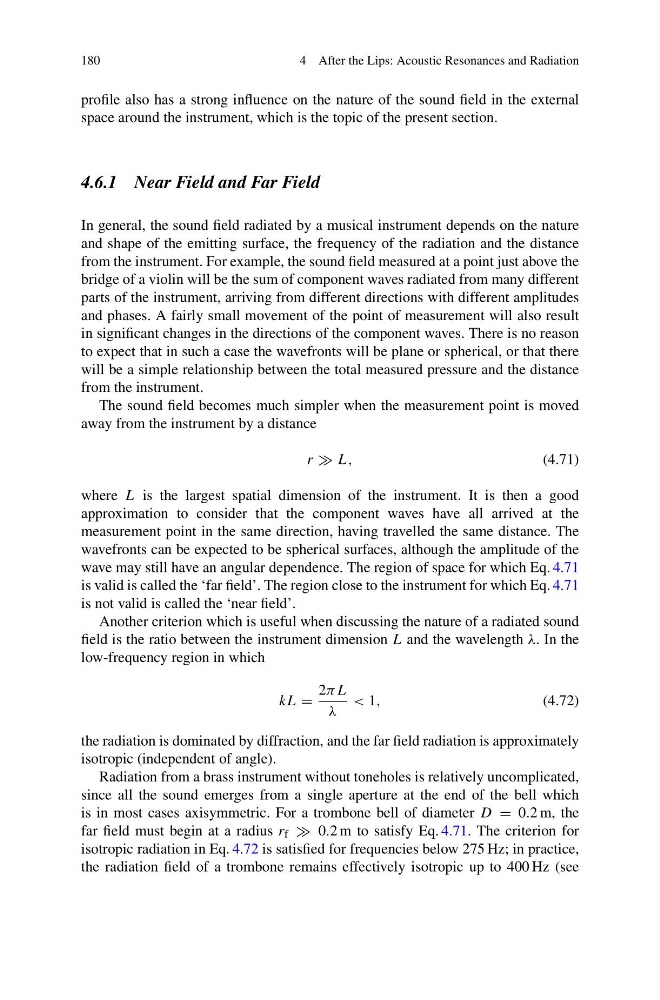
The sound field becomes much simpler when the measurement point is moved
away from the instrument by a distance
r L,
(4.71)
where L is the largest spatial dimension of the instrument. It is then a good
approximation to consider that the component waves have all arrived at the
measurement point in the same direction, having travelled the same distance. The
wavefronts can be expected to be spherical surfaces, although the amplitude of the
wave may still have an angular dependence. The region of space for which Eq. 4.71
is valid is called the ‘far field’. The region close to the instrument for which Eq. 4.71
is not valid is called the ‘near field’.
Another criterion which is useful when discussing the nature of a radiated sound
field is the ratio between the instrument dimension L and the wavelength λ. In the
low-frequency region in which
kL =
2πL
λ
< 1,
(4.72)
the radiation is dominated by diffraction, and the far field radiation is approximately
isotropic (independent of angle).
Radiation from a brass instrument without toneholes is relatively uncomplicated,
since all the sound emerges from a single aperture at the end of the bell which
is in most cases axisymmetric. For a trombone bell of diameter D = 0.2 m, the
far field must begin at a radius r f 0.2 m to satisfy Eq. 4.71. The criterion for
isotropic radiation in Eq. 4.72 is satisfied for frequencies below 275 Hz; in practice,
the radiation field of a trombone remains effectively isotropic up to 400 Hz (see
4 After the Lips: Acoustic Resonances and Radiation
profile also has a strong influence on the nature of the sound field in the external
space around the instrument, which is the topic of the present section.
4.6.1 Near Field and Far Field
In general, the sound field radiated by a musical instrument depends on the nature
and shape of the emitting surface, the frequency of the radiation and the distance
from the instrument. For example, the sound field measured at a point just above the
bridge of a violin will be the sum of component waves radiated from many different
parts of the instrument, arriving from different directions with different amplitudes
and phases. A fairly small movement of the point of measurement will also result
in significant changes in the directions of the component waves. There is no reason
to expect that in such a case the wavefronts will be plane or spherical, or that there
will be a simple relationship between the total measured pressure and the distance
from the instrument.
The sound field becomes much simpler when the measurement point is moved
away from the instrument by a distance
r L,
(4.71)
where L is the largest spatial dimension of the instrument. It is then a good
approximation to consider that the component waves have all arrived at the
measurement point in the same direction, having travelled the same distance. The
wavefronts can be expected to be spherical surfaces, although the amplitude of the
wave may still have an angular dependence. The region of space for which Eq. 4.71
is valid is called the ‘far field’. The region close to the instrument for which Eq. 4.71
is not valid is called the ‘near field’.
Another criterion which is useful when discussing the nature of a radiated sound
field is the ratio between the instrument dimension L and the wavelength λ. In the
low-frequency region in which
kL =
2πL
λ
< 1,
(4.72)
the radiation is dominated by diffraction, and the far field radiation is approximately
isotropic (independent of angle).
Radiation from a brass instrument without toneholes is relatively uncomplicated,
since all the sound emerges from a single aperture at the end of the bell which
is in most cases axisymmetric. For a trombone bell of diameter D = 0.2 m, the
far field must begin at a radius r f 0.2 m to satisfy Eq. 4.71. The criterion for
isotropic radiation in Eq. 4.72 is satisfied for frequencies below 275 Hz; in practice,
the radiation field of a trombone remains effectively isotropic up to 400 Hz (see